Tuesday, October 23, 2012

What now?

After today's not unexpected announcement that the proposed badger cull is to be postponed, many farmers are asking, what now? Once again a raft of cattle measures have been foisted on them - with no prospect of control of tuberculosis in wildlife any time soon.


So how we get to this crazy impasse? To answer that, we need to go back to reams of reports and epidemiological research, conducted at a time when 'political' science hadn't really got its collective feet under the table. Much of the work was done at Badger Heaven CSL's Woodchester Park, where generations of badgers have given their time and bodily secretions so that we may better understand how tuberculosis affects them and the environment they share.

 * There is a lot of information contained in this paper, jointly written by Dr. John Gallagher and Dr. Richard Clifton-Hadley, the latter a recently retired employee of VLA and signatory of a letter urging the new Secretary of State to reconsider 'culling as planned'.

 * After a decade of indecision on badger control known as the 'Interim Strategy', yet another report was commissioned, to follow Lords Zucherman and Dunnet. Professor John Krebs was invited to submit a plan. A trial to see if culling badgers really did work in reducing Tuberculosis in cattle. The fact that it had in the past was airbrushed, as was the pernicious salami slicing of how or over what area it could be carried out. Kreb's original protocol for the culling trial was pretty sound and contained explicit points to avoid perturbation, incomplete culls and the recolonisation of areas cleared. He also had no qualms about the removal of lactating sows, before they could infect their cubs and keep the whole shebang rolling.

We explained the reality of what really happened during this eight year charade in this post. and Professor Kreb's original plan can be viewed on this link. (pdf)

* So what went wrong? For that we have to listen to the lead wizard of the magic circle who carried out this plan. Professor John Bourne was quite open about how he was going to run 'his' trial, and also that he had had his instructions on its outcome from the day it started. We covered the whole appalling saga in this posting, when Bourne patiently explained to the EFRA committee his trial's political base. He said:
Let us go back to 1999 when we started our work. It was made very clear to us by ministers of the day - and they have not refuted it since - that elimination of badgers over large tracts of countryside was not an option for future policy". It was on that basis that we designed the trial. We also had to take into account welfare considerations with respect to culling used, and limitations on culling with respect that cubs were not killed or died underground [ ] Those were clear political limitations that we operated under; I have no reason to believe that those political limitations have changed".
As several shocked members tried to interject, Bourne continued;
"We repeatedly say 'culling, as conducted in the trial.' It is important [that] we do say that. Those limitations were not imposed by ourselves. They were imposed by politicians. [] Whatever has driven that I do not know but the fact is that a price has been put on the badger in this country which related to the way we were able to carry out our scientific work. That is exactly what we report."
Read for yourself on this link. Or listen to an interview with Professor Bourne on Dorset Farm Radio.

 The proposed (and now delayed) 300 sq km culls, using free shooting, were set up as Son-of-Krebs, despite the admissions which we describe above, but mainly we think, to defend a Judicial Review. The fact that the JR was successfully defended came as a shock to us. And many of the mathematically modeled numbers are now quoted as 'facts'.

*  But the biggest fraud of all is probably the claim of '74 per cent' efficacy for Badger vaccine. We explored this claim in this posting and links to the relevant papers are in it. Even today the claim was once again misquoted, during the Parliamentary announcement of a delayed cull. It doesn't seem to compute that very belatedly Defra issued a 'thou shalt not say that' message to its internal staff, or that Jim Paice MP described the claim as 'misleading' and 'unhelpful'. The BBC / FERA publicity machine was in top gear, and much of the general public now believe that anyone can launch into an un-prescreened, grossly infected badger population, jab them and bingo. Tuberculosis is sorted.

* What would they think if they knew that the vaccine only held a 'Limited Marketing Authority' (LMA) license, which means that data on efficacy was not submitted at all?
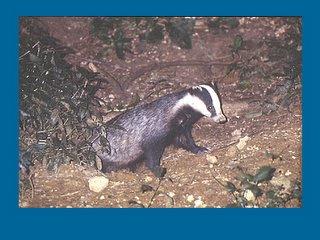
It wouldn't have helped this poor old chap.


This posting has turned out to be quite long, so we'll finish with a snippet on cattle vaccine, which Dr. May tells us is 'months away'. No it is not.

 * Despite years or research, the efficacy of cattle vaccines is still 50 - 60 per cent only, which means that 40 - 50 of the cattle injected in a 100 cow herd would have little or no protection. BCG doesn't pretend to stop tuberculosis. It works ( if it works at all) by reducing the size of and bacterial shed from, lesions. And recent work on cattle both in Africa and here has not been exactly promising. Unless you call killing the animal at 2 years old and NOT having the carcase condemned as a success. The test which differentiates vaccinates from infected cattle (DIVA test) is equally uninspiring with Defra explaining that a 'negative' result does not guarantee freedom from TB, and that the test is likely to throw up many false positives.
So that particular bar is set too low for us - and we assume for the OIE (office of International Epizooties) who do take tuberculosis seriously, and would invoke an immediate ban on all products from vaccinates to all countries signed up to TB eradication plans. Another Beef Ban.

 We would also point out that vaccinating cattle conveniently airbrushes overspill into many other mammals - some of which share our hearth rug. Or perhaps Dr. May has plans to vaccinate all those too.

Saturday, October 20, 2012

A Picture tells 1000 words.


As the dead-tree media line up with badgery stories, we thought we'd do something slightly different. We will track the disgraceful decline of this country's so-called TB eradication programme using Defra's own maps.


After the Attested herds scheme of the 1950s and 60s, we were so nearly TB free. But a couple of 'hotspots' remained, which finally responded to parallel action on badgers after the mid 1970s.

Farmers controlled badger numbers.

The Protection of Badgers Act (1972) meant that any population control, for any reason, was by license only. MAFF controlled badgers " to prevent the spread of disease".

 And in 1986,  where at least one confirmed TB reactor had triggered annual tests for the parish,  the maps looked like this.

638 cattle were slaughtered in 1986.


After 1986, the real decline began, as gassing of a complete group of badgers implicated in cattle breakdowns by MAFF, was replaced with cage traps and shooting those that hadn't been released or moved.

But the big change was the land allocated to the Ministry wildlife teams. This was reduced during the Interim Strategy  operating 1988 - 97 from 7km down to just 1km and then only on land cattle had grazed.
All arable, woodland or neighbouring land was out of bounds to the wildlife teams - if not badgers..

Over the same period badger numbers were estimated to have increased by 77 per cent.

 The 1996 map tells its own story of expanding hotspots.

3,881 cattle were slaughtered in 1996.


In 1997, the then Labour government accepted a £1m bung from the Political Animal Lobby (PAL), and a moratorium was introduced overnight on Section 10 (2) of the Protection of Badgers Act.
No licenses were issued to "prevent the spread of disease".
Two years later, the number of cattle slaughtered had doubled.

The moratorium is still in place.

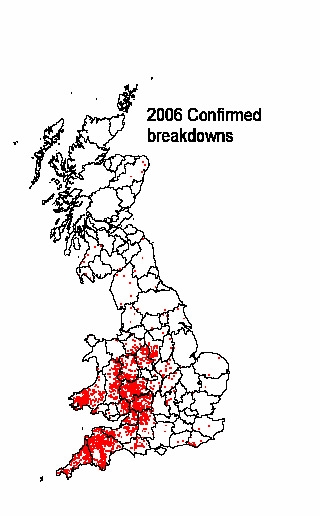
 The 2006 map shows hotspots expanding like Topsy.

 MAFF was now been re invented as DEFRA.

22,282 cattle were slaughtered in 2006.


After the end of the Badger Dispersal Trial  RBCT in 2006, Defra cracked down hard on cattle movements and ramped up testing.

 Pre movement testing was introduced in a valiant attempt to find this hidden reservoir of Tuberculosis in cattle.

The 2011 map showed the annual testing area as solid red, increased by several miles from Defra's original 2010 model. As far as badger could walk?


34,617 cattle were slaughtered in 2011.


Fast forward to this weeks' announcement of several new annual testing areas.

Please excuse the home made map - but as you can see, many buffer counties and those with sporadic and expanding problems now require annual tests and preMT of their cattle.


Defra say : "The number of cattle compulsorily slaughtered as reactors or direct contacts was 21,512 in January to July 2012, compared to 20,514 in January to July 2011."

Thus in 2012, reactors slaughtered so far, have increased by 1000 head over the Jan - July 2011 figure.


.


We think the new format of Defra's maps looks a tad truncated. In fact, very odd. We prefer the old format.

Wales has devolved completely - as have its figures in most of the press reports. And Scotland's head is removed.

Nevertheless the GB map, minus its top and left side, we print here - straight from Defra's new 2013 pdf file,
which explains their new cattle measures.


This whole sorry 35 year picture gallery could be entitled 'A Ministerial Victory for Tuberculosis'.

.

Friday, October 19, 2012

An unlevel crack down ?

Announced today is a further unraveling of many of the measures introduced over the last decade to allow cattle farmers to 'live with' TB herd restrictions. The cynical amongst us have long concluded that politicians, and through them Defra, will do anything but tackle TB in badgers, hence a raft of licensed movements to enable farming businesses to continue to trade.

But on the back of  EU cash and pressure for harmonisation of tuberculosis control across the Community, pretty well all of these opportunities have now been closed. Farmers Guardian report that the latest clamp downs include:
* Farmers who have had TB on their farm – in all cases - will not be allowed to bring new cattle in until the rest of the herd has been tested for TB and a vet has carried out an assessment.

* Farmers to have just 30 days, (down from 60) to move cattle that test negative for TB from a TB breakdown farm.

* Approved Quarantine Units (AQUs), units for calves from TB breakdown farms, will not be able to take on any more calves from the New Year.

* Conditions Approved Finishing Units (AFUs), which take clean cattle from infected farms for fattening before slaughter, to be ‘strictly monitored’, and will lose their licenses for serious breaches.
Note: The 30 day movement window may apply to all tested movements and not just from TB restricted farms. We will try to clarify this. Similarly  'orange' markets which were also under fire don't seem to be mentioned. And  we note that the closing of AQUs means many more calves will be shot at birth.

These measures will also see several more counties East and N/E of Defra's red area ,(already extended, see map below) hoovered up into an annual testing regime. These include Cheshire, Derbyshire, Nottinghamshire, Leicestershire, Northamptonshire, Oxfordshire, Buckinghamshire, Berkshire, Hampshire and East Sussex.


The latest report from DG SANCO came to the following conclusions:
It is however of utmost importance that there is a political consensus and commitment to long-term strategies to combat TB in badgers as well as in cattle.

The Welsh eradication plan will lose some impetus as badger culling will now be replaced with badger vaccination. This was not part of the original strategy that consisted of a comprehensive plan that has now been disrupted.

There is no scientific evidence to demonstrate that badger vaccination will reduce the incidence of TB in cattle. However there is considerable evidence to support the removal of badgers in order to improve the TB status of both badgers and cattle.

UK politicians must accept their responsibility to their own farmers and taxpayers as well as to the rest of the EU and commit to a long-term strategy that is not dependent on elections.

The TB eradication programme needs continuity and it must be recognised that success will be slow and perhaps hard to distinguish at first. There is a lot of skill and knowledge among the veterinary authorities and they must be allowed time to use it.
We discussed the paper in this posting, but having ramped up the EU harmonisation of cattle controls, we see no sign of a widespread, parallel targeted action taken on wildlife reservoirs, to prevent their infection in the first place.


Monday, October 15, 2012

Inconsistent?

There was a lot of froth over the week end with a letter opposing the proposed badger cull, signed by several scientists. They conclude:
We recognise the importance of eradicating bovine TB and agree that this will require tackling the disease in badgers. Unfortunately, culling badgers as planned is very unlikely to contribute to TB eradication. We therefore urge the government to reconsider its strategy.
"Culling badgers as planned ... "

Planned? Planned by whom?
We would refer readers back to the Defra Consultation Document, page 43. It's conclusion and thus the spin steer was:
Our preferred approach is option 6: to issue licences under the PoBA for industry to cull badgers, subject to a specific set of licence criteria. Under existing arrangements farmers and landowners will also be able to apply for licences to vaccinate badgers either on its own or for use in combination with culling. This approach will allow farmers to manage their own situations and use all the control measures available. It also means that taxpayers will not be paying for significant additional disease control measures. We consulted further on the implementation of this option, as articulated in draft Guidance to Natural England from July-September 2011

The research published and / or establishments occupied by many of the names on this letter are mentioned in these Defra documents. They would have been instrumental in constructing the protocols, the 'preferred option' of those on offer, was the one now being roundly trashed.
And we seem to have heard something like the phraseology of the protest before.

Indeed, some of the signatories to this letter were in the magic circle which conceived the RBCT Badger Dispersal Trial, which cage trapped into an infected population on 8 nights only, annually if you were lucky, with a couple of years off for FMD. And about which, their chairman and lead wizard was proud to tell any audience (in this case the EFRA committee in 2007) how 'his' trial was conceived and why it was carried out in such a way.

At that meeting, Geoffrey Cox, MP asked Professor Bourne to clarify the ISG's report's conclusions in the light of his statement describing a political steer in what should have been a scientific exercise.
Professor Bourne replied thus:
"We repeatedly say "culling, as conducted in the trial." It is important [that] we do say that. Those limitations were not imposed by ourselves. They were imposed by politicians."
and he concluded:
"Whatever has driven that I do not know but the fact is that a price has been put on the badger in this country which related to the way we were able to carry out our scientific work. That is exactly what we report".
Fast forward and the much quoted 16 per cent success projection for the current proposal. This was culled from the RBCT data, mathematically modeled figures taken over its whole politically rigged length. Why?

But to back to this current letter, now backed up by the lead wizard, himself. Yup, the very man who gave this statement (above) to support his 'political science' to his masters.

A salient point we think, is that many of the signatories to the Observer / Guardian letter appeared more than comfortable with the RBCT, when they were employed by it. We heard no shrieks of disapproval. But this was 'the science' - or pensions? Take your pick..But the RBCT debacle, which, having been involved in it,  we have criticised, and will continue to criticise,  mapped areas one third smaller than these proposals, used a different operating protocol and had a 'limitations imposed by politicians'.

Work that one out.

Thursday, October 11, 2012

Defra's Calculator

Last month, Defra produced an astonishing news release which trumpeted the following information:
There has been a notable decrease in the incidence rate over the past 6 months, mainly as a result of an increased number of tests on unrestricted herds compared to last year. The AHVLA are currently carrying out a data checking exercise to validate these test statistics.
The provisional June 2012 incidence rate is 4.2%, compared to 6.0% in June 2011. However, care needs to be taken not to read too much into short term figures, especially as this figure includes a number of unclassified incidents. As such, the incidence rates are subject to further revisions as more tests and their results for the period are input.
The number of new herd incidents during the period January to June 2012 was 2,706 compared to 2,720 for January to June 2011. The number of tests on officially TB free herds was 41,656 in January to June 2012, compared to 34,667 in January to June 2011.
The number of cattle compulsorily slaughtered as reactors or direct contacts was 18,213 in January to June 2012, compared to 18,081 in January to June 2011.
So all good news then?
Well, that depends on who is punching the buttons. We have archived the key figures for Jan - June 2011 and guess what? They do not compute to this conclusion at all. In the same 6 months of 2011, 6073 herds were under restriction 'due to a TB incident'. And that was 7.35 per cent of the total herds registered in GB. This year, 2012  Defra's current spread sheet ( apologies -  can't get a link to stick) shows 6567 herds in that position, but with fewer herds on the database, that equates to 8.2 per cent.

Cattle slaughtered are up too. The totals being 18,082 in 2011 compared with 18,645 so far this year. An increase of 563 animals. (Defra's figure in their announcement ignored 432 IRs, but they are still dead and for accurate comparison, IRs were counted in the total last year)

New herd incidents? That is benchmark Defra usually present, as it lower by a a mile than the tail end of herds under restriction and 60 day testing for years. That figure is pretty much the same at just over 2700.

So where has this alleged drop of almost 2 percent come from?  June 2011 was the last time Defra produced its monthly stats on the old system, and then dear old SAM took over and the number of tests logged increased by 30 percent. In fact his tally is 49,528 tests for GB in just six months. In some areas more than one test per registered herd in just six months.

 Defra explained this in a previous news release, saying that they were now counting pre and post movement tests, and also removing gamma failures and slaughterhouse cases from some totals as well, so figures may not be comparable. But despite all this tinkering, the number of herds under restriction for a 'TB incident'  is up, cattle slaughterings are up, and new herd breakdowns are at best, static. And yet Defra say that as a percentage,  new herd incidence is down? Something here doesn't ring true, but hey, the computer has spoken.

Could it be that those running the SAM system are refugees from this train wreck of computer generated mathematics?

UPDATE : We see our furry little friends in the Badger Trust have issued a press statement for 'Immediate release' trumpeting that Defra report a '30 per cent drop in cattle TB' - so stop the cull.
Oh dear. Another calculator which can't add up, and an organisation which can't see beyond a skewed headline.

Further investigation into Defra's stats do not support the 'wider testing' argument - should they make it.
The West region has recorded at least one test per registered herd - in just 6 months. And it's almost the same in Wales. So, in annual testing areas, with preMT ,  yes a huge increase in tests - but as Defra say, dear old SAM is now including ALL these tests which wasn't the case before.  And they haven't discovered many more reactors than last year. But the tail on this particular dog gets longer, as herds under restriction are not cleared by removing sentinel tested cattle. So to reiterate, and just for Uncle Jack Reedy, the key figures for the 6 month period Jan- July 2012 are here:
Herds under restriction during the period  - 6567, up by 494, almost 1 per cent.

Cattle slaughtered during the period - 18,645 up by 563.

New herd breakdowns - static at just over 2700.

Tests carried out, particularly in the West and Wales - up 30 per cent.


So that's a  30 per cent drop in cattle TB? If you say so, Jack. If you say so.

We don't think so.

Tuesday, October 09, 2012

He who pays the piper ..

.. calls the tune. And now the European Union is dipping into its coffers to assist Defra's so-called bTB eradication plan, then we sing to the European tune. Harmonisation of controls across the member states is also in the mix, which means that all the measures which the State Veterinary Service and now Animal Health have allowed over the 15 years to enable 8,000 cattle farmers to 'live' with herd restrictions, are being dismantled with indecent haste, and some retrospectively. These measures were there, we are sure, purely to avoid the thorny question of how to deal with tuberculous badgers. Now, thanks to our EU partners, although we still have the thorny problem, increasingly, we have no means of trading our cattle.


The pyramid of licensed movements and exemptions to herd restriction grew following the 1997 moratorium on Section 10 of the Protection of Badgers Act which prevented culling 'to stop the spread of disease'. This saw herd restrictions rise, sometimes continuing for years, as farmers struggled to maintain viable businesses - with no control at all on wildlife..

We referred to Jim Paice's thinly veiled hints, earlier this year in this posting. And sure enough, the threats restrictions have kept coming, compounded by a new computer system with hiccoughs which still appears unable to dispense paperwork. But whose operators follow up with promises of fines for non compliance. An excellent way to build a 'partnership'.


After their visit last September, the alleged breaches are contained in this DG SANCO paper.

Some of the tightening up measures, we have referred to already; but after reading this document, we feel sure that more may be in the pipeline. Which would be fair enough if bTB was affecting a few herds and if action was taken to clear the source of their problems. Restriction should mean precisely that. But last year, these restrictions applied to 8,108 farms. Over ten per cent of herds in GB. And some areas, despite frantic attempts to redraw borders, have up to a quarter of their herds under restriction. So if the EU imposes some of its more stringent measures, we would solve this county's unemployment problem, if not its budget deficit.

The executive summary of this SANCO paper explains:
While the approved eradication programme is broadly applied as described, the audit identified a number of potential weaknesses. These include numerous movement derogations, pre-movement test exemptions (including extended time intervals between testing and movement), the operation of "linked" holdings over large geographical areas, incomplete herd testing and the operation of specialist units under restriction, which lacked the necessary bio-security arrangements.
By this we assume the preMT exemptions for shows and the use of isolation facilities, which Paice and co have already closed down. But the 'extended time intervals' is a new one. At the moment, tested animals may be moved for up to 60 days from jab day, which in effect means about 50 - 55 days. Later in the document, SANCO mention 30 days, and we may have that to look forward to that. (p.8 5:2:3)
Incomplete herd testing, we assume is the exemption of young calves from testing. Given that the latency of the skin test is 30 days, it's pretty futile to jab anything under that age, but nevertheless, stacking up the payments, numbers, many vets do. In future they may have to. And in any testing area other than annual, yearlings may be exempt too. No doubt that too will cease.

 The summary continues;
Furthermore, despite efforts by the CA – some of their key targets could not be met in relation to the removal of reactors from breakdown herds and the instigation of epidemiological enquiries. There is a fragmented system of controls, involving a number of responsible bodies. This combined with a lack of co-ordination (particularly with Local Authorities) makes it difficult to ensure that basic practices to prevent infection/spread of disease (such as effective cleaning and disinfection of vehicles and markets) are carried out in a satisfactory way.
We have covered this fragmentation many times, and the installation of Defra's new toy, an all singing, all dancing computer system known for no particular reason as 'SAM', which is still failing farmers.

Only last week one cattle farmer was put under immediate movement restriction (by snail post) for failing to conduct a contiguous test - a test for which no notification had ever been received. Add to that a splitting up of responsibility between the various Animal Health offices, with no-one except the computer jockey in overall charge, and it is a recipe for chaos. Why should anyone be surprised?

With sporadic bTB outbreaks in the rest of the EU, a system very like FMD is in place, with a CA (Competent Authority) overseeing cleansing and disinfecting processes on farm. We suspect SANCO would like to see this too, on every one of  the 8,100 farms under bTB restriction last year. Hence our comment about halving unemployment.

 In May 2012 C&D notices were resurrected for reactors with no lesions and no culture. This even though the animals may have been slaughtered months ago. And a herd clearance form cannot be issued without it.

SANCO also mention the confiscation of passports from restricted herds and no licensed restocking until at least one 'satisfactory' whole herd test.The intensive biosecurity area of Wales is held up as pattern for the rest of GB - if it shows results.

So all in all a few more nails in the poor old cattle, and their owner's ability to trade at all. But the bit the Badger Trust and their assorted followers missed, is near the end:
Measures to prevent re-infection from other sources focus on the risk presented by wildlife (badgers). The CA maintains that the delay in implementing the proposed wildlife controls (i.e. a managed cull of badgers), which is a significant element of the approved eradication programme, remains the major obstacle to progress.
Quite.

Thursday, September 27, 2012

Save the Badger... ??

A stunning piece of artwork behind Dr. Brian May, backed by the RSPCA and fellow travellers, this picture is an amazing piece of PR. It may stir the hearts of his followers, but is it accurate?
Dr. May says he wants to 'Save' badgers. But obviously not from tuberculosis.


Cattle farmers  regularly see badgers in the later stages of tuberculosis, crawling around their fields and buildings in an emaciated and distressed state, coincidentally, often just before losing a shed load of cattle. But they don't look anything like the sleek, iconic beast behind Dr. May.

They look like this.


So in the interests of accuracy rather than spin, we invite Dr. May to pick up a badger with tuberculosis to advertise his aims . This one is rather messy, his tuberculous neck abscesses having burst... 


But it may look something like this. Now obviously this badger would not attract nearly so much attention ..... or funding. It may however attract sympathy for its plight and the manner of its death.

A victim of its protector's success.


Sunday, September 23, 2012

How much is enough?

When people (who should know better)  talk about vaccinating badgers, because this over time 'reduces transmission opportunities', what exactly do they mean, and in the case transmission to cattle, by how much?

As we pointed out in many previous posts about this subject, including the posting below, the amount of bacteria left behind is crucial to a sentinel tested cow. And although we are not in the habit of making assumptions, presumably to many other species too.

Secretary of State, Owen Paterson's Parliamentary Questions queried this and received the following answer on January 29th 2004:
Mr. Paterson: To ask the Secretary of State for Environment, Food and Rural Affairs pursuant to the answer of 8 December 2003, Official Report, column 210W, what the presumptive infective dose range of M. bovis is in respect of cattle; and whether some badgers suffering from bovine TB are capable of excreting sufficient numbers of M. bovis bacilli to constitute such an infective dose. [150526]

Mr. Bradshaw: Determination of the minimum infectious dose of Mycobacterium bovis in cattle is part of the TB pathogenesis research programme. Early indications are that the minimum infectious dose for cattle via the respiratory tract is relatively small; the lowest infectious dose recorded so far is 70 colony forming units (CPU) when introduced by the intracheal route or 9,600 CPU by the intranasal route.

Relatively high levels of M. bovis in the urine of badgers with renal TB have been identified. Bacterial loads of up to 300,000 CPU per millilitre of urine have been measured. This suggests that inhalation of as little as 0.03 ml of the urine could result in infection.
 Thus up to now, 70 CPU has been the figure which we have quoted. But coming in under our radar, and once again published in the USA is a paper   prepared by our own VLA which has downgraded that figure to just 1 CPU for calves. The paper explains that four groups of calves were infected with 1,000, 100, 10 or just 1 CPU of M.bovis.  These animals were skin tested twice and blood tested, then subjected to rigorous post mortem. The results were described thus:
 One-half of the animals infected with 1 CFU of M. bovis developed pulmonary pathology typical of bovine tuberculosis. No differences in the severity of pathology were observed for the different M. bovis doses. All animals that developed pathology were skin test positive and produced specific IFN-γ and IL-4 responses. No differences in the sizes of the skin test reactions, the times taken to achieve a positive IFN-γ result, or the levels of the IFN-γ and IL-4 responses were observed for the different M. bovis doses, suggesting that diagnostic assays (tuberculin skin test and IFN-γ test) can detect cattle soon after M. bovis infection regardless of the dose.


So 1 CPU of M.bovis is all it takes to infect a calf. Is this one 'safe'? Does anyone care?

As it is established that badgers can excrete up to 300,000 CPU (colony forming units) of bacteria in each 1 ml of urine, we would respectfully point out, that the amount of  'bacterial reduction' achieved by vaccinating an unscreened population of tuberculous badgers, has to go down a very long way for it not to affect our tested sentinels.

This paper was primarily about the minimum infectious dose needed to infect cattle, but not from any particular source. So we share the author's 'comfort' that the skin test found all the infected cattle.The summary is as follows:
In summary, we found that 1 CFU of M. bovis is sufficient to cause established tuberculous pathology in cattle. This pathology is identical to that resulting from significantly higher experimental doses (up to 1,000 CFU in this study) and reflects the pathology seen in naturally infected field reactor cattle. Cattle infected with 1 CFU that developed pathology exhibited strong positive responses to the diagnostic tuberculin skin test. Furthermore, the infectious dose of M. bovis had no bearing on the time taken to obtain a positive IFN-γ response in the animals that went on to develop pathology.
Our data are in accord with very low numbers of bacilli transmitted aerogenously between cattle, potentially by nasal shedding. Comfortingly, the animals that do go on to develop pathology and therefore become a likely source of contamination within a herd can be detected at an early stage with the IFN-γ test and also provide a positive tuberculin skin test response.

Quite. We kill all our positive skin test reactor sentinels, and leave their herd mates free to be infected by just 1 CFU of M.bovis. Very sensible.

Edit: The term CFU or CPU is a pathological term meaning a cluster of single bacteria, capable of establishing disease. Although Owen Paterson's  PQ referred to CPUs and the second paper CFUs, essentially they mean the same. A colony forming or producing clump of single m. bovis bacteria. 


Tuesday, September 18, 2012

Vaccination myths

We are hearing the 'V' word from numerous sources at every photo opportunity at the moment. Vaccination is the holy grail for bTB it seems. But does it work? We covered the debacle surrounding badger vaccines in several postings as the Myth unfolded in 2010. As that 74 per cent efficacy lie bounced round the world, courtesy of the BBC and FERA, very belatedly Defra told its advisory group that 'the data should not be used to support this claim', and Jim Paice found the headline was 'misleading and unhelpful'.


Nevertheless, on the basis that it did no harm to badgers, BCG was licensed as a Limited Market Product by the Veterinary Medicine Directorate (VMD) and is now being administered to un-screened populations of badgers in several parts of England and Wales. And the reason?


 In 2011 Defra published this little gem:
a): Bovine tuberculosis Animal species: Badger vaccination: Description of the used vaccination, therapeutic or other scheme Badger BCG licensed in March 2010 has been used as part of the Badger Vaccine Deployment Project to build farmer confidence in vaccines as a key tool in an eradication programme.
To build farmer confidence? What an extraordinary reason for promoting a vaccine which doesn't work.


 So what about cattle vaccination?
 Many people, some of whom really should know better, slip this into their conversations at every opportunity. If we vaccinate the cattle (who are telling us the true level of badgerTB in our increasingly polluted environment) then all will be well? No it will not. It's far to late for that, even if it were effective or affordable. Despite Defra's contorted gymnastics to dumb down its own statistics for over spill into other mammals, it is happening on a wide and increasing level.

But back to BCG for cattle. Weybridge VLA have published a report where sentinel vaccinated yearling cattle were kept with reactor cattle in 10 pairings for twelve months. Post mortem results from this study published in Vet.Record found that the pen level transmission rate was 50 per cent but crucially:
"There was no difference in the number of infected sentinels in the non-vaccinated or vaccinated groups."
This should come as no surprise, as Defra put its collective thoughts into this paper in 2007 which gave efficacy of cattle BCG little encouragement:
Annex 3. 6:3. A BCG vaccine is likely to confer full protection against M. bovis infection to 50% of vaccinated animals. For both the epidemiological model and economic assessment it is assumed that the protection conferred will last a lifetime. Of the remaining 50% that remain susceptible to infection, it is estimated that over half will be partially protected and have a much reduced capability of transmitting M. bovis should they become infected. The benefits of vaccination are likely to last for at least 12 months.
The cost is assessed at £8.25 per dose. The skin test is still mandatory and thus the DIVA test which differentiates between vaccinates and infection, must be used. So how accurate is that?
2.5.2: The DIVA test would be used when a vaccinated animal gives a positive reaction to the skin test (i.e. will be used as an ancillary test to the skin test). In such cases the DIVA test will confirm whether the animal is indeed infected or whether the positive response to the skin test is due to vaccination with BCG. 62. However, the nature of the test makes it impossible to guarantee the disease status of an animal. As with existing antemortem diagnostic tests for TB, there will be a number of false positive and false negative test results since neither the specificity nor the sensitivity respectively is likely to be 100%. The diagnostic accuracy of the new test will have to be assessed in field trials of herds of known TB status, which has already been done for some prototype DIVA reagents. In order to get the test accepted in EU legislation it will need to be at least as good as the current skin test in terms of sensitivity. However, data is available to suggest that the prototype DIVA reagent will satisfy this criteria, although as noted above this will need to coincide with the recommended age of vaccination.
So giving variable sensitivity / specificity, the DIVA test will cost around £26.00.

 Trade implications are huge, in that a number of both International and EU directives would need to accommodate this country's love affair with wildlife infected with tuberculosis. Withdrawal periods for vaccines and bans on all exports out of vaccinated 'zones' are mentioned.

So in summary, Defra say they are 'pump priming' farmers to accept vaccination, however futile its efficacy - and they will have to pay for it. All of it. As explained in this posting which invites farmers to have a 'conversation' with them.

Sunday, September 16, 2012

Defra invite a 'conversation'.

Our cash strapped Department of Environment, Food and Rural Affairs cordially invite all interested parties to 'engage' with them, on how they can screw cattle farmers even more save money from their TB budget.

Some of the ideas being bandied about are on this link.

It would be churlish to point out that if they'd kept a handle on infected wildlife two decades ago, they wouldn't be in this position, but we'll do it anyway as the patronising language phrasing this proposed cash grab is - irritating in the extreme. A 'conversation' implies a two way dialogue, but bitter past experience has proved this not to be case with Government. And successive 'consultations' have only served to show that Defra will do what they like, having 'consulted', regardless of replies.

We note that these reductions  proposed changes seem only to apply to farmers under restriction and their reactor cattle. So vets are not being asked to jab one, jab one free? Rhetorical question, as the EU's latest broadside has doubled testing requirements for many - hence doubled the cost to Defra.

Your views can be emailed to bTBengage@defra.gsi.gov.uk
Or you can write to: AHWBE (Bovine TB Call for Views), Nobel House, 17 Smith Square, London SW1P 3JR.

The AHWBE is also planning four open events in Exeter (September 18), Pulborough in West Sussex (September 25), Telford (October 2) and York (October 11).

Wednesday, September 12, 2012

"UK politicians must accept their responsibilty...

....to their own farmers and taxpayers as well as to the rest of the EU and commit to a long-term strategy that is not dependent on elections."

 This is the conclusion of the latest European Union report on Defra's efforts (sic) to comply with their assigned international obligation to eradicate bovine TB.

We touched on the most recent tranche of cattle measures, in this posting as our masters in the EU deftly unravelled almost all the measures put in over the last decade in order to allow farmers to trade while under TB restriction. These measures all had the effect of pushing further into the long grass, the question of what to do about the main cause of their problems.

In 2006, DG SANCO, the department responsible for Health and Consumer Affairs in Europe had this to say  about Defra's prevarications. They visited again this spring and their full report can be viewed on on this link.

Its conclusion is unequivocal.
"It is however of utmost importance that there is a political consensus and commitment to long-term strategies to combat TB in badgers as well as in cattle.

The Welsh eradication plan will lose some impetus as badger culling will now be replaced with badger vaccination. This was not part of the original strategy that consisted of a comprehensive plan that has now been disrupted.
There is no scientific evidence to demonstrate that badger vaccination will reduce the incidence of TB in cattle. However there is considerable evidence to support the removal of badgers in order to improve the TB status of both badgers and cattle.
UK politicians must accept their responsibility to their own farmers and taxpayers as well as to the rest of the EU and commit to a long-term strategy that is not dependent on elections.

The TB eradication programme needs continuity and it must be recognised that success will be slow and perhaps hard to distinguish at first. There is a lot of skill and knowledge among the veterinary authorities and they must be allowed time to use it."

There is nothing we could add to that.

Tuesday, September 04, 2012

Welcome Back!

A resounding welcome back to Owen Paterson, MP whose new appointment is Secretary of State for Environment, Food and Rural Affairs (Defra)

It was Owen Paterson's Parliamentary Questions on bTB and more importantly, their answers, which form the basis of this site. When he was Shadow Minister, the number of cattle herds having TB problems in Great Britain was 5.6 per cent, a figure which shocked him. Last year that total had almost doubled to10.07 percent. The number of cattle slaughtered in GB during 2004, (the year Owen asked the PQs ) was 23,000. Last year Defra sent  34,617 to their  premature deaths. The spillover into other species, especially camelids, had just started in 2004 and Defra recorded 6 herds with at least 1 infected animal 1999-2004.  We will post again on their contortionist gymnastics to avoid the question,' how many alpacas have you killed today?' But infected herds of camelids, (not individual deaths) we are told, now stands at 60.

A full biography of Owen Paterson is  here from Alistair Driver at Farmers Guardian.

Tuesday, August 14, 2012

New badger welfare group launch

Today, August 14th is the first meeting to introduce a new initiative which aims for healthy badgers, rather than shed loads of unhealthy ones. (Report of the Sedgemoor meeting is here. )

 Rather than get snarled up in a cats' cradle of mathematical calculations of how many badgers of undetermined health status to remove from a given area over a set time frame, a group of west country farmers have turned the clock back.

They have taken the sentinel cattle tests, badger tracking to determine territories and thus presented a much tighter target on those groups responsible for prolonged TB breakdowns in regularly tested cattle.

 The inaugural meetings to introduce the concept, are this week. Full story with venues and times are explained by the Western Morning News,  in this link.

We hope that the research painstakingly carried out over several years and which has now resulted in PCR being described in this publication thus: "An Inter-Laboratory Validation of a Real Time PCR Assay to Measure Host Excretion of Bacterial Pathogens, Particularly of Mycobacterium bovis" may find a place in this.

And we would point out, with the greatest of respect of course, that far from being 'never used in my lifetime' as described to veterinary practitioners a few years ago by the diminutive Professor Bourne,  PCR used on badger setts is now a real time test, validated (which means capable of repitition) by three different laboratories in two countries, the research peer reviewed and published. We have also touched on its use in abattoirs, in this project on sheep, and the posting below describes an ongoing project to investigate its eventual use as an ancillary ante mortem test for alpacas, who have a very poor response to the skin test.

So is this the 'science' needed to support this new farmer initiative, which seeks to identify unhealthy badgers, rather than take pot shots at any which cross across the countryside using the ISG's mathematical models?
Badger supporters (and Dr.Brian May) cannot really want them to suffer like this one, can they?

Monday, August 06, 2012

Someone else deserves a Gold medal.

As the country is gripped by Olympic fever, with medals and congratulatory speeches at every turn, we offer our sincere congratulations to the Camelid Tb Support and Research Group who last year, commissioned a Proof of Concept study into the use of PCR (Polymerase Chain Reaction) to detect m.bovis (bTB) in alpacas and llamas. Although the project still has to publish its full report in the scientific press, we are able to show you an interim glimpse of its preliminary results.
“The pilot project demonstrated that a two stage PCR test on camelid clinical samples has the potential to detect Mycobacterium bovis with reasonable sensitivity. Samples were taken post-mortem from 21 alpacas with gross lesions of tuberculosis: most of the alpacas selected had severe lesions. Fifteen faeces samples and ten nasal swabs were positive.
Samples that were negative in these PCR tests were from alpacas with less severe pathology”.


The full text of this announcement can be seen on the website of The Alpaca TB Support Group who commissioned the study. (Click the left hand buttons for more information on PCR including its current commercial uses by AHVLA)

 Using a combination of faecal and nasal material, this project showed PCR's ability to detect m.bovis in 17 out of 21 animals (80.9 percent) and importantly, gave no false positives.

We have supported PCR as a diagnostic tool for years; and in previous postings brought other major successes to your attention, including earlier this year, this project which detected m.bovis in badgers. We are puzzled why no media hacks have grabbed these 'good news' stories. But then it is easier to cut and paste press releases than to dig into what is really going on. We missed this validated, peer reviewed and published paper into PCR and badgers and we also missed this little gem.

In a project undertaken by a Nottingham University School of Biological Sciences student, Derrick Fall,  looked into using PCR in abattoirs to detect bTB. In this case on sheep. This is probably not the time to remind readers that in 1997, Professor John Bourne announced quite confidently to his farmer and veterinary audience that ‘sheep did not contract TB’. As in so many things, the man was quite wrong. But we digress ….. Commercial drug manufacturers MSD (Merck, Sharpe & Dohm) Animal Health offered this student a Bursary to investigate abattoir lesions in sheep. And his conclusion was that bTB was now present in the UK sheep flock. We may return to this project, if we can have sight of the Veterinary Record report on it.

The Camelid Tb Support and Research Group have had no such industry funding and indeed the brickbats keep flying, especially from within the alpaca community. Such breeders cannot really want to risk losing hundreds of animals, possibly exporting bTB and moving it around the country on the strength of a rubbish skin test, can they?  That was a rhetorical question, by the way.

The results of this Proof of Concept project on alpacas are extremely encouraging, especially where bTB is advanced. AHVLA now wish to undertake a further screening of samples where bTB lesions are less pronounced. This will investigate the level at which detection of bTB using PCR is possible. Samples are held ready to use and the PCR screen of these could be completed within a month. Donations towards this second phase would be most welcome. A 'donate' tab is available at the alpaca TB support group's website, www.alpacatb.org. When the second phase is completed, results will be published together with those from the initial screen which we report today.

As we have said before, if nothing else, this small group has shown the farming industry how to commission PCR as a diagnostic tool for bTB. It is no use asking Defra to do it; they have no cash and no interest in stopping this gravy train of misery which employs so many hangers on. But AHVLA now have to stand on their own commercial feet, and if cattle, sheep or pig  farmers and owners of other mammals susceptible to bTB want better diagnostic tools, then they only have to ask - and then pay up. Even the Badger Trust could put their hand further into Brian May's deep pockets and commission a wider screening of badger setts. That's if they have any interest at all in cleaning up the cess pit   maintenance reservoir of infection festering away in their chosen species.


Saturday, July 21, 2012

The Badger Trust pick up their pencil...

... and appeal the judgement, handed down by Mr. Justice Ouseley last week. In fact they appeal every point on which he trashed their original challenge. From Farmers Guardian report, (link later)
“It underlines the trust’s strong belief that the Government’s proposals to kill badgers in England are likely to do more harm than good,” the trust said, claiming that, despite the judge’s ruling, the science still showed ‘culling badgers can make no meaningful contribution to the eradication of bovine TB in Britain’.
FarmersGuardian has the full story, but those weasel words, contained in the ISG Final Report, were not bourne born out by their author's oral evidence to the EFRA committee, which we reported in this 2007 post.  To refresh your memories, this is what Professor John Bourne actually said, not what was written for him:.
"Let us go back to 1999 when we started our work. It was made very clear to us by ministers of the day - and they have not refuted it since - that elimination of badgers over large tracts of countryside was not an option for future policy".
and
"We repeatedly say "culling, as conducted in the trial." It is important [that] we do say that. Those limitations were not imposed by ourselves. They were imposed by politicians."
and finally:
"Whatever has driven that I do not know [ try copious multi million ££ donations to political parties? - ed) but the fact is that a price has been put on the badger in this country which related to the way we were able to carry out our scientific work. That is exactly what we report".
"Culling, as conducted in this trial, can make no meaningful contribution to the eradication on bovine TB in Britain" is much more sensible that this oft quoted truncated version. But the man knew this at the beginning, he said he did and he geared his trial protocol to achieving it.

This expensive charade known as the RBCT  showed us exactly how not to control tuberculosis in badgers.

Sunday, July 15, 2012

2 + 2 = 1 - The bigger the lie...

The title makes no sense does it? Of course 2 + 2 doesn't equal 1 unless of course you happen to be a treasury bean counter, or in this case a TB statistician within Defra.

Over the past months, we have noticed that many articles, all culled from Defra press releases, refer with shock and horror to '25,000 cattle slaughtered in 2011'. Leaving aside the hiccoughs with Defra's new toy, a computer called SAM, who found it difficult to add up and abandoned its monthly stats mid way through the year, the final tally was not 25,000. Or not if you were wanting a figure comparable with previously quoted figures. The oft mis-quoted 25,000 or 26,394 to be precise, is the figure for England. But Defra always collated their figures for 'GB', not its devolved parts. Unless of course this dumbing down was deliberate act. Surely not?

For the pedants among you, the total cattle casualties for GB which SAM has coughed up for 2011 are 34,505, including 7971 for Wales and 140 for TB free Scotland.

 But far worse are Defra's statistician's mathematical gymnastics when collating  'other species' deaths from TB, or slaughterings in the course of a Defra inspired cull. We have highlighted this many times and originally had not a little fun, printing off the most ingenious reasons which Defra gave for not making 2 + 2 = 4. This post describes a list of exclusions, which at one point, was longer than the table itself.

Nothing changes, and we now learn of another ruse to dumb down the 'other species' figures.

If trace animals prove positive on another holding, or in another group; or if they are not traced but merely die from TB but have originated in another herd, the stats 'tether' them to the index outbreak. Thus, the 398 animals slaughtered in the Sussex alpaca TB breakdown would which we told you about in this posting,, would appear on the Defra tables as the single (or a couple if we're being generous) microbial sample, confirming bTB. But moving on, the four herds traced (so far) which bought animals from this source and were found to be infected, remain on Defra's unique abacus as 1 outbreak.
"Je größer die Lüge, desto mehr Menschen es glauben werden."
Paraphrased from Adolf Hitler's Mein Kampf in 1925, (but attributed also to Joseph Goebbels) the point of any political party's speeches is to persuade people of what they think right. ... misquoted or paraphrased the above phrase translates as: "The bigger the lie, the more it will be believed."

And this is how we come to have press releases and statements from Defra, indicating '25,000 cattle slaughtered last year' (but forgetting to say that they are only from a devolved part of the previously quoted total GB figures) and a very small handful of bTB outbreaks in alpacas, which of course, are no problem at all. Except to the many hundreds which are dead.

Thursday, July 12, 2012

Over the first hurdle...

Press reports today tell us that the judge who presided over the Judicial Review into the proposed pilot badger culls, has not upheld the Badger Trust's challenge on its legality. However, despite this verdict, the legal threat has not entirely disappeared. The Badger Trust said it was ‘considering an appeal’, after the judge refused an oral request for appeal but left open the option of a written application.
 Farmers Guardian has more. And the Guardian's comment section has some predictably inane comments. The Farmers Union of Wales had this to say:
The Farmers’ Union of Wales today welcomed a High Court ruling that proposals to cull badgers in England to control bovine TB are legal.The Badger Trust had challenged the English proposals on three grounds, all of which were turned down. Responding to the decision, FUW’s TB spokesman, Carmarthen dairy farmer Brian Walters, said: “During the hearings the Badger Trust’s barrister acknowledged that they were not challenging the science behind culling badgers, but the legality of the decision. “The judge has made it clear that the English decision is legal and that licenses to cull badgers ‘for the purpose of preventing the spread of disease’ can be issued.”
Perhaps someone should point out to the learned judge that a moratorium, brought in in 1997, is still in force on that particular section of the Protection of Badgers Act, some 7 years after the RBCT ended its dispersal efforts.

Tuesday, July 10, 2012

Anytime soon would be good...

We read last weeks' news from Northern Ireland with great expectations. With a strapline "Northern Ireland Announces a Badger control Programme", one would expect the thing to be on the starting blocks.
The research project, which will involve a combination of culling and vaccination of badgers, could begin in targeted areas of Northern Ireland as early as next year, the Minister told the Agriculture and Rural Development Committee. She has tasked her officials to develop an approach to bTB control that would involve testing live badgers in the targeted areas. Badgers that test negative for bTB will be vaccinated and released back into the wild, while those that test positive will be ‘removed'.
The majority of farmers we speak to, want this type of approach. Not 'wipe out', not 'extermination' or any other emotive claptrap designed on a Pythagoras based model, but a measured and parallel strategy to protect other mammals from tuberculosis carried by free ranging wildlife. What was interesting was the reported response to this announcement. A measured welcome from Ulster Farming union with the caveat that this approach might take a while, but from the Belfast Telegraph report:
The Northern Ireland Badger Group also said it welcomed the minister’s announcement of a science-led badger strategy.
Well ain't that a surprise? After decades of blaming cattle and their owners for the spread of tuberculosis among many other mammals (and human beings), they 'welcome a science led badger strategy'. Mmmm.
So we asked exactly what 'screeening tests' would be used to identify groups of infected badgers. Together with others who enquired, we received what can only be described as a 'fudge' :
“Considerable preparatory work is required before the TVR approach can be finalised. The first step will be to commission the necessary mathematical modelling in order to help us design this wildlife intervention research to ensure that it is scientifically robust. This modelling will help us to answer “what if” questions, identify the most appropriate area, the optimum size of that area, and the appropriate duration of the intervention.
Methods of badger capture and removal and the types of tests to be used are also under consideration as part of this preparatory work. Animal welfare considerations will be paramount in the test, vaccinate, remove (TVR) approach that we are planning to pursue in the north of Ireland. We are committed to ensuring that any badger removal will be undertaken in as humane a manner as possible and in compliance with the terms and conditions of any legal requirements.”
So what is on the table to 'model' as a screening test for TB ridden badgers? This has been trialled before. First a lab based blood assay, known as the 'Brock Test' about which the ISG in their Final Report had this to say:
1.7 [] ... A live test for badgers had been developed and subject to trial from 1994-96, but its sensitivity was much poorer than had been hoped, successfully detecting only about 40% of infected badgers (Clifton-Hadley et al., 1995-a,Woodroffe et al., 1999)
Then Chambers et al, they of the '74 per cent' fame at FERA had the following comments having investigated the Stat-Pak blood screen :
The Brock TB Stat-Pak is a lateral flow assay to test for the presence of antibodies in serum to M. bovis antigen MPB83. It has an estimated sensitivity of 49.2% and an estimated specificity of 93.1% based on a study of 1464 badgers naturally infected with M. bovis as determined by culture (Chambers et al., 2008). Sensitivity of the Stat-Pak varies according to disease severity, such that sensitivity was found to be 34.4% in infected badgers with no visible lesions at post mortem, 66.1% in infected badgers with visible lesions at post mortem, 41.7% in infected badgers that excrete M. bovis; rising to 78.1% in so-called "Super-Excretor‟ badgers (Chambers et al., 2008).
So, to date, with much fanfare publicity, not born out by the results of 40% and 49% sensitivity respectively, two laboratory based blood tests, which require animal capture and blood samples before action - in either direction. Compare this, to the total media silence on this screening test, which can be field based, uses faecal samples, is pretty much instant and whose candidates may either vaccinated or 'removed' on results of over 80 per cent sensitivity - and no false positives. PCR is now a peer reviewed and validated test for TB in badgers, and awaits a larger field trial. Where? Ireland? Wales? England? Don't all shout at once.

We wait with baited breath, the results of the 'modelling' described in our reply to 'how are you going to do this'. Of course, being simple souls, we could suggest using the sentinel tested cattle as 'canaries' of a wildlife problem. But that wouldn't involve a 'scientist' or a model. We are assured that no coughing badger will be harmed in this exercise, but don't expect anything to happen any time soon. They still have to work out the 'removal' bit.

(With acknowledgement and thanks to Ken Wignall for the use of his cartoon, first published in Farmers Guardian)

Monday, June 25, 2012

Losing sight of the plot

Today, June 25th 2012, saw the beginning of the Badger Trust's challenge in the High Court; they are objecting to a couple of pilot badger culls. And the chattering classes are out in force, all with a view on something which affects very few.

Damian Carrington from the Guardian leads the pack with his report, which has attracted 130 comments so far. Very few show any awareness of the reason why tuberculosis in any species needs to be tackled and the risk to themselves and their pets, even in inner cities, is conveniently airbrushed. Leaving aside the grammatical niceties within its title, one sentence in the Guardian report has generated not a little hot air in itself, and it's nothing to do with a badger cull.
Cull opponents are also attacking the "undue influence" of the National Farmers' Union (NFU) in the decision to go ahead with the shooting of badgers across England. In a February letter to the Badger Trust, seen by the Guardian, officials at the environment department (Defra) argued that "advice from the NFU was so integral to the development of the cull policy" that it considered the NFU to be a part of the government in this instance, and would therefore not release its "internal" communications with the lobby group.
The incestuous relationship between Defra and the 'Guardian' newspaper which is also mentioned in the piece, is obviously seen as a different sort of 'relationship' by Guardian readers, as it escapes their comment. But the NFU part of government? We call it a revolving door. Government says jump, NFU replies 'on whom?' Why else is the moratorium on Section 10 of the Protection of Badgers Act still in place, a full 6 years after the end the RBCT? Why else have cattle farmers born the brunt of endless futile cattle measures in exchange for.... what? Deals which never materialise, promises never kept.

 So what have we really got here for barristers to squabble over? An untried policy to take pot shots at badgers, cobbled together from snippets of a political prevarication   ' trial ' which from its outset was designed to fail , with permissive licenses overseen by a quango which has made no secret of its discomfort over culling any badger, let alone one with tuberculosis. Some appear surprised to see Rosie Woodroffe (ex ISG) perching amongst the Badger Trust supporters, having given them a statement.
We are not surprised; it is a position she has always held.

When badger tuberculosis is eventually sorted out, and it will be, all these people will need another cause to support them in the manner to which they have become accustomed. The wider this polemic gets, the more hangers-on it attracts. And the excuses for doing nothing, become quite remarkable.

Thursday, June 14, 2012

We like this...

Searching for something else can sometimes turn up solid gold. And a search today has done just that.
PCR (Polymerase Chain Reaction) has been around for decades now, and  the most logical use of it with bTB would be to identify infected badger setts as opposed to those used by groups relatively clean and healthy. Ex WLU staff tell us that much of the resistance to culling badgers across wide areas using mathematical models could be negated if more confidence could be given to the disease status of the badgers themselves.

So it is with our apologies that we have to say, we missed this one, submitted for publication in August 2011, and published November 14th 2011 as a validated, peer reviewed piece in PlosOne. It is attributed to Travis E.R et al (2011) and entitled;

"An inter-laboratory validation of a real time PCR assay to measure host excretion of bacterial pathogens, particularly of mycobacterium bovis".

The Abstract from the paper :
Advances in the diagnosis of Mycobacterium bovis infection in wildlife hosts may benefit the development of sustainable approaches to the management of bovine tuberculosis in cattle. In the present study, three laboratories from two different countries participated in a validation trial to evaluate the reliability and reproducibility of a real time PCR assay in the detection and quantification of M. bovis from environmental samples.
The sample panels consisted of negative badger faeces spiked with a dilution series of M. bovis BCG Pasteur and of field samples of faeces from badgers of unknown infection status taken from badger latrines in areas with high and low incidence of bovine TB (bTB) in cattle. Samples were tested with a previously optimised methodology. The experimental design involved rigorous testing which highlighted a number of potential pitfalls in the analysis of environmental samples using real time PCR. Despite minor variation between operators and laboratories, the validation study demonstrated good concordance between the three laboratories: on the spiked panels, the test showed high levels of agreement in terms of positive/negative detection, with high specificity (100%)and high sensitivity (97%) at levels of 105 cells g21 and above.
Quantitative analysis of the data revealed low variability in recovery of BCG cells between laboratories and operators. On the field samples, the test showed high reproducibility both in terms of positive/negative detection and in the number of cells detected, despite low numbers of samples identified as positive by any laboratory. Use of a parallel PCR inhibition control assay revealed negligible PCR-interfering chemicals coextracted with the DNA.
This is the first example of a multi-laboratory validation of a real time PCR assay for the detection of mycobacteria in environmental samples. Field studies are now required to determine how best to apply the assay for population-level bTB surveillance in wildlife.
So, what are we waiting for? The field trial could be done at Badger Heaven  Woodchester Park, where not only is the disease status of every social group known and has been logged for decades, but no doubt individual badgers have Christian names too. This is from where some of  the 300 field samples mentioned in this study were matched to epidemiological information already held. Will someone please contact Brian May, the RSPCA, Jack Reedy and Secret World. In no particular order of course, but perhaps include Jim Paice too - as his department co-funded this project, he may be interested. Or not.

Tuesday, June 12, 2012

Haven't we done well?

As we approach the first Judicial Review on whether or not to cull badgers by taking pot shots at them, in Farmers Guardian, Alistair Driver examines how this country arrived at such a position.


Defra's graph shows that in 2011, despite ongoing problems with the ability of the new IT system to count correctly, we culled 34,175 cattle (compared with 31,965 in 2010)

Almost 3,000 herds (2,965) had their TB free status officially Withdrawn, meaning that TB had been confirmed in the slaughtered cattle. This represents 4.95 per cent of tests on TB free herds.

Of 80,454 herds registered on the VetNet system with Defra, a staggering 10.07 percent (8,108) had TB problems and herd restrictions due to a 'TB incident' during the year 2011.

For our readers' comparison, International TB free trading status demands 99.99per cent of herds test clear, and 99.98 per cent of cattle.

Haven't we done well?

Sunday, June 03, 2012

The silly season

They keep coming and sometimes it seems as if they come in bundles of ten. What are 'they'? Half cocked theories published in journals which really should do some checking before giving them credence and from people whose pedigrees suggest they should know better. Wild assumptions do not a theory prove. Especially when sooooo many other so called facts in the published papers are just downright wrong.

But then a judicial review is on the horizon, and true to form the beneficiaries of the badger v. cattle polemic are rising to the occasion. This time, trying (once again) to prove this huge undiscovered reservoir of bTB in cattle, researchers from Liverpool made some pretty wild leaps of faith and connected incidence of liver fluke with an alleged failure of the skin test. The 'science' journal  Nature published this, obviously without checking the detail. Jumping off the page was the assertion that preMT began in 2001. It did not, that was 2006 - but let that pass.

Lumping New Zealand with the UK and Ireland, as a country with a wildlife reservoir and bTB problems in cattle is also overstating the facts. After a twenty year blitz on its TB infected  possums, by 2013 NZ hopes to achieve TB free trading status, while ignoring our wildlfe reservoirs has ensured that the heap of sentinel slaughtered cattle in the UK and Ireland, continues to grow. For the record, NZ has achieved 0.35 per cent incidence in its cattle herds in 2010/11; but herd restrictions were applied in around 24 per cent of cattle herds in the west of England and Wales, with a GB average of 10 per cent. Hardly comparable.

But the assumption of specificity of the intradermal skin test with a mean average of 80 percent is the core of the paper. Thus it is missing shed loads of cattle - all with liver fluke? But the specificity of the skin test need not be 'assumed' at all. From a F O I request, Defra answered this question recently thus:
"... the SICCT test specificity in GB would be at least 995.9 per 1000 or 99.59%. Given that the majority of skin test reactors detected in GB originated from endemic TB areas of England and Wales and were likely to be infected (regardless of post-mortem findings), a better estimator of the true test specificity would be the converse of the proportion of test reactors observed in a very low TB incidence area such as Scotland, where the majority (but not all) of the test reactors could be expected to constitute false positive test results. Since we had a rate of 0.8 tuberculin skin test reactors per 1,000 animal tests in Scotland in the first nine months of 2010, this means that the test specificity was about 999.2 per 1,000 (or 99.92%). Therefore, in addition to the field trials carried out by Lesslie et al. in the mid-1970s, the current field data continues to indicate a very high specificity of the SICCT test ... "
And for once, Defra's answer to this paper's publication was spot on. If the skin test was missing millions of cattle - up to 20 % the paper asserts - then not only would this happen in all other countries using the test (unless Faciola hepatica is unique to the UK as well) but eventually all these infectious cattle would end up with gross lesions in the abattoir. A Defra spokesperson told Farmers Guardian that:
"..... research showed that ‘cattle that have both liver fluke and bTB still test positive for bovine TB, and would be culled to control the disease. The absence of positive cases of bovine TB in some areas coinciding with large amounts of liver fluke cannot be used to claim liver fluke is hiding cases, as cattle carcases are inspected in abattoirs and we would see evidence of TB in the slaughtered animals if this was the case."
Assuming this paper is correct in its many 'assumptions' that would mean about 20 per cent of all cattle slaughtered in the UK were riddled with liver fluke and also bTB would it not?
The UK cattle herd is around 9.6 million animals. Annual slaughterings involve about 3.5 million cattle so 700,000 or thereabouts should have lesions? Yes? No?
Just 1013 were confirmed with bTB at abattoir inspections in 2011.
That is the huge 'reservoir' which attracts so much hot air.

 And this week, Nature ran another paper, this time from Donnelly and Woodroffe, claiming that no one could really count badgers and thus the 70 percent clearance in the proposed pilot culls may be breached, leading to compliance problems with the Bern Convention. As one comment on this story pointed out, Bern has yet to have grasped the ecological impact of too many badgers - particularly on hedgehogs.

 Northen Ireland too has the begging bowl out. In this oral presentation, the Oliver syndrome is much in evidence. Please may we have some more porridge research cash? On top of the £3.5 million already spent of course.

And again some repeated wild assumptions about the skin test sensitivity (see above) and mathematical models based on mathematical models based on ... And Rosie Woodroffe's assertion seems to have gathered credence with the telling. Did you know that dead cattle spread TB?

Felling a single tree needs an 'ecological impact' assessment, so how much more 'impact' was there when these modellers cleared 11 million animals from the landscape in 2001? Thousands of acres were barren with altered cropping, long grass, funeral pyres and noise. And vitally for badgers, no grazing cattle or sheep. There was nothing for badgers to eat and so they moved. Woodroffe opined that delayed cattle tests 'were the only explanantion' for the spike in badger TB and thus cattle had given the disease to badgers. Rubbish. The whole ecology changed for that year, and the badgers moved out to find the nearest live cattle. They met resident badgers and fought. Result? Perturbation and TB, which they brought back with them when they returned back to restocked farms in the heartlands of this bloody carnage.

As well it being the silly season, on 25th June there's a Judicial Review coming up, and jobs to protect. These people need another cause.