Saturday, November 17, 2012

Babies and bath water


In our posting below we added a little padding to how a very selective cull of badgers infected with tuberculosis might be framed. But concentrating entirely on PCR, in a can't do, won't do piece, Badger Trust person David Williams, explains why the Trust don't support question this approach.
Mr. William's points are in quote boxes, with our answers below:
Did the sample come from cattle, badgers, foxes or other wildlife that could have walked through a farmyard, field or cow pat, any of them carrying infection?
We have the 'canaries' Mr. Williams. The sentinels. Try 34,000 cattle last year, a shed load of alpacas, sheep, pigs and even domestic pets. Thus the initial Risk Assessment and field maps of reactor location (any sort) gives AHVLA case managers the location of the problem(s.) And if badger groups (the animals, not their protectors, but ... ?) were baited with small (different) coloured beads or fluoresced powder, tracking from individual setts would show which group or individual was occupying the same land.
Prof. Krebs proposed following 'badger boundaries' in 1996, and he was quite correct. Only then would this be followed up by sett test on latrines, bedding or even air from a sett so identified.
Did the sample come from a live badger or a long-dead one?
If it was a long dead badger, he would hardly be likely to be leaving fresh deposits in latrines or changing his bed regularly (unless they are ghostly deposits)
If taken from soil did it come from a badger?
Again it is not just soil, but say soil in sett entrance, fresh latrines or any material associated with the group. So cross contamination unlikely.
If a positive sample was found in a sett, would you catch and kill all the badgers in that sett?
Yes because it would show that the TB bacteria was present in the sett so even if some badgers were not yet infectious it is very likely they would become so in time. The presence of m.bovis bacteria in the sett (humid, dark and most) offers the ideal situation for survival of this bacterium, and transmission. See PQs:  

"Mr. Paterson: To ask [] what evidence there is that viable M. bovis bacilli remaining in badger setts?
Mr. Bradshaw: M. bovis survival is promoted by low levels of sunlight, low to moderate temperatures and high relative humidity. A typical badger sett experiences 100 per cent. relative humidity at all times of year, a fairly constant temperature, which is always higher than ambient temperature and almost total darkness. Hence, although no quantitative studies have been carried out, it seems possible that M. bovis bacilli could remain viable in badger setts long enough to infect badgers during recolonisation."
Would you catch and then test beside setts where an infected sample was found?
No. Testing of individual badgers (with only the positive ones culled) would cause perturbation by breaking up the social group. And see PQ answer above, the uninfected ones would become infectious via their sett or latent infection, over time.
A positive sample from inside a sett could be from a badger not normally living in that sett or a fox using it temporarily.
PCR would not be used as a stand alone tool, but in connection with tracing reactor (cattle, pig, alpaca, sheep, buffalo) movements. This after AHVLA risk assessment to rule out movement on to farm or confirm a wildlife source for the reactor. See point 1.
PCR could then pinpoint infection after the first two stages. There is no need to take samples from every sett, just those flagged up by such mapping and bait marking. If the positive samples were gathered either from a 'disperser' badger (one not normally living in that sett and excluded from its normal group) or a fox,  if they are carrying m.bovis then they are a risk to all other mammals and should be culled.
 The target of eradication is not any particular species, but b.Tuberculosis.
If you don't identify and test all the social group, a massive task, selective removal becomes impossible.
Quite. Selective removal is impractical as stated before and for the reasons given. But the same applies to the 'selective' vaccination of badgers as promoted by the Badger Trust as the way forward. By not assessing population density prior to vaccination, thus not vaccinating all the social group, makes it pointless, even without taking into consideration the weaknesses of the vaccine or pre screening badgers for existing disease status.
Infected badgers do not necessarily excrete the TB bacillus.
This may be the case in individual badgers but at some point, infected badgers will excrete TB bacillus. PCR detects the DNA of m.bovis, rather than a candidate's immune response to it, thus bacteria will have to be present for it to flag up a positive sample. It is quite likely that if the social group is infected some will be shedding bacteria while others might not be doing so at the time of testing. But any sort of stress, and that could include cage trapping to vaccinate, is likely to push those badgers 'infected' but not 'infectious' into shedding status, with inevitable results.
For a selective cull expensive trapping is going to be required unless you gas or poison the sett indiscriminately.
'Indiscriminate' in the context of an positively identified underground midden of bacteria, (see above) is not a word we would use. It is extremely 'discriminate' having undergone a three part screen. And as explained, the survival of m.bovis in the confines of a badger sett, could keep infection going for years, infecting more and more occupants.
So ideally whole sett culling using daytime anaesthesia (not poison and not a material where a sub lethal dose harms) to cull the whole social group at one go and so avoiding perturbation. And incidentally, avoiding the cost and bureaucratic trappings of disposing of Class 1 Hazardous Waste, as a 'dead' badger is classified.
 It is worth remembering that Lord Krebs proposed the use of PCR and efficient whole social group removal in his original design for the RBCT in 1996. (See our posting below) He and fellow author Dr. Rosie Woodroffe, also wanted such setts unoccupied for at least two years, to prevent onwards transmission of disease to incoming badgers. They referred to this as 'prevention of recolonisation'. So we support this; such setts should be destroyed to prevent recolonisation by other badgers, thus preventing the onward transmission of disease to healthy badgers.

Conversely, the location of the 70 per cent of cattle herd sentinels testing clear, together withe negative PCR screens, could allow a much more targeted vaccination programme, should the Badger Trust wish to pursue this?


Thursday, November 15, 2012

This is encouraging..

It is always encouraging to find the opposition gathering their collective skirts and rushing headlong into a brick wall:  usually somewhat prematurely and for completely the wrong reasons.  We refer to the Badger Trust's broadside against the idea of using PCR (Polymerase Chain Reaction) technology to identify TB infected (or clean and healthy?) badgers. From their website:
DEFRA Secretary Owen Paterson told a Commons committee that he is exploring the possibility of using PCR (Polymerase chain reaction) tests to identify infected badger setts as part of a future badger culling strategy. However the Badger Trust warns that the use of such a test to detect the presence of bovine tuberculosis (bTB) cannot tell whether the infection came from cattle, badgers or any other wildlife. In addition, use of this test on its own carries with it huge risks of precipitate and counter-productive action. Finding the bTB bacillus close to a sett would not in itself prove where a particular sample had come from and localised culling also raises the risk of perturbation. Consequently the possible range of error in the field could be massive.
We think the Badger Trust would be better to grasp PCR to identify clean setts, prior to jabbing unscreened populations of badgers, but let that pass. It's Brian May's their money they're wasting.

But taking bite sized bits from a comprehensive 3 tiered plan, proposed by eminent scientists and also the European Union's DG SANCO is a tad premature we think. So we will quote what others have said.

 Firstly our Lords and Masters, the European Union. In its latest blast aimed at UK politician's non-policy for eradicating tuberculosis, DG SANCO pointed out that Defra should use the skill and knowledge accumulated by their own veterinarians. They said:
The TB eradication programme needs continuity and it must be recognised that success will be slow and perhaps hard to distinguish at first. There is a lot of skill and knowledge among the veterinary authorities and they must be allowed time to use it."
So the starting point of any strategy to eradicate tuberculosis must be maps of where reactors have been found. And that is any victim of tuberculosis, whether that is a cow, badger, sheep, pig, goat, bison, alpaca or domestic pet. Lord knows there are enough to choose from now. But bearing in mind that even in the worst affected counties, around 70 - 75 percent of cattle herds are still testing clear, then this is not a big ask.

Secondly, an overlay map of badger setts and more importantly their territories. And here we are most grateful to Lord Krebs and his co authors Dr. Rosie Woodroffe and Prof. Christl Donelley for their insightful proposals in 1996 which included the following statement on key features likely to influence the effectiveness of any strategy:
7.8.9)
(i) The size of the area cleared, (including the extent to which this takes into account badger territory)

(ii) The efficiency of the badger removal operation (to ensure all infected badgers are removed and minimise any problem of perturbation associated with partial removal of social groups)

(iii) The prevention of recolonisation for a sufficient period.
That seems pretty sensible. So when these two maps are overlaid, and bait or fluorescent marking has identified badgers sharing tuberculosis victims' territories, then PCR could be used to confirm the previous two chunks of data? Interestingly, the authors of the Krebs report proposed exactly that in 1996, and of course, we are delighted to remind them of it - even if it is some 14 years later:
7.9.5 We also recommend that the scope for using modern DNA amplification techniques, such as the polymerase chain reaction (PCR), for diagnosis should be further explored. The PCR is quicker than microbial culture and can detect the remnants of dead bacteria in addition to living organisms. If sufficiently sensitive, we see two applications for such a test.

(i) It could provide rapid screening of samples from badger carcases. We suggest MAFF should consider whether this might be an alternative to culture. We estimate that existing assays could be optimised within one to two years.

(ii) MAFF could monitor the presence and distribution of infection by environmental sampling of areas used by badgers.
Sadly, that 'two year' lead in time has stretched a bit, but so many jobs depend on keeping this polemic rolling, and so many pensions rely on not identifying infectious (or healthy) badgers. Including it would seem, the arch protectors themselves, the Badger Trust. Now why would that be?

And it not just 'us' who wanted a targeted cull, involving carefully crafted badger territories, and using cutting edge technologies. Others proposed the very same 16 long years ago, including another signatory to the recent letter condemning the  'culling as planned' Son-of-Krebs shooting party  (apart from Krebs, Woodroffe and Donelley) and that was Professor Stephen Harris.

In 1996, Prof. Harris also proposed a much more targeted cull, relying on 'hotspot' identification, using reactor maps and badger territories. We quoted it in this posting.
 
So far from throwing this particular baby out with the bath water, we suggest the Badger Trust make use of PCR technology. It is an arrogant presumption that its use as a stand alone is proposed, and equally arrogant that its only use would be to identify infected badgers. It is just as important, in fact more so, to find and protect clean badgers, which occupy around 70 per cent of the cattle grazing areas, before tuberculosis overwhelms them too. Why shouldn't farmers enjoy healthy shiny badgers instead of the miserable, diseased specimens we fall over in Tuberculosis hotspots?

Wednesday, November 14, 2012

The BBC never Disappoints..

... when it comes to supporting or promoting badgers. And true to form,  it did not disappoint this week when Panorama showed half an hour of cattle (being shot), a badger (being shot) and interviewed the usual uniquely unqualified commentators on what is a matter of Public Health.

A huge missed opportunity from a very uneasy Nigel Gibbons, as the dear old Beeb did its usual trick of isolating this bacterium to badgers or cattle. No mention of Government's statutory duty to protect public health, and no mention of overspill into hundreds of companion mammals, pets and their owners.
No mention either of the word 'Tuberculosis', which many still think can be cured with an organic carrot and  paracetamol.

 But the light has finally shone for the organisers of this proposed shooting party, as NFU leader Peter Kendall (reported in the Farmers Guardian)  suggests in the programme that Natural England may have wanted the cull to fail. Surely not?

We discussed this when NE's many annexes, choc full of tank traps for the unwary, were published in August 2011. And again in this posting, which co-incidentally mentioned a FERA / NE 'mole' which could possibly blow the whole thing to smithereens. And sure enough, in this programme, he popped up from his burrow.

 Dr. Chris Cheeseman, ex boss of Central Science Laboratory's Woodchester Park 'badger heaven' appeared quite relaxed as he explained he'd shared information, presumably gleaned from his sett mates at FERA / NE, with those intent on stopping a perfectly lawful (if daft) activity. Of course the whole thing was designed to fail.

The farmer whose cattle were filmed through the monotonous ritual of 60 day testing, followed by the slaughter of those having had exposure to m.bovis , was a tremendous figurehead for the cattle industry. His raw emotion and frustration, just below the surface as good young cattle went to be shot  was accompanied by Team Badgers's crass shrug, and throw away remark that 'they'd have been slaughtered sooner or later anyway.' 

Finally, conspicuous by their absence were clips of what tuberculosis does to badgers. These remained on the cutting room floor, as Cuddles Pauline Kidner cuddled cuddles chirping baby badger, to assorted 'ooohs and aaaahs' from her paying customers.


Rattle those tins why don't you? - no one would give a single penny to keep this poor old badger going.

Tuberculous pleurisy in any mammal is not just deadly, this type of lesion is excruciatingly painful.

There were 14 badgers in this group, all of which were in the same emaciated state and with advanced tuberculosis. Infectious to any mammal, with every step or breath they took.


Sunday, November 11, 2012

Consultation on vaccination.


To jab or not to jab, that is the question.
And the EFRA Committee invite your views on whether to vaccinate badgers or cattle, or both.


On badgers,  given the dog's breakfast that arose from the 2010 'Elf and Safety trial and that mythical '74 per cent' headline success rate, most of the public (via the BBC and Dr. May) believe that an unscreened badger population can be jabbed once and protected from TB for life. Try catching the wild ones. One farm taking part in a trial, caught just a single badger in several weeks. Just one. Now that's one very expensive jab.

BCG for badgers has been awarded an 'LMA' or  Limited Marketing Authority license. Under that type of license, data on efficacy (that's whether the damn stuff works or not) was not presented and thus that thorny question is passed down the line. It becomes the 'responsibility of the end user'.

Neither do we look forward to another complete trading ban on all cattle products should we venture down the vaccinating cattle route. A revamped Beef Ban on all cattle products, annual jabs of a product with at best, 50 per cent efficacy @ £8 plus a DIVA test offering many false positives @ £26. Restriction is still restriction and the cattle are still dead. And how many other mammals will need this annual jab? Try selling this one to all the sheep farmers, goat keepers, alpaca herds and cat and dog owners.

 But the European Directives on the eradication of TB in Member States, specifically forbid treatment or vaccination for Tuberculosis. And we not aware that these have changed.
Article 13
Member States shall ensure that under a plan for the accelerated eradication of tuberculosis: (a) the presence and suspected presence of tuberculosis are compulsorily and immediately notifiable to the competent authority;
(b) the following are prohibited:

(i) any therapeutic or desensitizing treatment of tuberculosis;
(ii) anti-tuberculosis vaccination.
However a recent European Parliamentary Question to the Commission gave a fudge of an answer. Not a 'Yes' not  a 'No', but a door that opens both ways, and no answer at all.

After a recent visit by Brian May and Team Badger, who came back with the headline  'vaccination of cattle within months' and all publicity that generated, the European delegates spluttered that they had been 'misquoted' with facts taken out of context.


Well ain't that a surprise?

Friday, November 09, 2012

"Why don't they ....


.....   use the same technique for badgers that we use in hospitals, to distinguish between patients with  M .tuberculosis  and M. bovis ?" So said a TB specialist, whose expertise lies in treating human patients for tuberculosis.

And that 'technique' is what?

Er ...  PCR (Polymerase Chain Reaction) with a reported specificity to M. bovis of 98 per cent, and that two percent difference usually because of bad sampling techniques, the man said.

Why indeed?

It is worth noting that these samples enter the laboratory with an M. tuberculosis complex tag, thus still further underplaying the role of M. bovis in human beings. The different drug regimes for each strain, paint a different picture.

(More on this story as it pads out.)


Wednesday, November 07, 2012

Under Defra's radar - but still dead.


We have written about Defra's extraordinary way of collating its ''other species' TB victims statistics many times now. This week, the body counters at Defra have produced another table of dead animals, but unlike their cattle statistics, these only show the single microbial sample which confirms Tuberculosis, for spoligotyping.

For sure, the outbreaks which are reported to AHVLA, do get followed up and hundreds of animals get slaughtered. But they do not get a look in on these stats. As we pointed out in 2010, in this post, they are the 'Disappeared'.

We thought this year, that just maybe, with the publication of a single outbreak of 'bovine' tuberculosis in which over 400 animals died, the Ostrich mentality of Defra's statisticians may be shamed into reality. But we were mistaken. Just 30 samples appear on their 3rd. quarter samples table. And we note that many trace herds are still 'tethered' to the index outbreak, and counted as one.

 This obfuscation is misleading and dangerous. And once again we are most grateful to the editors of the Alpaca TB support group for clearly presented facts about how this disease affects their animals, and where it is located.

So far this year, Defra's tables show that a positive Tuberculosis sample from an alpaca or llama has been identified in the counties of Carmarthanshire, Cheshire, Devon (3) Somerset, Staffordshire, Warickshire, West Midlands, West Sussex, Wiltshire and Worcestershire. But such is the urgency with with Defra have contained the known susceptibility, huge infectivity and onwards transmission of 'bovine' Tuberculosis from these delightful animals, that sales from these herds, may now involve several European countries or even 'TB free' Scotland..


In the interest of Royal relations, we are relieved for HRH that this alpaca was neither coughing  nor spitting during their face to face encounter.

But on the horizon, is a better test for camelids than the 'bovine' skin test, which has proved to be  rubbish on alpacas. And we welcome the imminent publication of the full report, following the Alpaca TB Support Group's privately funded study into cutting edge bTB diagnostics using PCR. The interim is looking promising.

Monday, November 05, 2012

So if it's not cattle .....?


Today we post the story of a closed dairy herd in Cheshire which has bought in no cattle for 16 years, has no neighbours with cattle directly contiguous but has suffered a devastatingly serious 70 cow loss at the latest TB test. Dairy farmer Philip Latham told his story in the Crewe Chronicle .


After doing the usual 'risk assessment', his AHVLA support officer has supported his assertion that badgers are to blame for the breakdown.. Having inspected Mr. Latham's livestock and maps of his farm she commented:
“He doesn’t buy in and has no contact with animals from farms around him, so the disease has to have come from wildlife and that tends to be badgers. Deer can carry TB but there aren’t deer in that area. In my opinion the information available points to badgers being the source of TB on this farm.
As a further indication of how her workload had changed over time the officer, Mrs. May (no relation, we are assured,  to the rock star leader of Team Badger) explained that :
When she first started working for the Government agency [AHVLA] only a small part of her two-day workload involved working with TB – now that is all she deals with.
What an miserable job for an AHVLA person to do, Condemning cattle to Defra's mincer on daily basis and dealing with stressed out frustrated farmers, when her own carefully crafted risk assessments show that the primary cause is wildlife, with a name most dare not speak. And they are ignored, as are her reports. This is a chart of badger related breakdowns in Devon in 2004 as produced from those AHVLA mapped risk assessments.
The source of 76 per cent of breakdowns were logged as 'Badgers', 16 per cent as 'Unknown origin' and just 8 per cent to purchased cattle.


Mr Latham is also quoted in the Farmers Weekly asking the NFU to consider an alternative to blanket and indiscriminate culling of badgers as planned in the pilot culls. Rather than culling both healthy and diseased badgers in a given area, Mr Latham said farm leaders should also consider a targeted cull involving the identification and culling of diseased badgers. A targeted cull would be more acceptable to the public, he said.
"As dairy farmers, we might be indignant that we have been badly done to this year. But we didn't manage to mobilise a fraction of the support mobilised by the 'Team Badger' brigade. We need a strategy that gets people behind us. We need to show we are willing to compromise. Many people think we want to kill badgers. But people are our consumers and we need them on side. Getting them on side would help them help us deliver what we want - which is not actually a cull of badgers but control of the disease. That is what we are after."
We are grateful to Mr. Latham for permission to tell his all too familiar story, and once again to the authors of the paper, first shown at the Killarney Conference on Epidemiology, for the use of their charts.

These risk assessments, so carefully prepared by Mrs. May and other AHVLA staff lie gathering dust, when what they should be doing is forming the first rung of data, for a management strategy to identify the location of all TB reactors. Take your pick: there are enough of them. Cattle for sure, but alpacas, pigs, sheep, deer, bison and goats are all logged now with AHVLA as are the poor old badgers. And we hear that VLA's spoligotype maps, so valuable in establishing spread (or not) of TB are now being built with the locations of several domestic cats. All the cattle have gone.

Saturday, November 03, 2012

Plan B?


We posted a short series of links to various scientific papers on a previous thread, which gave an insight into the background of the non - eradication of tuberculosis in this country. Today, we'll top that up with the recommendations of both Lord Krebs in 1996 and DG SANCO in 2012.

But first a reminder that the intra-dermal skin test is the universally approved test for cattle, world wide. It is the primary choice of the OIE ( Office International des Epizooties )- an intergovernmental organisation which was actually set up in 1924. There are international rules on the eradication of infectious diseases. We expect others to obey them, and we must do so ourselves, or take the consequences. All countries use this test, most with outstanding success. The exception is the UK.

No country in the world has made a dent in eradication of TB in cattle, while leaving a wildlife reservoir to reinfect both them and other mammals. Prior to the Protection of Badgers Act 1972, farmers managed the  badger population, so it incorrect to say that 'not a badger was killed' during the cattle eradication years.  After 1972, all removals for any reason needed a license. PQs confirm that over time, demand for such licenses increased exponentially, indicating an increasing population.
Mr. Paterson: To ask the Secretary of State for Environment, Food and Rural Affairs what estimate she has made of the total population of badgers in the UK; and in which areas the population is greatest. [148650]
Mr. Bradshaw: English Nature advises that there are likely to be in the region of 300,000 to 400,000 badgers in Great Britain. This figure is derived from a National Badger Survey which took place in the mid-1990's.

The survey also reported that there had been a 77 per cent. increase in badger numbers between the mid-1980s and mid-1990s. The increasing number of applications received by Defra for licences under the Protection of Badgers Act 1992 (up 50 per cent. since 1999) suggest that this trend is continuing. 
So plenty of badgers then.

We also note that the mantra of badger vaccination appears to have taken on a life of its own. It is now variously quoted by the Brian May, the Badger Trust, Wildlife Trusts, National Trusts and others, who trust that a single jab gives protection for life. It may give FERA employees a job for life, but it most certainly does not give that much protection, even on pre-screened badgers. We gave links to relevant scientific papers in this posting. And from those, anyone with half a brain can see that the jab was trialled on badgers pre-screened for tuberculosis, and it has to be repeated annually. If it has any effect at all, it may reduce lesions and thus bacterial spread over many, many generations.

Used as proposed by its followers, it is as bigger distraction as the RBCT.  But the licensing of this product may offer a clue: efficacy data were not produced. Badger BCG has a 'Limited Marketing Authority' (LMA) license. This means that any claims to its effectiveness are 'the responsibility of the end user'. They have not been independently verified. It may also be illegal under OIE rules on the eradication of tuberculosis, which forbid treatment or vaccination of any animal.

Also airbrushed are Defra's belated comment of its headline "74 per cent" efficacy for the product: 'The data should not be used to support the claim'. Former minister Jim Paice described claims for this product as: 'unhelpful' and 'misleading'. It doesn't alter the fact that a lot of people believe them.

So what have we got to work with to turn this charade around? The body which oversees the eradication of tuberculosis in the European Union is DG SANCO. Their latest blast at Defra this summer included the following statement:
The TB eradication programme needs continuity and it must be recognised that success will be slow and perhaps hard to distinguish at first. There is a lot of skill and knowledge among the veterinary authorities and they must be allowed time to use it."
We would agree. Rather than being the engine drivers of the trains which feed Defra's mincing machines for tuberculosis casualties, why not use the information that AHVLA staff collect when investigating a breakdown? Each breakdown is carefully mapped as to where, when and how exposure occurred. But that information is gathering dust.

So our suggestion is to use it to map the location of all reactors over a wide area. Any variety of reactors. There are plenty to choose from now. Cattle, badgers, alpacas, sheep, pigs, goats, cats and dogs. Then do a overlay field map of badger setts and their tracks, using fluorescent dust or coloured bait to track the movements over land occupied by these reactors.

Confirm the tracked locations of a) clean setts and b) infected ones by the now validated PCR test. And we do not want to hear that this technology does not work. It does and it is being used commercially for other bacteria in the M. tuberculosis complex  group by AHVLA. M. avium paratuberculosis  ( Johnes disease) samples are charged at around £26 for 5 pooled samples.

Get positive. This will work. It is already giving very encouraging interim results on alpaca samples.

But this is  Defra's dilemma; and the real stumbling block to progress. Neither Defra, FERA nor Natural England  want to cull badgers: any badgers, infected or not. Whether that is misplaced sentimentality or the worship of a particularly lucrative cash cow, is debatable. But when infected setts are identified, and litigation becomes a real threat, then action will have to be taken and taken quickly.

Professor (Lord) Krebs has been quite vocal recently, as have many more the Magic Circle involved in keeping this whole miserable shebang rolling. Their arguments echo Bourne's in 1997, 'culling badgers as done in the RBCT' is not the way forward. Krebs and co rephrased this with  'culling as planned'.

So what is the way forward? In his 1996 Plan, not only Krebs but co-authors Donelley and Woodroffe of the ISG clan, proposed and recommended the use of PCR. (p 131):
7.9.5 We also recommend that the scope for using modern DNA amplification techniques, such as the polymerase chain reaction (PCR), for diagnosis should be further explored. The PCR is quicker than microbial culture and can detect the remnants of dead bacteria in addition to living organisms. If sufficiently sensitive, we see two applications for such a test.
(i) It could provide rapid screening of samples from badger carcases. We suggest MAFF should consider whether this might be an alternative to culture. We estimate that existing assays could be optimised within one to two years.
(ii) MAFF could monitor the presence and distribution of infection by environmental sampling of areas used by badgers.
They most certainly could, but Defra have resisted this opportunity for the last 15 years, leading to a recent PCR abattoir screening of sheep picking up to 50 per cent infection. Do we really want to screw lamb exports as well as trade in all cattle products and alpacas?

With this totally predictable cock up, we have a hiatus. A chance to do a rethink of this modern day carnage by computer, which followed a politically motivated Son-of-Krebs, designed to fail from day one. Just follow the trail:

The crucial original population estimate (done by FERA) early this spring was based on the RBCT figures 16 years ago, other area densities and a small sample of the pilot areas. This amalgam figure was given to the NFU as the base line figure for the areas. And it was much too low.

From that, everything else flowed. Number of badgers, numbers of shooters and numbers of bullets, disposal and everything else. And thus cost. The cost was all to be collected from the farmers + 25 per cent contingency fund.

The culling protocol was set up by NE to be so bureaucratically complicated as to fail, thus no-one (except the NFU) expected it to get off the ground or to survive a Judicial Review. But it did, hence the frantic last minute scramble to count badgers living in Glos and Somerset instead of elsewhere, some 16 years ago.

And therein came the problem. There were up to 60 per cent more than calculated, so 60 per cent more cost, and to cap it all, Natural England announced that they wanted 80 per cent shot on 42 nights, to achieve the original target of 70 per cent. You really couldn't make it up.

So we have a toxic mix of a quango which doesn't want to cull any badgers at all, in charge of a politically driven mathematical model of Pythagorus and bingo. A PR disaster all round and the truth the biggest casualty of all.

So, to summarise: we propose a structured investigation using veterinary expertise, to locate clean setts, and protect them. This going hand in hand with seeking out infected badgers, using cutting edge technology and reactor mapping. There should be complete removal of these groups and only these, to halt the carnage ripping through our countryside. Fewer badgers would be culled and only infectious ones; clean ones protected and nurtured with more space. What's not to like?

 If we lose this opportunity, the only winner is this vicious and almost indestructible bacteria - Tuberculosis.


Monday, October 29, 2012

Brian who?


It is a sad day for our country when the national media accord such publicity to uniquely unqualified celebrities, over an issue as important and potentially dangerous as Tuberculosis. The hype seems to involve badger rescuers and sanctuaries, badger lovers, badger  photographers and badger wannabees. Pitted against that shed load of misguided emotion we may see a mathematical modeler or a farmer, but never an epidemiologist or a person qualified in communicable diseases.


No country in the world countenances setting up controls for a serious zoonotic disease in farmed animals without also including in the measures, a specific programme for eliminating disease reservoirs in the wildlife population. Except of course, the United Kingdom. And the long term effects of that, will be profound.

But as Defra appear to have handed their statutory responsibility for the eradication of a zoonotic disease to the light entertainment section of the BBC,  perhaps we should remind the followers of such celebrity hype of answers to Parliamentary Questions.
Remembering of course that while words are cheap, Parliamentary written answers are sacrosanct.

The mantra is that 'bovine' TB is a cattle disease and gave it to innocent badgers: but molecular geneticists say that the bacterium known as M. bovis developed over thousands of years and is now established in:
"... natural host spectra as diverse as humans in Africa, voles on the Orkney Isles(UK), seals in Argentina, goats in Spain, and badgers in the UK." [Brosch et al]
No mention of cattle there - even with a tag of 'bovine'. Not one. And such geneticists (not celebrity rock stars who just love badgers) say that analysis of recent work suggests that true cattle TB was eliminated by the 1970s, and what we have now is badger adapted TB spreading back into the environment.

As it seems to cause so much confusion, maybe mycobacterium meles would be a more accurate title.
But back to the 'Word', dutifully reported and frequently mis-quoted. "Managing infected badger populations has no effect on cattle TB." said the man in the video clip, and  "Bovine TB is a cattle disease".. Really?
Try these Parliamentary answers.
[148660] "All four clearances [of badgers] were followed by a reduction in the incidence of TB in cattle."
And after one particularly successful clearance, what was the result?
[150573] "No confirmed cases of tuberculosis in cattle in the area [] were disclosed by the tuberculin test in the ten year period following.."
Why was that? any extra testing, biosecurity?
[159066] No enhanced biosecurity measures were maintained during the [] badger clearance programme."
And the conclusion of why it worked so well:
[157949] The fundamental difference [] was the systematic removal of badgers from the area. No other species was similarly removed. No other contemporaneous change was identified that could have accounted for the reduction in TB incidence [in cattle] within the area."
So for the benefit of the Tweeting classes, and a juvenile, celebrity obsessed media, this is the conclusions of the latest EU report on our non-eradication policy for Tuberculosis, which now uses European cash:
It is however of utmost importance that there is a political consensus and commitment to long-term strategies to combat TB in badgers as well as in cattle.
The Welsh eradication plan will lose some impetus as badger culling will now be replaced with badger vaccination. This was not part of the original strategy that consisted of a comprehensive plan that has now been disrupted.
There is no scientific evidence to demonstrate that badger vaccination will reduce the incidence of TB in cattle. However there is considerable evidence to support the removal of badgers in order to improve the TB status of both badgers and cattle.
UK politicians must accept their responsibility to their own farmers and taxpayers as well as to the rest of the EU and commit to a long-term strategy that is not dependent on elections.
And do not look to VLA's pension pot work on vaccination.  We explored that in the two posts below, and the results, are not 'encouraging' even if the OIE gave us the go ahead to play. And there is no mileage in laying this at the door of the EU. Even without the EU, we are signatories to the Office International des Epizooties - an intergovernmental organisation which was actually set up in 1924. There are international rules. We expect others to obey them, and we must do so ourselves, or take the consequences.

And finally, if the penny has not already dropped, do not look to Defra's 'other species' duplicitous statistics for guidance on the continuing up-spill of badger-tuberculosis into other mammals. Try the BBC website for a report on 400 dead alpacas - in one herd. And the BBC are never wrong. Biased maybe, but not wrong.


Followers of celebrity fashion, led by a juvenile media, all intent on 'Twittering' are being used most cynically: but as they 'Tweet' their  misinformation and prejudices, Tuberculosis wins a dangerous victory. 

Sunday, October 28, 2012

BCG vaccination - cattle


And now to cattle BCG vaccines: heavily promoted by guitarist, pop idol and astrophysicist Dr. Brian May as 'only months away' with no obvious road blocks from the EU and obviously the answer to all our TB problems.

But not those of increasing numbers of alpacas, domestic cats (which we understand VLA use to fill in their M. bovis spoligotype maps in some areas), sheepdogs, tourist attraction bison, rare breed goats or even a TB-riddled sacred bullock.

Earlier this year a £7m cattle TB vaccination study in the UK was completed. It was carried out by VLA at Weybridge, Surrey (which makes a change from their frequent hops to Africa) and it started in 2005. (SE3227)

In this study 60 uninfected cattle were penned with 39 skin test reactor cattle. Of these 60 uninfected cattle, 20 were left unvaccinated, 20 were vaccinated and 20 were both vaccinated and boosted. After 12 months all the cattle were slaughtered and examined for signs of TB.

Eight of the 60 cattle were found to be infected (i.e. 13 percent) of which two were un-vaccinated, four were vaccinated and two were vaccinated and boosted. So not a great result then?

VLA's Glyn Hewinson reported his heroic efforts to torture the old BCG jab into working order, in this Farmers Weekly article. But for us, that 50-60 per cent efficacy, a repeat of his efforts in Ethiopia and Botswana, just doesn't cut it.

Combined with a DIVA test with less than perfect sensitivity or specificity, we could end up with more slaughtered cattle, a reservoir of TB in cattle and an OIE (Office of International Epizootics) Produce Ban.  It is not the European Union which sets the bar for eradication of tuberculosis, it is the OIE.

So from another contributor, a scenario to ponder, assuming of course we have OIE approval to use a cattle vaccine offering 50 - 60 efficacy, and a DIVA test of dubious sensitivety. (And ignoring the overspill into other mammals.)

Herd A/B of 100 cows is in TB hotspot area. These would be vaccinated annually at a cost of £8.25 per dose with a vaccine needing a 3 or 4 day withdrawal period for milk and meat. The vaccine is, in the words of VLA, only 50 - 60 per cent effective.
  • Around this herd, live both healthy and TB infected badgers and while every effort has been made to keep badgers out of cattle sheds in the winter. In the summer out in the fields cattle to badger (or badger excretion) contact cannot be avoided. 
  • Out of 100 cows in herd AB vaccinated, Group A cows (50-60 animals) would be protected but Group B (40-50 animals ) would have no protection. So after a skin test, (still compulsory) which showed reactors, we will not know which cows are protected and which are not from this herd. Group A may react to the test because of the vaccine, group B could react to the test either because of the vaccine inefficiency but also because they could have been exposed to the bacteria itself. The vaccine should have a 'marker', so any cattle who react to the skin test will have to have a DIVA test to find out if the skin test reaction is from the BCG vaccine or exposure to disease.
  • So lets say that 10 cows react to the test: we then have to DIVA test those 10 animals.
  • However the current DIVA test is not 100% effective, far less than that. But being generous, we'll say it's 90 %. Thus the result of a blood screen will be that either 1 infected cow will be missed as a false negative, or 1 cow will be culled as a false positive. On the other hand, we may get lucky and find the infected one.
  • Any infected cows missed and remaining in the herd, become a risk to the herd before possibly being found at the next test or on slaughter. But the worst case scenario is that they are sold on and possibly take infection to another herd. Which is why Defra helpfully point out that 'A negative DIVA test does not guarantee freedom from TB'.
  • So what does all this mean for the farm, its 100 vaccinated cows and the farmer?
  • As happens now, the farm will be placed under herd movements restriction because of the 10 cows which have reacted to the test; in fact just one reactor will kick start restriction of the whole herd. So for the farmer nothing will have changed in spite of vaccinating his cattle, except he may get less reactors than if he had not vaccinated. The status of any reactors is unknown. 
  • So what will not have changed should we go down the cattle vaccination road?
  • The farm will be under restriction and subject to 60 day testing, plus DIVA blood testing until clear, but with the added risk of more false positive or false negative results from the DIVA test.
  • Cattle movement off the farm will not be allowed (except for slaughter) until the farm has had at least one  'satisfactory' skin test. Strictly licensed live movements after that, have to be within 30 days of a preMT (down from 60 days)
  • Tuberculosis in badgers will still go unchecked.
  • Tuberculosis overspill into other species like alpacas, sheep, goats, pigs and cats and dogs from wildlife will continue.
  • What will have changed if farmers accept vaccination?
  • Some cows will have protection from bovine TB, but which ones will be unknown and some (maybe as many as 50% ) will have no protection at all.
  • Someone (most likely to be the farmer as Defra are broke) will have to pay for the vaccine (£8.25) and DIVA test (£24) [ Defra figures] Vaccination is annual.
  • BCG vaccine withdrawal period is 3 to 4 days, no milk sold and possible disposal problems. Meat sale delays.
  • Undetected DIVA false negatives will/could increase hidden bovine TB within the national herd.
  • Cows will / could be culled for false positives to the DIVA test.
  • But ongoing “jobs” for those in labs doing "DIVA" tests and research?
Conclusion 

 It is difficult to see any benefit from vaccinating cattle unless the vaccine is at least 95 percent effective in protecting cattle and unless the DIVA test is 98 / 99% effective in detecting vaccinated cattle from those with exposure to TB.

And this scenario is likely to cause even more confusion about tests for TB and if they work or not. So where is the supposed benefit to the industry or the cattle? The promotion of vaccinating cattle as "the answer" to the TB problem in the face of a known wildlife reservoir of bovine TB which can still infect the 40 to 50 percent of cattle not protected and which will probably involve GB in another Beef Ban is no "answer" at all. The European Commission are less than happy with the spin  Dr. May put on this idea as well, see their statement.

And our information is that 'in the face of the enormous challenge cattle face from infectious badgers, BCG is unlikely to work at all'. Remember, all it takes is is 1 cfu, a single Colony Forming Unit to infect a calf.

BCG - Reality (meles meles)


We've tickled this subject lightly over the past years, but as it seems to be flavour of the month with the BBC,  the media, an aged rock guitarist and assorted groupies, perhaps we better have another look.  There are several documents and links to the reality of BCG use both in badgers or cattle - or any mammal likely to come into contact with M. bovis so we'll summarise a few.

BCG vaccine for badgers has only applied for, and received what is known as 'Limited Marketing Authority' (LMA) licensing, which means its efficacy was neither shown nor needed to be shown, thus the oft' spoken claim of 74 per cent efficacy should remain moonshine.

 That 'trial' pre-secreened its badgers, catching 844, but only using 262 - an infection rate of around 43 percent we were told. They also anaesthetised those which were vaccinated. All vaccines come with instructions on administration which may include intradermal, subcutaneous, intra-muscular or oral routes. How they are given is very important, so the library pictures of a gowned and masked figure approaching a caged badger with a long hypodermic are quite farcical. But we digress.


On badger vaccination, from Dr. Ueli Zellweger, a Swiss veterinary practitioner with several years of experience dealing with  bTB,  a short paper entitled " Bovine Tuberculosis, Animal Welfare and the BCG Vaccine."
The darkness and sticky air conditions in a badger set is the ideal climate for tuberculosis bacteria to survive for months. Any cub born in a set with TB is likely to get infected in the first few weeks of his shortened and possibly very miserable life. It might be even infected by its own mother. Some will die soon and some will be carrying this Tb infection in latent form until they die. If such an already infected badger is vaccinated with BCG there is the risk that the latent infection opens up with the consequence that this badger is spreading billions of TB bacteria. Where is the animal welfare aspect?
Unlike most other common vaccines the BCG vaccine does not stimulate the huge production of specific antibodies. Therefore the BCG vaccine does not prevent an infection; the only thing it does is reducing the risk of a so called bacteriaemia, which means that the risk of TB bacteria being spread via the blood or lymph-flow is reduced ( but not eliminated ).
It is highly unlikely that the European Veterinary Commission will ever accept that England is using the BCG vaccine for cattle. Why should they expose all other European countries which had managed to eradicate bovine TB ( bTB ) to the risk of reinfection? Much more likely is sooner than later a total import ban of any English livestock, dairy and beef products.
Sure bTB is a matter to be sorted out by veterinary science and not by laymen like politicians and musicians. It is obvious that in this country the way to deal with this very long known disease has utterly failed over the last 10 or even 15 years. There certainly are highly experienced and well respected senior veterinary epidemiologists in Europe. Why not asking one or two of those for advice what to do? It should have happened 10 or more years ago.
Finally I am amazed that in all the discussions about bTB, the testing of dairy and beef herds and biosecurity on farmyards the role of pet cats is never mentioned. Cats can carry bTB and being a veterinary surgeon myself I do remember very well the one single cat we had finally sorted out in my home-country some 35 years ago to have infected and reinfected 3 different dairy herds in one bigger hamlet over almost 2 years. To diagnose TB in a cat the usual intra-dermal test is not reliable. The only way to do it is by radiography or by long lasting cultures of dubious excretions.
Dr. Ueli Zellweger, MRCVS, GST, GThT
We are grateful for Dr. Zellweger's insight.

A further comment from virolgist, Dr. Ruth Watkins can be found on www.warmwell on this link.


Tuesday, October 23, 2012

What now?

After today's not unexpected announcement that the proposed badger cull is to be postponed, many farmers are asking, what now? Once again a raft of cattle measures have been foisted on them - with no prospect of control of tuberculosis in wildlife any time soon.


So how we get to this crazy impasse? To answer that, we need to go back to reams of reports and epidemiological research, conducted at a time when 'political' science hadn't really got its collective feet under the table. Much of the work was done at Badger Heaven CSL's Woodchester Park, where generations of badgers have given their time and bodily secretions so that we may better understand how tuberculosis affects them and the environment they share.

 * There is a lot of information contained in this paper, jointly written by Dr. John Gallagher and Dr. Richard Clifton-Hadley, the latter a recently retired employee of VLA and signatory of a letter urging the new Secretary of State to reconsider 'culling as planned'.

 * After a decade of indecision on badger control known as the 'Interim Strategy', yet another report was commissioned, to follow Lords Zucherman and Dunnet. Professor John Krebs was invited to submit a plan. A trial to see if culling badgers really did work in reducing Tuberculosis in cattle. The fact that it had in the past was airbrushed, as was the pernicious salami slicing of how or over what area it could be carried out. Kreb's original protocol for the culling trial was pretty sound and contained explicit points to avoid perturbation, incomplete culls and the recolonisation of areas cleared. He also had no qualms about the removal of lactating sows, before they could infect their cubs and keep the whole shebang rolling.

We explained the reality of what really happened during this eight year charade in this post. and Professor Kreb's original plan can be viewed on this link. (pdf)

* So what went wrong? For that we have to listen to the lead wizard of the magic circle who carried out this plan. Professor John Bourne was quite open about how he was going to run 'his' trial, and also that he had had his instructions on its outcome from the day it started. We covered the whole appalling saga in this posting, when Bourne patiently explained to the EFRA committee his trial's political base. He said:
Let us go back to 1999 when we started our work. It was made very clear to us by ministers of the day - and they have not refuted it since - that elimination of badgers over large tracts of countryside was not an option for future policy". It was on that basis that we designed the trial. We also had to take into account welfare considerations with respect to culling used, and limitations on culling with respect that cubs were not killed or died underground [ ] Those were clear political limitations that we operated under; I have no reason to believe that those political limitations have changed".
As several shocked members tried to interject, Bourne continued;
"We repeatedly say 'culling, as conducted in the trial.' It is important [that] we do say that. Those limitations were not imposed by ourselves. They were imposed by politicians. [] Whatever has driven that I do not know but the fact is that a price has been put on the badger in this country which related to the way we were able to carry out our scientific work. That is exactly what we report."
Read for yourself on this link. Or listen to an interview with Professor Bourne on Dorset Farm Radio.

 The proposed (and now delayed) 300 sq km culls, using free shooting, were set up as Son-of-Krebs, despite the admissions which we describe above, but mainly we think, to defend a Judicial Review. The fact that the JR was successfully defended came as a shock to us. And many of the mathematically modeled numbers are now quoted as 'facts'.

*  But the biggest fraud of all is probably the claim of '74 per cent' efficacy for Badger vaccine. We explored this claim in this posting and links to the relevant papers are in it. Even today the claim was once again misquoted, during the Parliamentary announcement of a delayed cull. It doesn't seem to compute that very belatedly Defra issued a 'thou shalt not say that' message to its internal staff, or that Jim Paice MP described the claim as 'misleading' and 'unhelpful'. The BBC / FERA publicity machine was in top gear, and much of the general public now believe that anyone can launch into an un-prescreened, grossly infected badger population, jab them and bingo. Tuberculosis is sorted.

* What would they think if they knew that the vaccine only held a 'Limited Marketing Authority' (LMA) license, which means that data on efficacy was not submitted at all?
It wouldn't have helped this poor old chap.


This posting has turned out to be quite long, so we'll finish with a snippet on cattle vaccine, which Dr. May tells us is 'months away'. No it is not.

 * Despite years or research, the efficacy of cattle vaccines is still 50 - 60 per cent only, which means that 40 - 50 of the cattle injected in a 100 cow herd would have little or no protection. BCG doesn't pretend to stop tuberculosis. It works ( if it works at all) by reducing the size of and bacterial shed from, lesions. And recent work on cattle both in Africa and here has not been exactly promising. Unless you call killing the animal at 2 years old and NOT having the carcase condemned as a success. The test which differentiates vaccinates from infected cattle (DIVA test) is equally uninspiring with Defra explaining that a 'negative' result does not guarantee freedom from TB, and that the test is likely to throw up many false positives.
So that particular bar is set too low for us - and we assume for the OIE (office of International Epizooties) who do take tuberculosis seriously, and would invoke an immediate ban on all products from vaccinates to all countries signed up to TB eradication plans. Another Beef Ban.

 We would also point out that vaccinating cattle conveniently airbrushes overspill into many other mammals - some of which share our hearth rug. Or perhaps Dr. May has plans to vaccinate all those too.

Saturday, October 20, 2012

A Picture tells 1000 words.


As the dead-tree media line up with badgery stories, we thought we'd do something slightly different. We will track the disgraceful decline of this country's so-called TB eradication programme using Defra's own maps.


After the Attested herds scheme of the 1950s and 60s, we were so nearly TB free. But a couple of 'hotspots' remained, which finally responded to parallel action on badgers after the mid 1970s.

Farmers controlled badger numbers.

The Protection of Badgers Act (1972) meant that any population control, for any reason, was by license only. MAFF controlled badgers " to prevent the spread of disease".

 And in 1986,  where at least one confirmed TB reactor had triggered annual tests for the parish,  the maps looked like this.

638 cattle were slaughtered in 1986.


After 1986, the real decline began, as gassing of a complete group of badgers implicated in cattle breakdowns by MAFF, was replaced with cage traps and shooting those that hadn't been released or moved.

But the big change was the land allocated to the Ministry wildlife teams. This was reduced during the Interim Strategy  operating 1988 - 97 from 7km down to just 1km and then only on land cattle had grazed.
All arable, woodland or neighbouring land was out of bounds to the wildlife teams - if not badgers..

Over the same period badger numbers were estimated to have increased by 77 per cent.

 The 1996 map tells its own story of expanding hotspots.

3,881 cattle were slaughtered in 1996.


In 1997, the then Labour government accepted a £1m bung from the Political Animal Lobby (PAL), and a moratorium was introduced overnight on Section 10 (2) of the Protection of Badgers Act.
No licenses were issued to "prevent the spread of disease".
Two years later, the number of cattle slaughtered had doubled.

The moratorium is still in place.

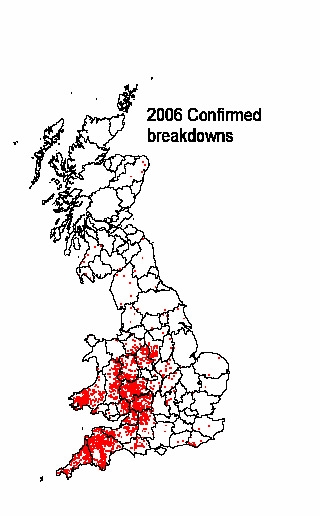
 The 2006 map shows hotspots expanding like Topsy.

 MAFF was now been re invented as DEFRA.

22,282 cattle were slaughtered in 2006.


After the end of the Badger Dispersal Trial  RBCT in 2006, Defra cracked down hard on cattle movements and ramped up testing.

 Pre movement testing was introduced in a valiant attempt to find this hidden reservoir of Tuberculosis in cattle.

The 2011 map showed the annual testing area as solid red, increased by several miles from Defra's original 2010 model. As far as badger could walk?


34,617 cattle were slaughtered in 2011.


Fast forward to this weeks' announcement of several new annual testing areas.

Please excuse the home made map - but as you can see, many buffer counties and those with sporadic and expanding problems now require annual tests and preMT of their cattle.


Defra say : "The number of cattle compulsorily slaughtered as reactors or direct contacts was 21,512 in January to July 2012, compared to 20,514 in January to July 2011."

Thus in 2012, reactors slaughtered so far, have increased by 1000 head over the Jan - July 2011 figure.


.


We think the new format of Defra's maps looks a tad truncated. In fact, very odd. We prefer the old format.

Wales has devolved completely - as have its figures in most of the press reports. And Scotland's head is removed.

Nevertheless the GB map, minus its top and left side, we print here - straight from Defra's new 2013 pdf file,
which explains their new cattle measures.


This whole sorry 35 year picture gallery could be entitled 'A Ministerial Victory for Tuberculosis'.

.

Friday, October 19, 2012

An unlevel crack down ?

Announced today is a further unraveling of many of the measures introduced over the last decade to allow cattle farmers to 'live with' TB herd restrictions. The cynical amongst us have long concluded that politicians, and through them Defra, will do anything but tackle TB in badgers, hence a raft of licensed movements to enable farming businesses to continue to trade.

But on the back of  EU cash and pressure for harmonisation of tuberculosis control across the Community, pretty well all of these opportunities have now been closed. Farmers Guardian report that the latest clamp downs include:
* Farmers who have had TB on their farm – in all cases - will not be allowed to bring new cattle in until the rest of the herd has been tested for TB and a vet has carried out an assessment.

* Farmers to have just 30 days, (down from 60) to move cattle that test negative for TB from a TB breakdown farm.

* Approved Quarantine Units (AQUs), units for calves from TB breakdown farms, will not be able to take on any more calves from the New Year.

* Conditions Approved Finishing Units (AFUs), which take clean cattle from infected farms for fattening before slaughter, to be ‘strictly monitored’, and will lose their licenses for serious breaches.
Note: The 30 day movement window may apply to all tested movements and not just from TB restricted farms. We will try to clarify this. Similarly  'orange' markets which were also under fire don't seem to be mentioned. And  we note that the closing of AQUs means many more calves will be shot at birth.

These measures will also see several more counties East and N/E of Defra's red area ,(already extended, see map below) hoovered up into an annual testing regime. These include Cheshire, Derbyshire, Nottinghamshire, Leicestershire, Northamptonshire, Oxfordshire, Buckinghamshire, Berkshire, Hampshire and East Sussex.


The latest report from DG SANCO came to the following conclusions:
It is however of utmost importance that there is a political consensus and commitment to long-term strategies to combat TB in badgers as well as in cattle.

The Welsh eradication plan will lose some impetus as badger culling will now be replaced with badger vaccination. This was not part of the original strategy that consisted of a comprehensive plan that has now been disrupted.

There is no scientific evidence to demonstrate that badger vaccination will reduce the incidence of TB in cattle. However there is considerable evidence to support the removal of badgers in order to improve the TB status of both badgers and cattle.

UK politicians must accept their responsibility to their own farmers and taxpayers as well as to the rest of the EU and commit to a long-term strategy that is not dependent on elections.

The TB eradication programme needs continuity and it must be recognised that success will be slow and perhaps hard to distinguish at first. There is a lot of skill and knowledge among the veterinary authorities and they must be allowed time to use it.
We discussed the paper in this posting, but having ramped up the EU harmonisation of cattle controls, we see no sign of a widespread, parallel targeted action taken on wildlife reservoirs, to prevent their infection in the first place.


Monday, October 15, 2012

Inconsistent?

There was a lot of froth over the week end with a letter opposing the proposed badger cull, signed by several scientists. They conclude:
We recognise the importance of eradicating bovine TB and agree that this will require tackling the disease in badgers. Unfortunately, culling badgers as planned is very unlikely to contribute to TB eradication. We therefore urge the government to reconsider its strategy.
"Culling badgers as planned ... "

Planned? Planned by whom?
We would refer readers back to the Defra Consultation Document, page 43. It's conclusion and thus the spin steer was:
Our preferred approach is option 6: to issue licences under the PoBA for industry to cull badgers, subject to a specific set of licence criteria. Under existing arrangements farmers and landowners will also be able to apply for licences to vaccinate badgers either on its own or for use in combination with culling. This approach will allow farmers to manage their own situations and use all the control measures available. It also means that taxpayers will not be paying for significant additional disease control measures. We consulted further on the implementation of this option, as articulated in draft Guidance to Natural England from July-September 2011

The research published and / or establishments occupied by many of the names on this letter are mentioned in these Defra documents. They would have been instrumental in constructing the protocols, the 'preferred option' of those on offer, was the one now being roundly trashed.
And we seem to have heard something like the phraseology of the protest before.

Indeed, some of the signatories to this letter were in the magic circle which conceived the RBCT Badger Dispersal Trial, which cage trapped into an infected population on 8 nights only, annually if you were lucky, with a couple of years off for FMD. And about which, their chairman and lead wizard was proud to tell any audience (in this case the EFRA committee in 2007) how 'his' trial was conceived and why it was carried out in such a way.

At that meeting, Geoffrey Cox, MP asked Professor Bourne to clarify the ISG's report's conclusions in the light of his statement describing a political steer in what should have been a scientific exercise.
Professor Bourne replied thus:
"We repeatedly say "culling, as conducted in the trial." It is important [that] we do say that. Those limitations were not imposed by ourselves. They were imposed by politicians."
and he concluded:
"Whatever has driven that I do not know but the fact is that a price has been put on the badger in this country which related to the way we were able to carry out our scientific work. That is exactly what we report".
Fast forward and the much quoted 16 per cent success projection for the current proposal. This was culled from the RBCT data, mathematically modeled figures taken over its whole politically rigged length. Why?

But to back to this current letter, now backed up by the lead wizard, himself. Yup, the very man who gave this statement (above) to support his 'political science' to his masters.

A salient point we think, is that many of the signatories to the Observer / Guardian letter appeared more than comfortable with the RBCT, when they were employed by it. We heard no shrieks of disapproval. But this was 'the science' - or pensions? Take your pick..But the RBCT debacle, which, having been involved in it,  we have criticised, and will continue to criticise,  mapped areas one third smaller than these proposals, used a different operating protocol and had a 'limitations imposed by politicians'.

Work that one out.

Thursday, October 11, 2012

Defra's Calculator

Last month, Defra produced an astonishing news release which trumpeted the following information:
There has been a notable decrease in the incidence rate over the past 6 months, mainly as a result of an increased number of tests on unrestricted herds compared to last year. The AHVLA are currently carrying out a data checking exercise to validate these test statistics.
The provisional June 2012 incidence rate is 4.2%, compared to 6.0% in June 2011. However, care needs to be taken not to read too much into short term figures, especially as this figure includes a number of unclassified incidents. As such, the incidence rates are subject to further revisions as more tests and their results for the period are input.
The number of new herd incidents during the period January to June 2012 was 2,706 compared to 2,720 for January to June 2011. The number of tests on officially TB free herds was 41,656 in January to June 2012, compared to 34,667 in January to June 2011.
The number of cattle compulsorily slaughtered as reactors or direct contacts was 18,213 in January to June 2012, compared to 18,081 in January to June 2011.
So all good news then?
Well, that depends on who is punching the buttons. We have archived the key figures for Jan - June 2011 and guess what? They do not compute to this conclusion at all. In the same 6 months of 2011, 6073 herds were under restriction 'due to a TB incident'. And that was 7.35 per cent of the total herds registered in GB. This year, 2012  Defra's current spread sheet ( apologies -  can't get a link to stick) shows 6567 herds in that position, but with fewer herds on the database, that equates to 8.2 per cent.

Cattle slaughtered are up too. The totals being 18,082 in 2011 compared with 18,645 so far this year. An increase of 563 animals. (Defra's figure in their announcement ignored 432 IRs, but they are still dead and for accurate comparison, IRs were counted in the total last year)

New herd incidents? That is benchmark Defra usually present, as it lower by a a mile than the tail end of herds under restriction and 60 day testing for years. That figure is pretty much the same at just over 2700.

So where has this alleged drop of almost 2 percent come from?  June 2011 was the last time Defra produced its monthly stats on the old system, and then dear old SAM took over and the number of tests logged increased by 30 percent. In fact his tally is 49,528 tests for GB in just six months. In some areas more than one test per registered herd in just six months.

 Defra explained this in a previous news release, saying that they were now counting pre and post movement tests, and also removing gamma failures and slaughterhouse cases from some totals as well, so figures may not be comparable. But despite all this tinkering, the number of herds under restriction for a 'TB incident'  is up, cattle slaughterings are up, and new herd breakdowns are at best, static. And yet Defra say that as a percentage,  new herd incidence is down? Something here doesn't ring true, but hey, the computer has spoken.

Could it be that those running the SAM system are refugees from this train wreck of computer generated mathematics?

UPDATE : We see our furry little friends in the Badger Trust have issued a press statement for 'Immediate release' trumpeting that Defra report a '30 per cent drop in cattle TB' - so stop the cull.
Oh dear. Another calculator which can't add up, and an organisation which can't see beyond a skewed headline.

Further investigation into Defra's stats do not support the 'wider testing' argument - should they make it.
The West region has recorded at least one test per registered herd - in just 6 months. And it's almost the same in Wales. So, in annual testing areas, with preMT ,  yes a huge increase in tests - but as Defra say, dear old SAM is now including ALL these tests which wasn't the case before.  And they haven't discovered many more reactors than last year. But the tail on this particular dog gets longer, as herds under restriction are not cleared by removing sentinel tested cattle. So to reiterate, and just for Uncle Jack Reedy, the key figures for the 6 month period Jan- July 2012 are here:
Herds under restriction during the period  - 6567, up by 494, almost 1 per cent.

Cattle slaughtered during the period - 18,645 up by 563.

New herd breakdowns - static at just over 2700.

Tests carried out, particularly in the West and Wales - up 30 per cent.


So that's a  30 per cent drop in cattle TB? If you say so, Jack. If you say so.

We don't think so.

Tuesday, October 09, 2012

He who pays the piper ..

.. calls the tune. And now the European Union is dipping into its coffers to assist Defra's so-called bTB eradication plan, then we sing to the European tune. Harmonisation of controls across the member states is also in the mix, which means that all the measures which the State Veterinary Service and now Animal Health have allowed over the 15 years to enable 8,000 cattle farmers to 'live' with herd restrictions, are being dismantled with indecent haste, and some retrospectively. These measures were there, we are sure, purely to avoid the thorny question of how to deal with tuberculous badgers. Now, thanks to our EU partners, although we still have the thorny problem, increasingly, we have no means of trading our cattle.


The pyramid of licensed movements and exemptions to herd restriction grew following the 1997 moratorium on Section 10 of the Protection of Badgers Act which prevented culling 'to stop the spread of disease'. This saw herd restrictions rise, sometimes continuing for years, as farmers struggled to maintain viable businesses - with no control at all on wildlife..

We referred to Jim Paice's thinly veiled hints, earlier this year in this posting. And sure enough, the threats restrictions have kept coming, compounded by a new computer system with hiccoughs which still appears unable to dispense paperwork. But whose operators follow up with promises of fines for non compliance. An excellent way to build a 'partnership'.


After their visit last September, the alleged breaches are contained in this DG SANCO paper.

Some of the tightening up measures, we have referred to already; but after reading this document, we feel sure that more may be in the pipeline. Which would be fair enough if bTB was affecting a few herds and if action was taken to clear the source of their problems. Restriction should mean precisely that. But last year, these restrictions applied to 8,108 farms. Over ten per cent of herds in GB. And some areas, despite frantic attempts to redraw borders, have up to a quarter of their herds under restriction. So if the EU imposes some of its more stringent measures, we would solve this county's unemployment problem, if not its budget deficit.

The executive summary of this SANCO paper explains:
While the approved eradication programme is broadly applied as described, the audit identified a number of potential weaknesses. These include numerous movement derogations, pre-movement test exemptions (including extended time intervals between testing and movement), the operation of "linked" holdings over large geographical areas, incomplete herd testing and the operation of specialist units under restriction, which lacked the necessary bio-security arrangements.
By this we assume the preMT exemptions for shows and the use of isolation facilities, which Paice and co have already closed down. But the 'extended time intervals' is a new one. At the moment, tested animals may be moved for up to 60 days from jab day, which in effect means about 50 - 55 days. Later in the document, SANCO mention 30 days, and we may have that to look forward to that. (p.8 5:2:3)
Incomplete herd testing, we assume is the exemption of young calves from testing. Given that the latency of the skin test is 30 days, it's pretty futile to jab anything under that age, but nevertheless, stacking up the payments, numbers, many vets do. In future they may have to. And in any testing area other than annual, yearlings may be exempt too. No doubt that too will cease.

 The summary continues;
Furthermore, despite efforts by the CA – some of their key targets could not be met in relation to the removal of reactors from breakdown herds and the instigation of epidemiological enquiries. There is a fragmented system of controls, involving a number of responsible bodies. This combined with a lack of co-ordination (particularly with Local Authorities) makes it difficult to ensure that basic practices to prevent infection/spread of disease (such as effective cleaning and disinfection of vehicles and markets) are carried out in a satisfactory way.
We have covered this fragmentation many times, and the installation of Defra's new toy, an all singing, all dancing computer system known for no particular reason as 'SAM', which is still failing farmers.

Only last week one cattle farmer was put under immediate movement restriction (by snail post) for failing to conduct a contiguous test - a test for which no notification had ever been received. Add to that a splitting up of responsibility between the various Animal Health offices, with no-one except the computer jockey in overall charge, and it is a recipe for chaos. Why should anyone be surprised?

With sporadic bTB outbreaks in the rest of the EU, a system very like FMD is in place, with a CA (Competent Authority) overseeing cleansing and disinfecting processes on farm. We suspect SANCO would like to see this too, on every one of  the 8,100 farms under bTB restriction last year. Hence our comment about halving unemployment.

 In May 2012 C&D notices were resurrected for reactors with no lesions and no culture. This even though the animals may have been slaughtered months ago. And a herd clearance form cannot be issued without it.

SANCO also mention the confiscation of passports from restricted herds and no licensed restocking until at least one 'satisfactory' whole herd test.The intensive biosecurity area of Wales is held up as pattern for the rest of GB - if it shows results.

So all in all a few more nails in the poor old cattle, and their owner's ability to trade at all. But the bit the Badger Trust and their assorted followers missed, is near the end:
Measures to prevent re-infection from other sources focus on the risk presented by wildlife (badgers). The CA maintains that the delay in implementing the proposed wildlife controls (i.e. a managed cull of badgers), which is a significant element of the approved eradication programme, remains the major obstacle to progress.
Quite.