Tuesday, June 18, 2013

Snipping the truth.

We have pointed out many times, this brazen and deliberate misquoting editing both of scientific papers and television programmes when it comes to badgers, or indeed the disease which they carry, Zoonotic tuberculosis.

In this week's Telegraph, countryman and writer Robin Page,  having spoken to contributors to a recent BBC 'show', wrote an extensive piece showing just how much celluloid attracts the BBC's editorial scissors, and what a biased view this can give.

He points out that a recent Countryfile programme show was edited to explain that the decline of hedgehogs was due to habitat depletion or passing Reliant Robins. There was no mention of predation by badgers. After contacting a main contributor to the programme, who confirmed that she mentioned the badger point several times, Robin Page concludes:
In my view, this is highly selective editing. I will leave it up to readers – is the badger omission simply a matter of “editorial discretion” or is it the Disneyfication of nature? [snip] In my view it is not objectivity; it seems to be little short of animal-rights propaganda. What is the BBC hierarchy going to do about this unacceptable situation?
We would guess, precisely nothing. A coughing badger is a very valuable asset to many, including or especially,  the British Broadcasting Corporation.

In another snippet from Robin's excellent and informative piece, he describes the arrival of 'bovine' zoonotic tuberculosis into a dairy herd in Dorset which has been 'closed' to cattle movement for decades.
Cattle on a closed dairy farm in Dorset – “closed” meaning that no cattle have moved on to the farm (it has been closed for 99 years) – have suddenly got TB. Since autumn, more than a third of the herd has been slaughtered. And the strain of TB? A virulent form usually found in Exmoor.

This almost certainly means that animal rights campaigners are trapping badgers in the Somerset cull area (illegal) and releasing them in Dorset (illegal) with no concern for the consequences. This also means that healthy Dorset badgers will get TB. It is an act of stupidity and cruelty, as bad as when those misguided hooligans released mink from mink farms into the general countryside several years ago.
We too have described the utter stupidity of allowing businesses to make a living out of translocating badgers 'rescued' from other areas. The risk of disease transmission both to other badgers or any mammal is huge.

But it appears that  the 'asset' value of a badger outstrips common sense. And thus far this loophole has not been closed; which is pretty damned insulting to those of us with cattle under restriction.

Saturday, June 15, 2013

Where did it all go wrong...... ?


Having spent the last decade collating and collecting snippets about the non-control of Bovine Zoonotic tuberculosis  in Great Britain and posting them on this site, we thought a potted history may bring our readers up to date. There are many statements flying around which are just fairy stories, and in the next few paragraphs, we will attempt to blow a few myths away.

 During the 1950s and 60s, what was known as the 'Compulsory Eradication ' process swept through the cattle herds of the country, starting at the coasts and working inwards towards the midlands. Testing cattle, and slaughtering those which reacted to the skin test was very successful leaving only a few red dots on the ministry's maps to spoil a complete clearance.

The Badgerists will claim that this clearance this was carried out without a hair of a badger's head being harmed. But that is not true. Farmers were controlling numbers right up until The Badgers Act (1973) made this illegal, hoovered up with action against the obscene 'sport' of badger baiting. Populations were 'managed' and kept stable before and during the eradication process, until 1973.
And TB incidence fell from an estimated 40 per cent of cattle affected in the 1930s to 0.04 per cent at the end of the Compulsory Eradication process.

It was around this time that an infected badger was found on a farm in Gloucestershire. The farm was was having persistent problems getting the herd clear with testing and slaughter of its cattle. It was also noted that in West Cornwall, cattle herds went clear during winter housing, only to go under restriction again after grazing open pastures.

We explored the resulting cattle carnage in this posting, with the aid of the CVO reports from 1972 - 1976.

During the 1970s, badgers were routinely euthanased by the Ministry's wildlife teams, while underground in their social groups, if cattle breakdowns failed to clear with cattle testing and slaughter. And the incidence of Zoonotic tuberculosis dropped to a level which would have allowed TB free trading under the OIE regulations.


That level is set at less than 0.01 per cent of herds affected, and 0.02 per cent of cattle slaughtered in a three year period of surveillance by skin testing and slaughter. Remember that figure: it is important.

 This was the parish map in 1986, showing a handful of breakdowns in  a few clusters. Any population control by landowners, had been banned in 1973.

But in the early 1980s, puppet 'scientists', singing political tunes for their suppers research grants and pensions, came to the fore and veterinary experience and expertise took a back seat.


One of the first reports to cause problems,  was by Lord Zuckerman which concluded that underground euthanasia was fine for rabbits, foxes and moles - but cruel to badgers.


 And although he accepted that badgers were involved in the cycle of 'bovine' tuberculosis, he was going to make it damn difficult for MAFF to control the disease in them. Thus in 1982, gassing was replaced by cage trapping and shooting in a 'ring' of around 7km from the breakdown or until badgers postmortemed 'clean'.. Incidence bumped along at a fairly low rate, with 605 cattle slaughtered in 1982 and 843 in 1985.

 But an even more damaging tweak came in 1987, with the Dunnett report. Another 'scientist' who concluded that badgers played a significant role, but then proceeded to emasculate the Ministry's ability to control Zoonotic tuberculosis in them even more.

 Professor Dunnett's report introduced the 'Interim strategy' which ran from 1987 - 97, while politicians decided what to do about increasing numbers of reactor cattle and wrung their collective hands with the Badgerists. And the reason for this increase?

After Dunnett, the amount of land available to the Ministry of Agriculture's State Veterinary Service to trap on, was cut from 7 km to just 1 km. And then only on land which cattle had grazed. Thus if the badger's ancestral home was in forestry, an arable field or 2km from base, it was off limits. Untouchable.

And cattle slaughtering climbed from 782 in 1986 to 3,760 in 1996 - the last year of any semblance of control by the Ministry at all. A potted chronology can be seen on this link.

But the real nail in the coffin came in 1997, with a £1 million bung from the Political Animal Lobby (PAL) and not a little influence from a diminutive Professor, leading the anything but Independent, and arguable most un-Scientific Group of all - the ISG. The Randomised Badger Culling Trial  Badger dispersal trial started in 1997 and no badgers were culled outside its triplet zones. As the RBCT wildlife teams stirred up infected populations occasionally for 8 nights, with time out for FMD, cattle reactors went through the roof.

Those of us unfortunate enough to experience these areas of carnage, were not surprised to see the initial rubbish results but we were surprised at the brazen opportunism, which drove this charade.


Professor Bourne did not say 'culling badgers' would have no place in controlling zoonotic Tuberculsosis in cattle in this country. What he said to the EFRA committee in 2007, we quote again below. Read it and weep.


"We repeatedly say "culling, as conducted in the trial." It is important [that] we do say that. Those limitations were not imposed by ourselves. They were imposed by politicians."


Bought and paid for then?

 This is the map of GB's testing  in 2013, with around 40,000 cattle culled annually, over 10 per cent of GB's cattle herds under restriction compared with the OIE's TB free trading level which is set at  0.01 per cent.

And we now have the inevitable spillover of Zoonotic tuberculosis into many other mammals including domestic pets, companion animals and their owners.


This non-eradication policy for zoonotic tuberculosis went so very wrong over the last three decades for two very simple reasons. We have the best administration that lobby money can buy, and a raft of political scientists willing to sell their souls for an index linked pension.


Thursday, June 13, 2013

Taking it seriously.

"Exposure to M. bovis can be a serious health hazard." So said an executive from the Health and Safety Executive (HSE), after slapping AHVLA on the wrist, censuring AHVLA for breaches in handling live samples of m.bovis, the causative agent of Zoonotic tuberculosis, over a period of two years.
"The Health and Safety Executive (HSE) completed a Crown censure procedure against the Weybridge-based organisation following an investigation into the handling of samples containing Mycobacterium bovis (M. bovis) - the causative agent of bovine TB, which in some circumstances can be harmful to humans."
Given the seriousness of the disease known as 'tuberculosis', a group term which includes Zoonotic tuberculosis (bovine TB) that's a bit of an understatement, but let that pass.
Farmers Weekly, reported last month an HSE investigation into the handling of live samples for further testing collected at Starcross, Exeter and submitted to Weybridge AHVLA. Their findings included:
* Standard operating procedures were not fit for purpose - they lacked clarity and detail, and did not take proper account of the equipment at Starcross used to inactivate M. bovis, or the experience of personnel at that laboratory.
* The wrong equipment was provided - the equipment provided to the staff at Starcross for the M. bovis inactivation procedure was not the right equipment for the task

. * Training for Starcross technicians was inadequate - personnel undertaking the M. bovis inactivation procedure received no formal training on the process.

* Effectiveness of the inactivation process was not monitored - personnel at Starcross did not routinely check that the inactivation process was working and that the M. bovis samples were safe to handle.

* Managers failed to resolve issues - some operators at Starcross raised concerns about the inactivation process and equipment, but no action was taken.
If a private company or individual had acted in a such a reckless matter during the handling of a Grade 3 zoonotic pathogen, prosecution would be inevitable. However, the report explains:
Crown bodies such as AHVLA, an executive agency of DEFRA, must comply with the requirements of the Health and Safety at Work Act. However, they are excluded from the provisions for statutory enforcement, including prosecution and penalties.
The Protection of Badgers Act (1992) made provision under Section 10(2)(a) for 'culling to prevent the spread of disease'. The 'disease' carried by these animals, being the very same Zoonotic tuberculosis for which HSE have censured AHVLA so heavily in respect of their employees.

 In his raft of Parliamentary Questions lobbied in 2004, Owen Paterson asked "What was the current policy on the issuing of licenses under this section of the Act, and how many the Secretary of State (then Madame Beckett) expected to issue in the next 5 years. [158605]

The answer given on 18th March 2004, Col 431W was;
Under section 10 (2) (a) - to prevent the spread of disease: "It is current policy not to issue any licenses under sub section 10 (2) (a) to prevent the spread of bovine tuberculosis, except for animals held in captivity."
And since that moratorium on Section 10(2)a) (purchased in 1997 with PAL lobby cash) we have culled no badgers 'to prevent the spread of disease' , except a very few in the RBCT, the operating protocol of which ensured not the control of Zoonotic tuberculosis, but its spread.

 However to the end of 2012, AHVLA have slaughtered 354,084 cattle. They have also been responsible for the slaughter of several thousand 'other species' TB victims, in their quest to eradicate TB from everything else - except badgers. Species affected include alpacas, llamas, bison, pigs, goats, deer and sheep.
Transmission of Zoonotic tuberculosis from these animals, particularly domestic pets and companion animals to their owners, has already been recorded.


How culpable does that make Defra / AHVLA?

Monday, June 10, 2013

Incarcerated ... but safe.

There have been many opinions published when dairy farmers consider keeping cattle inside 24/7.

"But they're grazing animals" tweet the Twits. "They must be free  and in the open air. It's not natural to keep them inside all the time."
But what happens when the badgers which have caused the annihilation of one herd, still have the Right to Roam to reinfect the replacements?

In March, we told the story of one such herd, which AHVLA 'depopulated' - which is a fancy word for slaughtered the lot - after a devastating routine test at the end of January. The habitat of the badgers living next to this farm, had been turned into football pitches, hotels and a leisure facilities, thus displacing their food supply. The result appeared to be a doubling of numbers and territorial scrapping on a huge scale for this dairy herd. This combined with very little UV light last summer, and floods.

There wasn't a field on this farm  without contamination by badger faeces - and it was not in latrines. The cows paid the ultimate price.


Gillian Bothwell has now posted an update to her story, on British Farmers Forum.. In her own words:
You may recall that we lost our entire milking herd in February due to a TB breakdown, thought I'd just update where we are up to now: When the last of the cows had left the farm we got stuck into cleansing and disinfecting, what a soul destroying job that is!! All you can think about is the cows that have gone, I never realised just how difficult a cubicle shed is to completely clean to the standard required, hubby took a week out to visit his family in NI as it hit him very hard.

We then badger proofed the sheds and the maize/wholecrop clamps (feed store in an enclosed shed so that was OK) had two inspections by AHLVA before a license finally granted to buy in some cows. Many tears shed during all of this I can tell you!!
Before restocking, AHVLA had put some very stringent conditions on this farm. None included badgers, but all was geared to keeping them away from the dairy cattle. Gillian continues:
Anyway, we had stipulations as to buying in cows - they had to come from farms with a clear TB history so it was going to be pretty difficult finding large numbers here that we could afford. Eventually we spoke to BACA and went to Germany and selected 130 cows and heifers in total on three trips.

Very interesting trips: the farmers over there have very little knowledge of TB and seemed amazed at our situation with regard to us having to slaughter all our cows whilst the badgers run free.
We're amazed at the situation in this country too - but let that pass.

Gillian tells us that the cattle travelled beautifully and have settled in well - "it just takes a little while and some TLC to get them used to new surroundings, new diet and my husbands strong Irish accent!!!"
 The youngstock and calves from the original herd had been grazing well away from the new sports complex and they have once again tested clear.

But what of these new dairy cattle in their hermetically sealed, AHVLA approved, badger proofed box unit?:
We have made the decision to keep the cows inside this summer where they are safe due to the badger proofing, obviously it will cost us more to feed them but we feel to nervous to turn them out. All in all its been completely hellish and I wouldn't want it to happen to anyone, as well as the heartbreak of losing the cows the cost of it all has been massive.

If you take it all in - loss of 4/5 month's milk sales from 140 cows going through the parlour, cost of buying replacements (compensation doesn't cover it) all the work done to the sheds and clamps, cost of feeding calves that we have not been able to sell due to movement restrictions, cost of spring work with no income, I reckon we are well into six figures.

How is a small family dairy farm supposed to stand a hit like that??
So this farm has " milk going out of the yard again," and in July should see a milk cheque. And the Bothwells say that they are " grateful for good friends for their help, suppliers who are working with us and our AHVLA vet has been very supportive and lastly our three little boys who have kept us going through it all. We just have to keep going and hope we can survive it ."

 But those cattle now stay inside because the badgers are still roaming free to infect - again? And as Gillian has said "we can't go through this a second time." One comment on the BFF post asks: "
"So AHVLA have made you expend time, energy and cash before they have allowed you to restock. Have they spent the same in identifying the source of the infection and eliminating it?
If not why not?"
Good question. A case for screening those badgers? Or have the Bothwell's dairy cows got to stay cooped up for the rest of their lives, just to avoid being infected with Zoonotic Tuberculosis by an animal, deemed by some, to be worth more than a cow?

Friday, June 07, 2013

Not cattle ....

Following the lead of the United States' Centre for Disease Control and Prevention (CDC), and as described in other papers from Africa we shall in future, refer the 'bovine' TB, as Zoonotic tuberculosis.

 The word 'bovine' seems to confuse. And for sure, Team Badger appear to want to confine this debate to cattle versus wildlife. This stance does not take in the wider implications of allowing a deadly zoonosis, with an indefinite incubation period, free rein the British countryside, thus enjoying an inevitable interface with other mammals.

This was bought home quite forcefully during a debate at the Cheltenham Science Festival this week, when a motion to cull manage badgers was discussed and decisively won. The speakers for such management were Roger Blowey, a published veterinary surgeon, and dairy farmer, Phil Latham. Opposing any sort of management - except vaccination - were another vet and the fragrant, badger homing owner of Secret world, Mrs. Pauline Kidner.


But in questions or points from the floor, one speaker announced that in her professional capacity and at the present time, she was treating 8 people in the county of Gloucestershire for Zoonotic tuberculosis - which they had contracted during an up close and personal relationship with the family cat.

 And that dear readers is how distorted this debate has become: cattle v. badgers. Either one or the other, and not parallel action on managing Zoonotic Tuberculosis in both.


The result is many hundreds of dead animals, some companion mammals to human beings. Cats are as much victims of Zoonotic tuberculosis as our tested sentinel cattle, and their owners face an unenviable period of intensive drug therapy, to try and control this evil disease.  The outcome of which is by no means a certainty.

Thursday, June 06, 2013

The debate.


Yesterday, a smattering of MPs made the effort to put the case for the management of an acknowledged and proven wildlife source of zoonotic tuberculosis in England, during a 3 hour debate in the House of Commons.

 After spending a productive afternoon taking a metaphorical strimmer to a collection of overgrown weeds (which could have been childish and destructive Members of Parliament) I found the debate very bland. Lacking in much passion at all - except for badgers and their associated political science.

Opposing the motion for the government, Secretary of State, Owen Paterson MP, made his point forcefully.

Concentrating on the fact that although we are not the only country to have zoonotic tuberculosis (M. bovis) established in wild mammals, when this disease feeds up into sentinel tested cattle, we are alone in the developed world in ignoring it.

The results of that one sided policy, is that in Great Britain, our statistics for control of this grade 3 pathogen are the worst in the developed world, putting trade at some risk. But human health at considerable risk.

Owen mentioned his visit to Australia, and compared our efforts at eradicating reactor cattle, sheep and alpacas with that of the Republic of Ireland, and New Zealand, who take a wider view of the problem this bacterium causes. He also touched on emerging problems in countries within the European Union, which we have begun to trace recently
.
 Although some honourable Members failed to see this relevance of a combined action on mycobacterium bovis, preferring the far easier target of England's cattle, of note are NI's Jim Shannon and Sheryll Murray (SE Cornwall) who put their points well.

But possibly the most succinct speech came late in the day from Roger Williams (Brecon and Radnor) who observed:
One thing that we are certain about is that badgers infected with TB can pass it on to cattle, but there are other methods of infection. When there are diseased badgers in fields where cattle are grazing, there is the opportunity for the disease to be transmitted. Although we are cleaning up the disease in cattle, as long as there are infected badgers where they are grazing, the disease can spread. We have heard a lot about increased biosecurity, but the same people advocate natural forms of cattle production—in other words, grazing. As far as I know, there are no biosecurity measures that can keep badgers and cattle apart when cattle are grazing.
Predictably, the destructive base of modern, modelled 'political' science, links to which can be found in this posting was ignored. The motion was defeated by a substantial margin.


But why in the 21st century we should be having a debate at all, about control of a Grade 3 zoonotic pathogen, could have been the subject for this debate. The consequences for our MP's continuing political protection of M. bovis have already proved deadly and profound.

Zoonotic TB: the bigger picture


000acull 005-cre.jpg

A minor but nonetheless important parliamentary event took place yesterday, with the opposition day debate on the badger cull, against the motion that, "this House believes the badger cull should not go ahead".

Fronted by Mary Creagh, Labour MP for Wakefield and shadow secretary of state of the environment, she opened with the question: "is culling badgers the most effective way to stop the spread of bovine tuberculosis?" 

This is the classic straw man ploy, setting up a false premise in order to knock it down. No one with any sense will actually argue that a cull will stop the spread of what I prefer to call zoonotic TB – the bacterial strain has long adapted to multiple hosts and can no longer be considered a bovine pathogen. 

To any sensible person, the cull is simply one tool in a complex "toolbox" of measures available to control the disease, which in the UK is largely out of control, spreading geographically and affecting increasing numbers of animals. 

Thus, it would have been far more appropriate to address the issue of whether, in the context of the disease having established itself in the wild fauna, zoonotic TB in domestic cattle had ever been successfully eliminated without first dealing with the wildlife reservoir. 

And it is here, as in many other things, we can benefit from taking a broader view of the situation, looking beyond our borders, and seeing what is happing elsewhere. And, if we do, we find that the UK is by no means alone in suffering from the upsurge in zoonotic TB. 

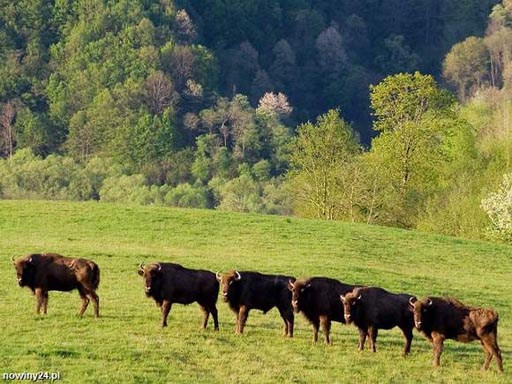
For instance, in the Bieszczady region in the southeast of Poland, not far from the Ukraine border, there has been a major outbreak in wild bison (below). 

000abison.jpeg

Significantly, the local veterinary authorities carried out investigations of other wild animals and, in mid-April discovered infection in wild boars – to which badgers are closely related. As recently as May, tuberculosis had been confirmed in three pigs that had died in the Bieszczady forest, in the same area where previously tuberculosis had been found in bison. 

This broader view, therefore, underlines the relationship between the disease in ruminants and other fauna, a relationship so well established in veterinary circles that, when Mexico domestic cattle were found to be infected with zoonotic TB, the authorities immediately undertook surveillance of wild ruminants in what was called the "wildlife-livestock interface". White-tailed deer, North American elk and red deer were “harvested” via controlled hunting. 

The relevance of the "wildlife-livestock interface" is further emphasised by official Italian veterinary advice, which lists the different "risk factors" in production systems, including as a major factor in the spread of TB, "poor surveillance systems and control of bovine tuberculosis in wildlife". 

Thus, in a major outbreak of zoonotic TB in cattle in Sovona in 2007 – a region which was a long history of TB outbreaks, much emphasis was placed on controlling the wild boar population, which were implicated in the spread of the disease. Wildlife management was thought essential before there could be a return to what was termed "normal care". 

In Spain, it has long been recognised that high densities of wildlife, mainly Eurasian wild boar and red deer have been able to maintain M. bovis in circulation, even in the absence of domestic livestock, this forming what is technically known as a self-sustaining “maintenance” reservoir. 

In 2008, a ground-breaking study of Spain's Doñana National Park proved unequivocally the link between infection in the domestic cattle, using genotyping to demonstrate the epidemiological relationship. European wild boar, red deer and the fallow deer were examined for the presence of zoonotic TB. The infection was confirmed in 52 percent of wild boar, 27 percent of red deer and 18 percent of fallow deer. 

The results obtained confirmed that wildlife species were infected with the M. bovis strains which are more prevalent in cattle, with the official report concluding that introduction of domestic animals into wildlife areas when there no guarantee of freedom of disease and without appropriate diagnostic techniques and control measures represented a risk to cattle health. Researchers suggested that identifying and culling animals with advanced bovine TB could reduce the number of super-shedders and the availability of contagious carrion. 

This builds on the work from the Office International des Epizooties (OIE), which reports that 22 percent of countries with TB infection have detected bovine tuberculosis in wildlife (deer, elk, wild boar, feral goat, buffalo, possum, ferret, mink, hedgehog, lion, cheetah, kudu, baboon, and seal) in the last 10 years. Where wild species become "maintenance host" for M. bovis, they can be responsible for continuing outbreaks even when infection is eliminated from domestic cattle. 

The best-known examples of this dynamic are cited by the OIE as the European badger (Meles meles) in the United Kingdom and the Republic of Ireland, the possum (Trichosurus vulpecula) in New Zealand, the white-tailed deer (Odocoileus virginianus) in Michigan, which has served as the presumptive source of infection for cattle herds and carnivores, and the African buffalo (Syncerus caffer) in Africa, which has spread the infection to predators. 

Thus, when a very recent TB outbreak was observed in Bavarian cattle, investigation of deer and roe deer in the Upper Allgäu were carried out and infection of the same type was found, with a prevalence of 18.2 percent. As a result, 1,614 red deer have been shot by the deer hunting community. Similarly, recent outbreak in Swiss cattle, in the Cantons of Fribourg, Vaud and Valais – the first cases for 50 years – deer have been examined for potential infection. 

A reminder of the zoonotic character of the disease, incidentally, comes from the latest outbreak in Germany where, on a farm in the district of Rotenburg, a farmer has succumbed to the disease. In this country, the owner of a flock of alpacas which was found to be infected, is currently being treated for a serious case of the infection, and may need an operation to remove one of her lungs. 

There has also been a recent outbreak of zoonotic TB in Belgium, which has been free from the disease since 2003 – the disease having been discovered in a slaughterhouse in Holland. Investigations are currently being carried out, but it is significant that the affected cattle are from a beef herd which does not have contact with other cattle. 

From the UK's perspective, some of the more significant outbreaks have been in France, where the increase is regarded as "worrying" by the authorities. There, we note, in some prefectures, badgers have been associated with the spread of disease and the Ministry of Agriculture is seeking destruction of badger setts when they are classified as harmful. 

In France, currently, a policy of whole-herd slaughter is practised, but there is also no reticence about culling wildlife. In February 2012, M. bovis infection was detected in wild boar in a game park in Marne department, previously a bovine tuberculosis-free area. In order to prevent spillover, all the game present in the park was slaughtered, including 280 wild boars, where the prevalence of infection was determined at 7.3 percent. 

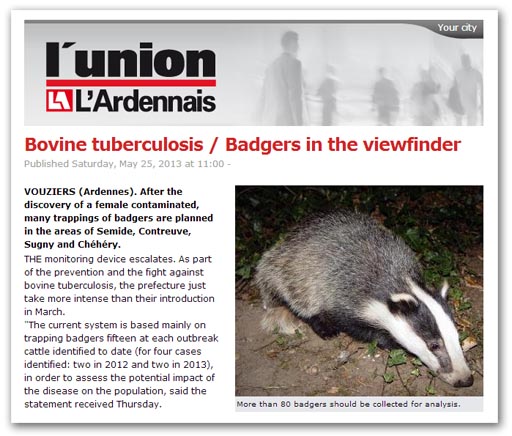
000aardennes 005-bad.jpg

At the end of May this year, after three cases of bovine tuberculosis were diagnosed in less than a year in herds Semide, Contreuve and Sugny, resulting in the slaughter of about 200 cattle, two badgers carrying bovine tuberculosis were found, close to the areas where the cattle infection had occurred.

000ahunters.jpg

 The local hunts were involved (pictured above) by the prefecture in the Ardennes, through the formal system of "lieutenants de louveterie" and in the first days of this month, systematic trapping and analysis of badgers was conducted, with 60 badgers taken. Four have been found to be infected.

Control measures are ongoing, and one notes that while the media here lauds a former pop-star guitarist, who believes M. bovis to be a virus rather than a bacterium, Pascal Mailhos, prefect of Burgundy and Côte-d'Or, recently awarded medals to officials actually dealing with TB in the front line, including Jean-Luc Loizon, the local Lieutenant louveterie. This is an interesting reflection of relative national priorities. 

000acull 005-pat1.jpg

But, as he went into bat for the government's plans, no one was more conscious of this "bigger picture" than Secretary of State for the Environment, Owen Paterson. One of the most eurosceptic ministers in the Cabinet, he regularly outflanks his own officials at EU council meetings by being able to speak with his French and German counterparts, whose languages he speaks fluently.

And thus, while Mary Creagh flounders around as the perpetual "little Englander", Paterson is in touch with the European and global scene, using data from all over the world to strengthen the case for dealing with the wildlife reservoir over here.

Fortunately, the "bigger picture" prevailed and the motion was defeated by a handsome majority. Owen Paterson lives to fight another day.


Monday, June 03, 2013

Vive la France!


We mentioned in this posting the emergence of bovine zoonotic tuberculosis in the Ardennes region of France. More is emerging on the response of the French authorities to this threat. If you remember, they had already confirmed disease in two badgers, and were about to trap and examine a further 80. They don't hang about in France.

The deed is done, with more infected badgers found. Here is a quick auto-translation from the first link:
Attention only animals collected on risk areas and therefore the corresponding analyzes are supported financially by the state, through this monitoring on national wildlife called 'SYYLVATUB.'
To date, 24 badgers have already been taken, mainly in the sector and Semide Contreuve. Early results showed five negative cases, but a badger gave a positive result (the latter was trapped in the town of Mont-Saint Martin - our edition of May 18)
The discovery of this infected with bovine TB badger, has the effect of changing the main device, which now calls for:
• the continued trapping and systematic analysis of a sample of 60 Badgers (4 x 15 badgers) around four homes cattle in 2012 and 2013;
• trapping intensified and systematic analysis of badgers captured in a one-kilometer radius around the infected badger burrow;
• trapping and systematic analysis of a sample of 15-20 badgers in the periphery (one to two kilometers) of the aforementioned area.
A hunter is concerned at the large number of badgers to take, but do not balk at the task.
And another auto-translate from the second link:
"We conducted analyzes of sixty badgers trapped around the four foci of tuberculosis identified. We have twenty returns including analysis was positive. "The regulatory framework indicates that at least one infected for the department going in the red zone animal," says Pierre N'Gahane, the prefect of the Ardennes.
Evaluation of the rate of infection:
* As a precautionary measure to monitor more regularly wildlife, the representative of the State has already asked the Directorate General of Food Ministry in charge of Agriculture (EB) transition in level 3 Sylvatub the plane.
* A meeting of the monitoring unit will be held Tuesday, June 4 to discuss the evolution of the health situation in the department and the implementation of measures already experienced in the Marne and the two French departments most affected by this disease, Côte-d'Or and the Dordogne


 In France, la chasse (the hunt) are seconded to collect suspect blaireaux (badgers) and deliver to the appropriate authorities for sampling.

This article explains and they kindly send us pics as well. They don't hang about in France, do they?

 It's good to see that at least someone takes zoonotic tuberculosis seriously.


Saturday, June 01, 2013

June 1st - A Wish list

As a few high profile but vociferous opponents of the control of tuberculosis prepare to descend on London today (are there any badgers in the Metropolis?) we have prepared a 'Wish list' to summarize the current stupidity policies surrounding this disease.

Why a start and finish date for controlling a fatal zoonotic Grade 3 pathogen? M. bovis, the bacteria which causes tuberculosis in mammals works 24/7 and not to a bureaucrat's time clock. Lord Krebs pointed this out in his policy document of 1996. So our first wish is for a long term management strategy for any wild hosts of b. tuberculosis.


Secondly, we would propose a cull of Defra's statistical computer weasels so that the full extent of other species overspill of this deadly disease is visible to the general public.


For sure, the risk to human beings from their pets is now being mentioned.

But the evidence base to back this up is still firmly glued to the counting of the single microbial sample which confirms 'bovine' tuberculosis only.
Other victims - and there are thousands - have disappeared


 When the results of dubious data collection are fed into a mathematical model, (or even Brian May's astrophysical calculator ) perhaps it would be a good idea to check the source of that data. So our third wish is for less 'rough assumptions', vague estimates or downright lies which subsequently become hard facts. With Defra's ability to tweak boundaries and the Badger Trust's failing calculator batteries, the cynical amongst us may believe that this dumbing down of our senseless sentinel cattle slaughter is a deliberate ploy to keep the gravy train this disease has created, on its rails.

 And while we're on the subject of dodgy data, our fourth wish is for the John Bourne's comments describing the conception of 'his' 8 year prevarication trial on how to disperse infectious badgers, be quoted in full, and not castrated to fit his political steer. If you remember, in his evidence to the EFRA committee, he proudly announced not that culling badgers to control tuberculosis would not work, but:
"We repeatedly say "culling, as conducted in the trial." It is important [that] we do say that. Those limitations were not imposed by ourselves. They were imposed by politicians."
And the method of culling Bourne chose to satisfy his political steerage? Cage trapping for 8 nights only, once a year if you were lucky, with time out for FMD in 2001 / 2002 and open access for the badgerists to remove or destroy 69 per cent of the traps set up to October 2003. Some policy. Some 'trial'. Some data.

But it from this crazy skyscraper of 'facts' that the present pilot cull - and its vociferous opposition - has sprung.

 Meanwhile, the columns of the press, TV interviews and the Twits are full of very wild assumptions made by many 'experts' who know nothing either of this disease, its progress through mammals or its control in other countries. As Derek Mead says in his Western Morning News column this week:
"People who you wouldn't expect to know the first thing about bovine TB, bio-security, gamma interferon testing and the personal habits of badgers have been occupying platforms and writing letters to the newspapers, all with an immense air of authority..."
This while the men and women on the phone lines at Farm Crisis Network are trying to calm the fears of the farmers who have had whole herds of cattle, sheep, pigs and alpacas slaughtered, and are then faced with turning out any replacements or the survivors of a what can be lifetime's work, onto the killing fields again.

The wildlife responsible for this carnage continue to enjoy free range, defended by the totally ignorant or the wilfully misled.

So our final wish is for Defra to target Tuberculosis wherever that may lurk. Defra takes a lead in its non-eradication of tuberculosis in cattle and bison from DG SANCO in the European Union, which in turn follows the Office Internationale des Epizooties guidelines on TB eradication. But to ignore, deflect or dumb down a continuing threat from an acknowledged and established wildlife host, is not just expensive, it is just plain reckless, as DG SANCO so forcefully said in their latest blast paper describing the lack of progress made in Great Britain.
"It is however of utmost importance that there is a political consensus and commitment to long-term strategies to combat TB in badgers as well as in cattle. The Welsh eradication plan will lose some impetus as badger culling will now be replaced with badger vaccination. This was not part of the original strategy that consisted of a comprehensive plan that has now been disrupted.
There is no scientific evidence to demonstrate that badger vaccination will reduce the incidence of TB in cattle. However there is considerable evidence to support the removal of badgers in order to improve the TB status of both badgers and cattle.
UK politicians must accept their responsibility to their own farmers and taxpayers as well as to the rest of the EU and commit to a long-term strategy that is not dependent on elections.

The TB eradication programme needs continuity and it must be recognised that success will be slow and perhaps hard to distinguish at first. There is a lot of skill and knowledge among the veterinary authorities and they must be allowed time to use it."
There is nothing we could add to that.

The target for the eradication of Tuberculosis should not just be a sentinel cow's head. That is the easy option, but solves nothing if the cause of her 'reaction' is left to reinfect any other passing mammal. Tuberculosis is a slow burn disease in human beings. It has a long term incubation, even with a BCG jab. And passing the buck to a hard pressed NHS is not an option. 


We leave you with a picture of a badger with tuberculous pleurisy - one such that May's groupies, marching today, want to preserve, protect or vaccinate.
Did it suffer?
It was completely emaciated: suffocating  with its lungs full of fluid  and abscesses, and highly infectious with every breath it was able to take.

On its 'suffering' - we'll leave you to judge.

Thursday, May 30, 2013

Update on bovine tuberculosis in the EU


We are grateful for updates on the developing situation in parts of mainland Europe, where bovine tuberculosis was thought to have been eradicated. With incidence at or below 0.02 percent of cattle reactors and 0.01 per cent of registered herds, TB Free trading status has been the norm for many parts of Europe for decades. Thus herds were on abattoir surveillance only, but this unfolding story involves wildlife reservoirs and a human case. (For comparison, please note that our incidence of TB in tested GB cattle reveals around 10 per cent of herds with problems and an increasing spread to the north and northeast of the traditional badger havens of the south west.)

We touched on the problems in parts of Bavaria and Switzerland in this posting, also pointing out that once cattle reactors are found, farms can no longer sell milk or meat on the open market.

And in another part of Germany over 100 cattle have tested positive on one farm.
Hemslingen - On Monday morning, more than a hundred cattle Hemslinger cattle and dairy farm have been culled. All animals had been previously tested positive for tuberculosis (TB), a disease that was considered extinct in Germany until 1997. Since then there has been in Germany only isolated cases of bovine tuberculosis, to the infectious disease transmitted by droplets in March occurred in greater numbers in the Allgäu.

The farm in question is about one-third of the stock concerned. The veterinary Rotenburg / Wümme has led ring controls in which a further spread of the disease is to be found on other stocks through sale of fattened animals or infection of animals on neighboring land. "The affected farm in Hemslingen is safe," said district veterinarian Dr. Joachim Wiedner on demand from our newspaper. Provisionally neither dairy animals there may still be recycled sold".
And from this outbreak, a much more worrying connection and a reminder of why we sign up to International directives to control and eradicate tuberculosis - a fatal zoonosis - from any animal host. The farmer concerned has been seriously ill for months, with a disease which should have been consigned to the history books. It is not yet clear whether he infected his cattle, or vice versa. 

Further cattle tracings from Hemslingen have revealed more problems. And more cases are coming to light originating the Allgau region, where the wildlife reservoir in deer has caused havoc along the foothills of that alpine area.

This report explains, and briefly, the translation is this:
In Allgäu Bovine tuberculosis is rampant. Now there is increasing evidence that deer the dreaded epidemic has spread - in other alpine regions. From Lindau to Berchtesgaden cattle now be tested and shot deer increased."

But reports are now coming in from the Ardennes region of France which implicate badgers as a possible wildlife vector.


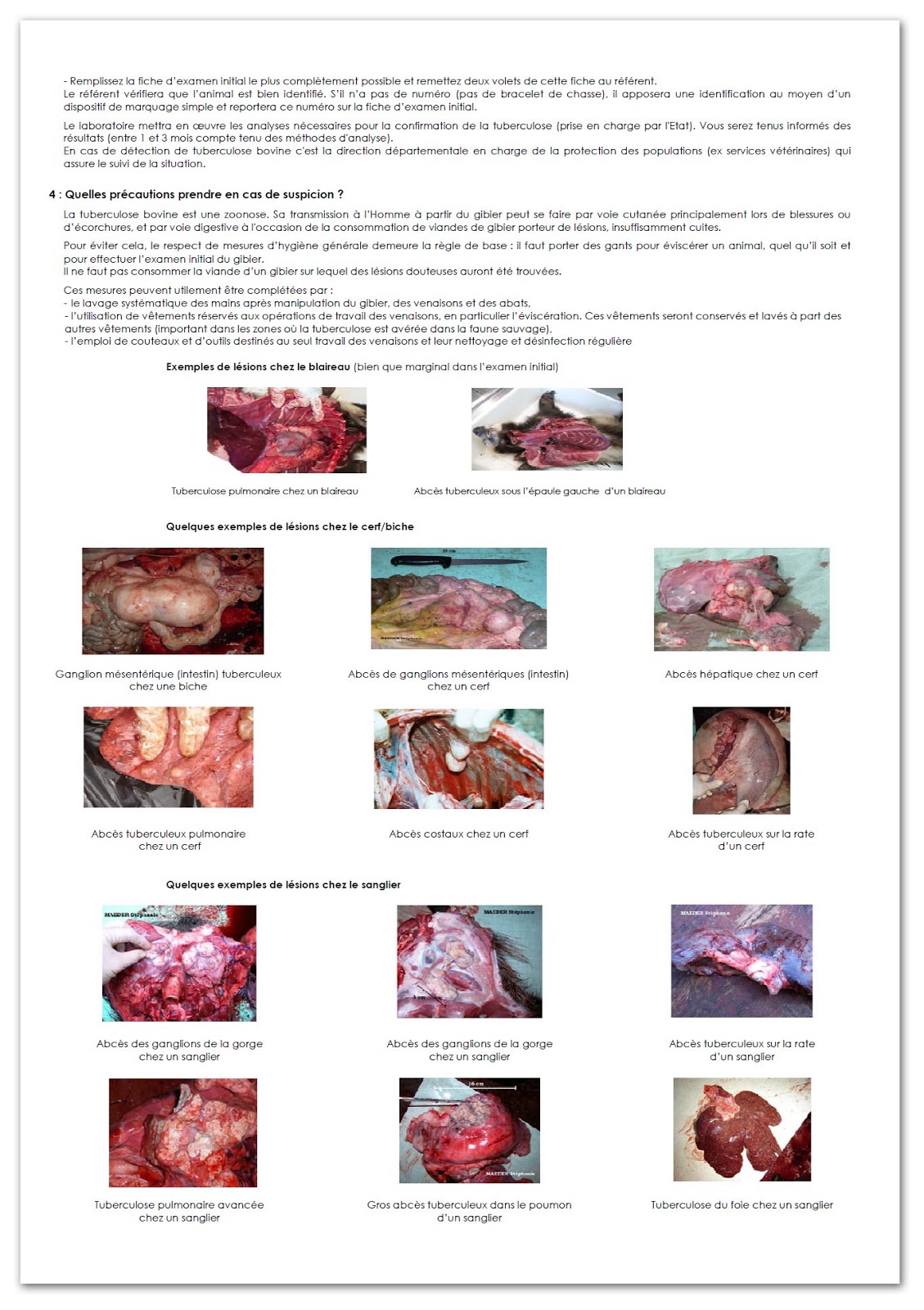
On the left is page 1 of a poster circulated by the French equivalent of our  AHVLA / Defra. This is to inform about the ravages of 'bovine' tuberculosis on various known wildlife hosts. 


And this is rough translation, describing the postmortem of a second tuberculous badger, in the Ardennes, courtesy of our colleague in Bavaria:

"Another Badger was diagnosed with symptoms of bovine tuberculosis . This time, it is a male who was taken on May 5 Contreuve commune, at a place called The Aspière. He was transported to the laboratory of department of Hagnicourt analyzes.

There, an autopsy and samples were taken. "The results of this animal have to highlight the DNA of Mycobacterium tuberculosis complex," said in a statement the prefecture. The strain in question is close, as the first badger, from that detected on households and cattle Semide Sugny (our editions of 18 and 25 May). "At this stage it is impossible to conclude that a significant infection of wildlife in this area," he said.
"[We] must await the results of all the trappings to assess the rate of infection in the Semide-Contreuve-Sugny area. "In fact, more than 80 badgers will be captured".

 
It's good to see that France takes wildlife reservoirs of tuberculosis seriously. We have open days to find them new homes.


Page 2 of this  graphic poster from France carries post mortem pictures of the effects of tuberculosis in a badger ( un blaireau) deer (un cerf / biche) and wild boar (un sanglier).

While in Great Britain, we prefer the black and white image at the start of this posting.

And airbrush the consequences of tuberculosis on anything it may have contact with.

Wednesday, May 29, 2013

Management v. a mathematical modeled cull?

Today the press is full of  Defra Secretary of State Owen Paterson's comments as the June 1st start date for a pilot cull of badgers approaches. The firewall protected Sunday Times has this taster:
OWEN PATERSON, the environment secretary, has drawn up plans for a big expansion of badger culling — including allowing farmers the freedom to shoot the animals — before the first two controversial trial culls have even begun.

Paterson wants to create 40 more cull zones in the next four years as part of a drive to eradicate bovine TB, the deadly disease transmitted between cattle and badgers. The two planned trial culls, scheduled to start in Somerset and Gloucestershire next Sunday,will see the killing of 5,000 badgers.
The badgerists are predictably 'outraged', 'horrified' and every other adjective they can trawl up, to describe this 'murderous carnage'. Predictably ignoring the root cause of the target - tuberculosis.
We find an intriguing paradox in this attitude, especially from cheerleader Dr. Brian May. The newspapers had a field day last year when he announced that as he knew nothing about 'management' of woodland and its fauna, while he had cuddled Brock, he had no qualms about shooting Bambi.

And this we think, is the key.  Since the mid 1980s, the badger population has had no 'management' to keep it stable within a shrinking environment. Unfettered breeding, linked to an infinite feed supply has ensured a recorded growth of 77 per cent in the decade to 1997. That was 16 years ago. And in 1997, the infamous moratorium on culling badgers in response to disease, ensured that more infected ones survived to spread their lethal load - and 'scientist's' largesse. We don't call this crazy and dangerous situation a 'beneficial crisis' for nothing.

So could the situation have been handled better? For sure it could; particularly if the public had access to the full story that Defra is not telling. No single species should be a target at all. But tuberculosis, a disease to which successive governments have signed international directives to eradicate, most certainly is.

But in parallel to the badgerists, our lords and masters are hooked firmly onto the convenience of a dead cow's tail. Cattle. Cattle Cattle - ignoring the blindingly obvious overspill which we explored in this posting.

As more sheep flocks and free range pigs herds are restricted, and alpacas and other pets and companion mammals die, the conditions over the last eighteen months have created the perfect storm for the spread of tuberculosis from its primary maintenance host. Badgers. A cool and very wet, dull summer ensured infection on cattle grazing stayed for weeks, available to any other mammal. The months of continuous rain and floods, caused badger setts to become waterlogged, and while they appreciate an occasional dip, they do like a dry bed. Those which didn't drown in flooded meadows, moved, causing the social perturbation notorious for the spread of the disease which they host.

Thus this spring's cattle slaughterings are at an all time high with 6000 animals slaughtered in January and February and whole herds slaughtered in many areas. The sheep and pig casulalties continue to be dumbed down and their devastated owners locked on the hamster wheel of Defra's test and slaughter cattle policy, while their animals are exposed to continued infection as they graze.

So to return to our title question. Owen Paterson is quoted as saying he predicts a '25 year cull' of badgers. And then what? 'Management' of this highly protected but also highly infectious animal would be a better description, responding to pockets of sentinel reactors. And that strategy has no time limit.

Wednesday, May 15, 2013

Badger tuberculosis - in pictures


This simple but important video illustrates the ravages of badger tuberculosis on badgers.  It provides a graphic example of how these poor animals become such a weapon of mass destruction to many other mammals when they are so infected.


Monday, May 13, 2013

A catch up...

Apologies - blogging light recently. Our main editor is selling shed loads of cattle after a flat test ... so that's the main (and very good) reason. So in this posting, we'll link to other stories so that readers can catch up on TB news.

 Not so good is news from Shropshire of a positive test on a valuable show calf, only born in February. Farmers Guardian has the story:
Last week the Platt family, from Weston, near Shrewsbury, arranged pre-movement tests on a group of eight animals to ensure they could attend local shows in the early part of the season, building up to the National Charolais show at the NEC and the Royal Welsh Show in July.
Among the group was champion Charolais heifer Lindford Frankie, who last year picked up 10 breed titles, as well as reserve female at the Royal Welsh Show, having enjoyed similar success in 2011.

Also tested was Frankie’s daughter, Lindford Imogen, born in February. But on Friday came the bombshell that she alone of the group had come out as a reactor.
Another bombshell this week was the discovery, in a 4 year testing area, of a cluster of new breakdowns on the Cumbria / Lancashire border. Until some strain typing (spoligotyping) is done - always assuming there are bacteria to culture - then it is speculation as the source of this one. But our own gut feeling is that with a 'cluster' of several farms affected, it ain't cattle.
 This is where post movement testing of cattle moving to a 4 year area is vital. But so is control on the movement of any susceptible mammal, and especially translocated badgers coming to an orchard near you.

Our Secretary of State, Owen Paterson MP has recently returned from a fact finding mission to Australia and New Zealand.
He described how in Australia bTB had been ‘absolutely rampant’ in both cattle and buffalo over ‘vast areas of difficult terrain’.

A ‘huge programme’ of cattle measures combined with culling buffalo - in the face of fierce public opposition – has brought TB levels in cattle down below the 0.2 per cent threshold required for Australia to regain international ‘TB free status’, he said.
This would be the Australian BTEC programme which we told you about in this 2008 post.

And in New Zealand, another wildlife reservoir in the brush tailed possum - which Mr Paterson described as as an ‘alien animal’ that came to the country from Australia - had evolved populations of which were ‘absolutely out of control’. That sounds familiar.


This is the graph of New Zealand's success. Or, you could turn it upside down and see our progress (in red)
 in the graph below.


The grey line is Ireland's which is also achieving success by tackling tuberculosis - wherever it lurks and in so doing, halving the number of sentinel cattle killed..

This graph shows 38,000 cattle slaughtered by AHVLA in Great Britain last year.


2012 was one of the highest on record - despite numerical back flips by the Badgerists to scalp the official figures.

Sunday, April 28, 2013

The 'regional accents' of m.bovis.

It is somewhat unusual to find us agreeing with Defra on anything at all to do with 'bovine'  badger Tuberculosis. In fact we have been heard to say on more than one occasion, that badgers are not the problem, but Defra's attitude to the control of those infected with Tuberculosis, most certainly is.

So it is refreshing to agree with Professor Ian Boyd, Defra's Chief Scientist, on the regional patches of spoligotypes found in Great Britain. He explains:  

... when one drills down in to the details of this clonal complex within Britain one finds an interesting pattern. There are different forms of bTB in different areas. Put simply, if bTB could talk it would probably have regional accents. This implies, for example, that bTB from Somerset doesn’t mix much with bTB from Cornwall. Now, if you are in to bTB like I am, this is just fascinating.

Fascinating??? We could think of other adjectives - but let that pass. Professor Boyd continues:
It is also an encouraging signal that cattle movement controls to prevent the spread of bTB are working, as otherwise we would probably a lot more mingling of the bTB strains and an eventual blurring of regional distinctions. That there are still such thick ‘accents’ between regional variations suggests some success in containing them within their regions.
Without wanting to rain on the good Professor's parade, these 'regional variations' have existed for decades - and certainly long before Defra nailed our cattle to the floor. And we use Defra's maps to illustrate this. Nevertheless, the article is good and can be read in full, on this link.

Our more down to earth (and earlier?) view on these spoligotype groupings were covered in this 2006 post we looked again in 2008, and more recently in this 2012 posting.
And in 2007, Farmers Guardian also covered what Professor Boyd describes as the 'regional accents' of m.bovis.


For some time now, molecular geneticists have said that true cattle tuberculosis was eradicated by the country wide screens of the 1960s.

What we have now is 'badger adapted' tuberculosis feeding back up into sentinel tested cattle, and despite Defra's reluctance to publish anything other than the single confirming microbial sample, many hundreds of other mammals.


Professor Boyd finishes his piece with the following observation:


This leads me to an intriguing hypothesis; is SB0140 specifically adapted to survive and thrive in badgers?
You've got it.

But whaddya gonna do about it?

Saturday, April 27, 2013

Do the maths.


Various of the advisory bodies on 'bovine' tuberculosis have, over the years, proposed a jointly funded insurance scheme for reactor cattle and possibly consequential losses associated with herd restrictions.

This works well with other diseases, and in some countries, with management policies for any wildlife reservoir, for bT uberculosis. The latest scheme to be hatched up comes from the Animal Health and Welfare Board for England (AHWBE) who will report their cash saving ideas findings in the summer.

Defra's deputy Chief Veterinary officer Alick Simmons, had this to say:
... using insurance in some cases could serve the dual purpose of reduce the liability on taxpayers for animal disease and ‘incentivising the right behaviour’ among farmers.
Weasel words if ever we heard them. But from Lee McDonough, Defra’s director for animal health and welfare, a more realistic approach. She commented:
AHWBE has had ‘some initial engagement with the traditional end of the insurance industry’. She admitted there are ‘complication and hurdles to get past’, the biggest of which appears to insurance companies’ concern that the disease risk is simply too big.
Farmers Guardian has the full story.

But back to those 'complications' and 'hurdles'. A decade ago, Owen Paterson, as shadow minister, asked exactly the same question regarding the underwriting of bTuberculosis by the main loss adjusters.
After they'd finished laughing, the answer then was:
Recent contact with insurance industry early in 2003 indicated that, although companies are honouring existing policies, they are not offering new policies to cover TB in cattle herds, particularly in areas where TB is increasingly prevalent. This is because farmers do not wish to take the cover in areas where the risk is low (such as Yorkshire), but do wish to purchase cover in areas of high incidence (such as the South West).

However, the insurance companies consider that the financial risks in offering insurance policies in areas of high incidence are too high at present.


In 2003, when that PQ was asked,  5,460 herds in great Britain had TB restriction notices served and Defra shot 23,972 cattle.


In 2012, 9,032 herds in Great Britain  had TB restriction notices served and Defra shot 37,754 cattle.

 Do the maths. The insurance industry has .... and if exposure to risk was too high in 2003, just take a long, hard, look at it now.


Insurance companies are in business to make profit and TB premiums drawn from farmers still able to get insurance, are hemorrhaging the company's bottom line profit when they make the inevitable claims.

And insurance companies are not in the habit of offering umbrellas when it's raining.


Thursday, April 25, 2013

They don't like it up 'em...


During the last year or so, some Welsh badgers have had the benefit - or not - of a very expensive BCG jab.

 Ignoring the protocol adopted by the FERA 2010 'trial', which pre-screened its badgers for existing evidence of exposure to disease - and rejected about half - the Welsh teams ploughed into a grossly infected population regardless. They trapped any badger who volunteered - infected or not, and, while offering sympathy and often a TV camera, jabbed and released it.

The cost of this charade was revealed in this FW article as £662 per badger.

 But the latest figures released by Defra show that in January 2013, in the whole of Wales, cattle herds restricted by 'Badger' Tuberculosis numbered 1173. This is a 29 per cent increase over January 2012, when 906 herds were under restriction.

But in the Dyfyd area, which includes the 1,424 badgers jabbed with BCG in Pembroke, the increase is 31 per cent. Up from 487 herds under restriction in 2012 to 639 in January 2013.

 And Farmers Guardian reports an almost doubling of cattle slaughterings for Wales in January 2013.
In Wales, the number of cattle slaughtered in the month nearly doubled to in excess of 800, compared with January 2012, despite the Welsh badger vaccination programme getting under way last year.
So despite £662 per badger, and a blaze of publicity, if results are anything to go on, it could be said that those vaccinated Welsh badgers really don't like it up 'em..

Sunday, April 21, 2013

Words fail us...

There seems to be a confusion about the colloquial title of the zoonotic bacteria known as 'Bovine' Tuberculosis in that it affects cattle - otherwise why would it be called 'bovine', Duh - but affects nothing else.

Whenever there is a badgery story or a cull feature in the newspapers, the Tweeters and Twitterers crawl out, many confirming their total ignorance of this disease. That is one of the reasons why we zapped the comment section on this site. Repetition and tiresome repetition which just confirmed the mind numbing ignorance of many commentators. And incidentally gave us an illuminating insight into the so-called education which many  of these baby Tweeters have received.

 Drumming up support for Brian May's anti cull marches, a story from Somerset carried some real howlers. Here is one such:
"bTB isnt TB, but I suspect you already know that ;-) To put it into perspective you've far more chance of getting struck by lightening than you have contracting bTB.”
Really? Ask Dianne Summers how she feels after eleven months of chemo-therapy, and now facing the removal of part of her lung. But we digress.

Several people affected by 'badger' Tuberculosis in the last few years, have caught it from their pets and companion mammals, who have had contact with infected badgers. These are the tip of an iceberg of exposure to this bacterium which we as a population, have never faced before. Milk was the easy bit. Test and slaughter the cows, pasteurise milk. Job done. But infected badgers? In your garden? In the kid's sandpit? Coughing over your cat, your alpaca, your dog? Tuberculosis is a slow burn disease. Exposure to the bacteria which cause it, now may take years to show itself. But eventually it will.

We are also up against the establishment with the reporting of m. bovis as a particular strain of tuberculosis. AHVLA describe the reporting and index case screen as a 'one way street', with possible exposure to farmers and vets passed up the chain to the Health Protection Agency, (HPA) but a big fat zilch in the other direction. HPA operate in their own private bubble.

 So for example, if a patient presents with possible 'tuberculosis', (which most doctors will have only read about, and HPA still refuse to acknowledge any other source for, except foreign travel, unpasteurised milk, homeless shelters and drugs) the diagnosis is recorded as m. tuberculosis complex.

Drugs are tailored appropriately and few spoligotype screens are done, except possibly in inner cities. But the drug regime for m.bovis is substantially different from that required for m.tuberculosis, and it is often altered to accommodate bovis, without the original data being changed. Both strains belong of course, to the group m. tuberculosis complex so technically .......

Thus a degree of under reporting is occurring. To what level, we can't say. But we can and do listen to the health professionals who administer these different drugs, and they tell us that m. bovis is 'substantially' under reported.

So to all you Twitterers, who genuinely think 'bovine' tuberculosis is a disease of cattle, and that they pass it to innocent badgers. Wake up. Another comment from the link above says it far more succinctly - but less politely, than we could:
It's that word 'bovine' plus an unshakable faith in badgerism. A cult job. Government couldn't give a flying Fork about cattle - or badgers, for that matter. But m.bovis is under OIE and EU statutes as a Grade 3 zoonosis which they must eradicate to protect mutts like XXXXXXXXX. But when you read comments like that, you really wonder why.”
For information, 'OIE' is the acronym for the Office des Internationale Epizooties and a zoonotic disease is one which affect animals, from which infection can pass to human beings.
 More on the different branches and known hosts of the bacteria within m.tuberculosis complex can be found on this yoosfool link.

Sunday, April 14, 2013

A catch up ....

Apologies from blogger HQ - blogging light this week. This posting will be a catch upon some of our recent postings.

First an update on Dianne Summer's progress, after her recent scans and biopsies.
She tells us that unfortunately the scans revealed that she still has active infection in the lung lesion. This after 11 ( yes, that is eleven) months of drug therapy, which has just about floored her. And if that wasn't enough, she described the biopsy to remove samples for culture, as 'horrendous'.

Unable to be inserted nasally, the procedure involved inserting a tube through Dianne's mouth into her lung. Her face was covered with a mask to prevent infection to those conducting the tests and her blood pressure went through the roof. This poking and prodding lasted about half an hour.
We wish that Defra would take the control of so called 'bovine' tuberculosis as seriously.

Dianne's consultants are divided as to the next step in her treatment. One suggests removal of the affected upper lung lobe, while another wants to continue the drug therapy for a few more months.

She is not out of the woods yet.

So, a timely wake up call for all those pushing for abandoning all TB control in cattle, on the grounds of pasteurisation, abattoir surveillance and cost. That attitude is just plain reckless, when 'bovine' TB is infecting companion animals, pets and many other mammals.
 Those 35,000 sentinel 'messengers' which Defra shot last year, were telling us something. We ignore their message at our peril. This level of environmental 'bovine' tuberculosis is causing a dangerous spill over into many other mammals, and passing the cost of Dianne Summer's illness - identified as the same spoligotype as her dead alpacas, none of which had had contact with cattle - to a cash strapped NHS is not very smart.

Last month we reported outbreaks of tuberculosis occurring this year in 'TB free' Germany and Switzerland. Here it may be prudent to point out that 'TB free' does not mean zero cases. The term refers to the OIE's (Office of International Epizooties) definition of  what is officially tuberculosis free, from which Owen Paterson's Parliamentary Questions extracted the following answer:

 20th November 2003: column 1205W [ 140308]
The Office of International Epizooties (OIE) provides expertise for the control of animal diseases. Article 2.3.3.2 of the OIE Terrestrial Animal Health code states that for a country or zone to qualify officially as officially free from bovine tuberculosis,it shall satisfy the following requirements:
* bovine tuberculosis is notifiable in the country.
* 99.8 per cent of the herds in the considered geographical area have been officially free from bovine tuberculosis for at least the past three years as disclosed by periodic testing of all cattle in the area to determine the absence of bovine tuberculosis.
(Periodic testing of all cattle is not required in an area where a surveillance programme reveals that 99.9 per cent of the cattle have been in herds officially free from tuberculosis for at least six years).
We have already pointed out that in this area of the EU, sales of milk are banned from affected farms until they test clear; although if such farms can find dedicated transport and a manufacturing route, then the product may be turned into powder. But we understand that sales of meat are also banned.
The cost of all this is shared between government, farmer and private insurance with compensation paid for cattle taken. This money comes from the compulsory insurance + Government contribution but for production losses private insurance is needed. (In the hot spot areas of GB, no such insurance is available. Where it may still be offered, premiums have more than doubled and pay outs halved.)

 Diagnosis of TB in Germany and Switzerland, is primarily the intradermal skin test, followed by PCR (Polymerase Chain Reaction ) screens on inconclusive reactors.

Meanwhile, as Dianne Summers attempts to get her life back (her lung appears to be past repair), cattle farmers struggle with restrictions piled on restrictions piled on restrictions and the word 'Tuberculosis' fades from view - if it was ever there in the first place - the Twits and Tweeters are planning a March.


Nice poster. Shame about the message.

This disease is not about cattle, or badgers.
Already we are seeing spillover to and consequential human infections from companion mammals and domestic pets.

An eradication programme should seek to control and eradicate a killer zoonosis -Tuberculosis. Not any single species.

We forget that at our peril.