Sunday, June 03, 2012

The silly season

They keep coming and sometimes it seems as if they come in bundles of ten. What are 'they'? Half cocked theories published in journals which really should do some checking before giving them credence and from people whose pedigrees suggest they should know better. Wild assumptions do not a theory prove. Especially when sooooo many other so called facts in the published papers are just downright wrong.

But then a judicial review is on the horizon, and true to form the beneficiaries of the badger v. cattle polemic are rising to the occasion. This time, trying (once again) to prove this huge undiscovered reservoir of bTB in cattle, researchers from Liverpool made some pretty wild leaps of faith and connected incidence of liver fluke with an alleged failure of the skin test. The 'science' journal  Nature published this, obviously without checking the detail. Jumping off the page was the assertion that preMT began in 2001. It did not, that was 2006 - but let that pass.

Lumping New Zealand with the UK and Ireland, as a country with a wildlife reservoir and bTB problems in cattle is also overstating the facts. After a twenty year blitz on its TB infected  possums, by 2013 NZ hopes to achieve TB free trading status, while ignoring our wildlfe reservoirs has ensured that the heap of sentinel slaughtered cattle in the UK and Ireland, continues to grow. For the record, NZ has achieved 0.35 per cent incidence in its cattle herds in 2010/11; but herd restrictions were applied in around 24 per cent of cattle herds in the west of England and Wales, with a GB average of 10 per cent. Hardly comparable.

But the assumption of specificity of the intradermal skin test with a mean average of 80 percent is the core of the paper. Thus it is missing shed loads of cattle - all with liver fluke? But the specificity of the skin test need not be 'assumed' at all. From a F O I request, Defra answered this question recently thus:
"... the SICCT test specificity in GB would be at least 995.9 per 1000 or 99.59%. Given that the majority of skin test reactors detected in GB originated from endemic TB areas of England and Wales and were likely to be infected (regardless of post-mortem findings), a better estimator of the true test specificity would be the converse of the proportion of test reactors observed in a very low TB incidence area such as Scotland, where the majority (but not all) of the test reactors could be expected to constitute false positive test results. Since we had a rate of 0.8 tuberculin skin test reactors per 1,000 animal tests in Scotland in the first nine months of 2010, this means that the test specificity was about 999.2 per 1,000 (or 99.92%). Therefore, in addition to the field trials carried out by Lesslie et al. in the mid-1970s, the current field data continues to indicate a very high specificity of the SICCT test ... "
And for once, Defra's answer to this paper's publication was spot on. If the skin test was missing millions of cattle - up to 20 % the paper asserts - then not only would this happen in all other countries using the test (unless Faciola hepatica is unique to the UK as well) but eventually all these infectious cattle would end up with gross lesions in the abattoir. A Defra spokesperson told Farmers Guardian that:
"..... research showed that ‘cattle that have both liver fluke and bTB still test positive for bovine TB, and would be culled to control the disease. The absence of positive cases of bovine TB in some areas coinciding with large amounts of liver fluke cannot be used to claim liver fluke is hiding cases, as cattle carcases are inspected in abattoirs and we would see evidence of TB in the slaughtered animals if this was the case."
Assuming this paper is correct in its many 'assumptions' that would mean about 20 per cent of all cattle slaughtered in the UK were riddled with liver fluke and also bTB would it not?
The UK cattle herd is around 9.6 million animals. Annual slaughterings involve about 3.5 million cattle so 700,000 or thereabouts should have lesions? Yes? No?
Just 1013 were confirmed with bTB at abattoir inspections in 2011.
That is the huge 'reservoir' which attracts so much hot air.

 And this week, Nature ran another paper, this time from Donnelly and Woodroffe, claiming that no one could really count badgers and thus the 70 percent clearance in the proposed pilot culls may be breached, leading to compliance problems with the Bern Convention. As one comment on this story pointed out, Bern has yet to have grasped the ecological impact of too many badgers - particularly on hedgehogs.

 Northen Ireland too has the begging bowl out. In this oral presentation, the Oliver syndrome is much in evidence. Please may we have some more porridge research cash? On top of the £3.5 million already spent of course.

And again some repeated wild assumptions about the skin test sensitivity (see above) and mathematical models based on mathematical models based on ... And Rosie Woodroffe's assertion seems to have gathered credence with the telling. Did you know that dead cattle spread TB?

Felling a single tree needs an 'ecological impact' assessment, so how much more 'impact' was there when these modellers cleared 11 million animals from the landscape in 2001? Thousands of acres were barren with altered cropping, long grass, funeral pyres and noise. And vitally for badgers, no grazing cattle or sheep. There was nothing for badgers to eat and so they moved. Woodroffe opined that delayed cattle tests 'were the only explanantion' for the spike in badger TB and thus cattle had given the disease to badgers. Rubbish. The whole ecology changed for that year, and the badgers moved out to find the nearest live cattle. They met resident badgers and fought. Result? Perturbation and TB, which they brought back with them when they returned back to restocked farms in the heartlands of this bloody carnage.

As well it being the silly season, on 25th June there's a Judicial Review coming up, and jobs to protect. These people need another cause.

Monday, May 28, 2012

Is there a difference?


AHVLA's Regional Operations Director (or ROD) in the SW and based at Exeter is was a chap called Mark Yates. He first came to our attention when problems surfaced last year for Defra's new toy,  a computer which they call SAM.

We are assured that the acronym stands for nothing at all, but many farmers and AH staff on the receiving end of its ongoing indigestion could invent a few words - Sodding Awful Machine is one more polite suggestion offered. In an interview, Mr. Yates offered to help out any farmer with problems.

The fact that most of us couldn't get within a mile of him is neither here nor there... but we digress. Mr Yates has gone. Left, as in disappeared ... gawn. It is said that he may have rejoined his previous employer, the British Army, called to the colours to do battle with them in forin parts.

Now that is scary. Surely a cosy seat in AHVLA, talking (or not) to cattle farmers whose main concern is the health and welfare of their animals, is preferable to facing a Taliban fighter waving an AK summat, or an RPG wotsit launcher in his face?

Or perhaps when the latest tranch of cattle measures hit farmers and there is no sign of a parallel policy to control badgers, there may be no difference at all.  But then, hell hath no fury like a cattleman scorned. It could be safer where he's going.

Thursday, May 24, 2012

The ostrich syndrome


We have used that description before when describing the overspill of bTB from an ‘environmental, non-bovine source’ – badgers, into another popular mammal, alpacas.
 
Playing with their own published statistics, and deflecting searching questions about the true level of losses has become just a game to Defra. But just how are their bTB team going to deal with the latest news, widely reported not only in the Farming press but the BBC  and some national papers, of a 400 animal cull of alpacas from a single herd in Sussex?

From the FG piece:
"The sheer scale of the outbreak sheds new light on the scale of the bTB problem in UK alpacas. Official Defra figures show 58 alpaca and llama herds had been confirmed with bTB in Britain up to September 2011, although there is a suspicion that not every case has been reported over the years.
There is, however, no official record of the number of animals slaughtered as result of the disease as Defra’s official figures for ‘non-bovines’ only record the positive sample or samples that has confirmed the outbreak, not other animals subsequently slaughtered."


We cannot identify the collective head of Defra in this picture. Or precisely who is responsible for the arrogant and misleading hubris which their bTB team spit out so convincingly. That is very firmly in the sand.

Sunday, May 20, 2012

How can you be 100% sure ....


...   that she contracted TB from wildlife? So said a curt note from the Badger Trust in reply to a farmer in Wales, about to lose this beautiful cow. For good measure they also said they cared about ALL animals. You could have fooled us;  they sure as hell don't care about badgers riddled with TB. Those collecting tins wouldn't rattle much if they'd showed the reality of TB in their chosen species.

The answer of course, is quite simple. Whenever a new TB breakdown is flagged up by sentinel tested cattle, then AH do a 'risk assessment' to discover the source. The clue is in the word 'risk'. AH officers trawl movement books and BCMS records (amongst other documentation) back to a couple of months prior to the herd's last clear TB test.  Any cattle sold will be traced and if alive, check tested.

But if like many self contained pedigree herds, no cattle have been purchased in, and if like most of us, boundaries are secure from nose to nose contact with any other cattle, as bTB bacteria don't fly in with the tooth fairy and aren't wind borne,  then the conclusion has to be .... wildlife.
Then it is down to whether deer can scramble under gates and share food with housed cattle.

When these assessments are done, the Badger Trust's money machines favourite  mammal starts way down the list of possibles. But guess what? In the majority of cases, they come out AH's favourite. By default, and having excluded every other possibility, up to 90 per cent of TB breakdowns in the West and SW are officicially placed at the door of badgers.

Her name is 'Candice' by the way : she lived in Powys, tested clear in December 2010 and again in May 2011. But she failed the herd's annual test this year and on monday, May 21st. 2012 she will die.


Saturday, May 19, 2012

Update - Dianne Summers

Following our postings on Dianne's illness, she has updated the  website with this thumbnail of how she is coping with the intensive bTB drug regime. (click News tab for the full account)
On April 12th 2012 Dianne started a nine month regime of a cocktail of drugs and was advised the side effects can be very unpleasant. 


"Unfortunately 8 days into the course I had severe side effects to the drugs which included severe all over body rash – blurred vision – faintness – severe headache and aching joints and had to seek emergency care on Sunday 22nd April. The drugs were stopped immediately and once again I had to go to hospital. I was then put on drugs to sort out the side effects and once they had cleared then the drugs could be reintroduced one at a time until we discover which drug caused the problem. "

As Dianne says, bTB (m.bovis)  in humans isn’t a quick fix – and it isn’t a case of 2 weeks of aspirin and you will be right as rain.

On April 29 I ended up back in hospital for 6 days because of a downturn in my condition. The drugs were reintroduced in a controlled environment and it was revealed I had an allergic reaction to Ethambutol. A new regime was set up and I have been on the new drugs for the past week. The side effects of the drugs are very difficult to cope with – total fatigue – dizziness – nausea to name but a few. The thought of feeling like this for the next nine months is pretty daunting
.
On 10 May I received a letter from H.P.A. in response to my constant requests asking why none of my contacts had been offered testing. The letter informed me that because I was culture positive but smear negative this meant I was not infectious to others and therefore none of my contacts would be offered tests. Only members of my family household would be offered: but as I live on my own this meant no one would be tested. It is a relief to me and no doubt to my contacts that they were not at any risk nor were my own animals.

On May 11th I was informed by my consultant that the spoligotype was the same as my herd from 2009. I had not helped any other herd with the same strain type as myself so at least we now know it was from my breakdown back in 2008/09. As stated earlier I had lost 8 only 6 of these had visible lesions and I took all the necessary precautions once I knew I had TB. We have many many owners who have lost far more infected alpacas then I have so the risk to them/us is huge and let’s not forget Vets and Shearers who are constantly exposed to risk .

The full script of Dianne's story and her fight with 'bovine' TB can be viewed on http://www.alpacatb.com/


Thursday, May 17, 2012

Mayday at Heolfawr Cross - short film.


It's May 1st 2012 and on Dai Bevan's farm in Carmarthenshire the future for his herd of pedigree Longhorn Cattle looks bleak. Bovine TB has struck. Many will have watched Adam Henson's visit to the farm just before the cull on the Sunday evening 13th May edition of Countryfile.


English Longhorns are one of, if not the oldest breed of cattle in the UK. Developed and improved by Robert Bakewell in the 1750s, they are now nurtured by specialist breeders the world over.

The following film, made by Dartmoor's Chris Chapman shows more of Dai Bevan's story.

 http://www.youtube.com/watch?v=ofTpfzEUUBY

Most of his beautiful herd of Longhorn cattle are now dead.
 

Saturday, May 12, 2012

A farmer's story.

Many times on farming forums and in the comments sections of the farming press, we are the butt of the same old, same old mantra. bTB is all our fault. It is dirty farmers, lax farming practises, cattle movements and fraud which cause bTB. Not only is this a slight on the whole of our industry but it is plain wrong.

Last year one such farmer told his story in the comments section of an article on badger vaccination, published in the Farmers Guardian. Christopher Sturdy tells it as it is; he speaks for those of us snarled up in Defra's cats' cradle of smoke and mirrors which surrounds the so-called control of the disease known as 'Bovine' Tuberculosis.

"Well, I read these Anonymous posts this morning, and then I went out to spend a few minutes with my suckler cows and their spring-born calves, some of which are now almost as tall as their mothers. They were grazing happily in some welcome autumn sunshine.

And I thought – we’re due another TB test very soon; already had four tests in the past 12 months – we’re pretty well tested to destruction round here. And the Dread stirs. How many will they take this time? They have killed over one-third of my fine, mainly home-bred, healthy cows in the last year, more in previous years. I want my cattle, not the "massive compensation" that Anonymous thinks I’m paid, (when the reality is that this year I will be £20,000 short on income, with almost no parallel reduction in my costs).

Then I thought "remember, it’s your fault".

What? Why? What have I done?

Anonymous says so – to the whole world. Anonymous says that "cattle, farmers and Defra’s failure ..." are the "real root of the problem". He can’t mean corn farmers, he must mean me.

I am the real root of the bTB problem. But I’ve done all the required tests for years and years, so has every neighbour and beyond that I know, they just go on doing it and put up with the loss, hands tied behind their backs, slow motion execution. Or they give up. Some kill themselves. Good riddance, they’re the "real root of the problem". They leave desperate notes. And they leave families.

Then I think: maybe Anonymous didn’t actually mean "farmers". Maybe he (or she, apologies, I’ve never been to a christening where the priest says "I name this child Anonymous") meant "a very very few farmers".

And I thought: I don’t tell Anonymous that he’s a thief and a criminal just because a minute proportion of our society are thieves and criminals. Anonymous must mean cattle farmers. Anonymous isn’t stupid, or ignorant, or careless with what he blags over the internet. If he meant "a very few" he would say that. Anonymous knows stuff.

And I thought: having got all the cattle in yet again, twice in one week, maybe raining on us all day, all the stress, will I have to hear the vet, one after another "another reactor I’m afraid". Will I be able to go on running them down the race. Will I finally succumb to the overwhelming urge to walk off and say "test them your ****self".

When I phone Animal "Health" and say "I don’t think I can bring myself to load these fine cattle for such unnecessary premature slaughter, you’re asking me to buy the bullets for my own execution" will she laugh like last time – think I’m joking. Think I’m joking. Think I’m joking. Will she think I’m joking? Will I return happily home and tell Jane "no worries, just another 15 going today, what’s for tea?" Will she say "what are they doing about the badgers?" Nothing. None have been even tested. All they do is talk and delay. They don’t want to lose the vote of Anonymous. Anonymous knows such a lot.

Anonymous is a badgerist, and badgerism is a faith thing.

Anonymous’s grasp of logic is so slender that he has just written that if we think badgers are the real problem why is it that the proposed slaughter of badgers will produce at best a 16% fall in bTB over 9 years.

But Anonymous doesn’t understand that this is Defra’s guess, that the proposed cull will be on their incredible terms - not in winter so they can breed again, no more than 70% of the population and so on ... Anonymous has written that Defra’s guess means that badgers aren’t the "real problem". That’s the "logic". Incredibly. Anonymous doesn’t understand that whether or not badgers are the "real problem" has absolutely nothing to do with Defra’s culling proposals.

Anonymous won’t even understand what I’m saying. If he could understand, he could not possibly have written what he did.

And I say to the Ministry vet at the test "it’s not working is it?"

What isn’t working?

Your policy to control bTB.

Well, we’re clearing it from the cattle.

Yes, you’re clearing it from the cattle. Like you have done since about 1930.

I need to remember. It’s my fault. Anonymous is right. It’s my fault. The farmers are the "real root of the problem". And I’m one of them. I hang my head. I will not let despair take over. I try and enjoy the autumn sunshine.

Hard luck story? No, that’s exactly how it is, here on the coal face. For thousands and thousands of us here in the West and Wales. Exactly how it is.

This FG news story, sabotaged to revisit yet again the culling thing, was a real breath of fresh air. The Badgerists, or some of them, stepping gingerly back from pure faith and dogma, to do a little experiment. Linking up with a very enlightened NFU man and  five very enlightened farmers.

No doubt if there are good results, the Badgerists won’t be worrying about lack of control experiments.

It’s light years away from a solution, but it’s a supernova in terms of human progress. Let’s hope that the enlightenment grows, more tests ensue, truly independent observers tell us what results they find.

In the intervening years, while we carry on waiting, like we waited for Nick Brown, Margaret Beckett, David Miliband, Hilary Benn, Jim Paice and others, what will Anonymous have to say to me when they have killed my last breeding cow?

Silly cow farmer, you were the real root of the problem, ten of your mates disobeyed the rules."

Mr. Sturdy speaks for all of us writing on this blog, and the vast majority of cattle farmers.

We are most grateful for permission to publish his posting.

Thursday, May 03, 2012

A few more nails

Coming in on July 1st are a few more nails in cattle movement options for England, introduced to secure EU funding ..... to slaughter more cattle. We had the bones of the story in this posting, and today Farmers Guardian have the detail in this article. NBA TB committee chairman, Bill Harper said that farmers will have to prepare and he urged them to take up the new rules quickly.

Wednesday, May 02, 2012

Di Summers - Update.

In a follow up to our recent posting about Dianne Summers who has herself contracted pulmonary TB, (confirmed as m.bovis), Di has put an update about her progress on this link. At present Dianne is once again in hospital. We note from her update, written on 27th. April, that moving with all the urgency of a sloth on Valium, HPA have yet to get in touch with any of Dianne's recent contacts.

Several cattle farmers have mentioned Di's illness to us and all have sent best wishes to her.

EDIT: 5/05/12 Di has sent a message that she spent all of last week in hospital again. She is struggling to feel anything like 'normal' and is not taking this cocktail of drugs very well at all. We understand that on certain systems, MAC being one, the link to Di's own story is not working. If not, please go to http://www.alpacatb.com/ and click the tab 'News'.

Sunday, April 29, 2012

Not the Final Report.

Since the Badger Dispersal Trial RBCT ended in 2006, producing its bible in 2007, we have been extremely critical of its published results. Not without cause, as many of our contributors had the misfortune to be caught up in this charade of 8 nights well publicised and vandalised cage trapping, once a year if you were lucky.

On reading the Final Report, it became apparent that far from using information contained in the painstakingly time consuming TB99 forms - each of which was a ream of paper dealing with risk, prepared by trained veterinary officers with back up from several government agencies - the ISG chose to ignore what was airily described as 'apocryphal' evidence.

The personnel completing these forms for the RBCT, are highly trained veterinary practitioners, with back up support for the data from government agencies such at the British Cattle Movement Service (BCMS), Cattle Tracing Service (CTS), Ordnance Survey office and Veterinary Laboratories Agency (VLA). So it was a wasteful, arrogant, disgrace disappointing to realise that far from actually using this robust, complex, epidemiological data, the ISG chose to ignore it. But worse than that, within the section concerning the spread of tuberculosis in cattle, the ISG describe their epidemiological base, stating that they included:
"........ local infection across farm borders, infection from animals bought, in particular but not only, from high incidence areas and infection from wildlife, especially badgers. [] In the following calculations, we assume all three sources to be roughly equally important." (ISG 7.24 p148)
Thus the ISG chart would appear like this .... :

... because far from using that robust, complex epidemiological data contained in these forms to actually see what was going on, the ISG 'roughly assumed' two parts cattle, one part badger, pumped that into a mathematical abacus and switched on.

Since then two further reports have been published. The first from Jenkins et al, in 2008 which found that the notorious 'edge effect' of increased TB incidence associated with the fiasco that was the first couple of years of the trial, had reversed in subsequent years. The paper looked at the trial data for each of the years in which it tried to cull badgers, and then ran the TB incidence in cattle data onwards for each of a further two years at Defra's request and taxpayer's cost. As we explained in the posting:
The estimated effects on cattle TB of culling badgers within the cull areas during the trial increased over the time frame from a modest 3.6 percent in its first year, to 31.8 percent from the 4th to final year. But two years later that effect had increased to 60.8 per cent. Conversely the 'edge' effect, unique to the ISG 8 night cage trap fiasco, caused 43.9 percent increase in breakdowns up to 2 km outside the triplet zone in the first year of culling, falling to 17.3 percent in the 4th - final year's scrape up. But within two years, that negative effect had somersaulted to a (minus) -30.1 percent incidence outside the proactive zones..
Further work from Prof. Donnelly followed in 2010 which showed that the cull areas, had maintained that benefit. That paper explained:
This updated data shows that in the period starting one year after culling stopped up until 31 January 2010 the incidence of confirmed breakdowns in the proactive culling areas was 37% lower than survey only areas (areas which were surveyed but not culled). Furthermore in the areas adjoining the culled area the incidence was 3.6% lower. This means that any initial perturbation effect has been quickly overturned and there is now a lower than previous incidence in these areas.
Now Prof. Donnelly has turned the power on again, and come up with a rather interesting conclusion using the post mortem results of the trapped trial badgers - or those they did manage to cage trap in 8 nights, very occasionally with time out for FMD:
The observed and model fitted per-herd incidence of confirmed TB herd breakdowns within each proactive trial area and the corresponding estimated proportion of confirmed TB herd breakdowns attributed to infectious badgers. The observed data related to 12 months prior to the initial proactive cull (so a different 12-month calendar period in each case). The fitted values were obtained from a model, fitted by Donnelly and Hone (2010), to the relationship between the incidence of confirmed TB herd breakdowns and the prevalence of M. bovis infection detected among badgers culled in the initial proactive culls.
Prof. Donnelly's results show that within the triplets, two areas had cattle breakdowns of up to 72.7 per cent 'attributed to infectious badgers'. A further two attributed 60.6 per cent to infectious badgers, four between 41 and 49 percent and the last two (where from bitter experience, much interference took place) 16.8 - 32 per cent.


We are grateful once again to use these images, both first shown at the Killarney Conference. But hey - 72.7 per cent of cattle breakdowns 'attributed to infectious badgers'? We note that with each publication, Prof. Donnelly's electrical abacus is catching up with the reality and effect of TB infected badgers.
Perhaps the ISG would care to redraft their 'Final Report' of 2007?

Wednesday, April 25, 2012

Zoonoses - they affect humans.


This week has seen a media frenzy after a Cornish alpaca owner was confirmed as suffering from ‘bovine’ tuberculosis. We have been 'banging on' about the risk of so called 'bovine' TB to other mammals for as long as this site has been online. Testing cattle and slaughtering those that react to exposure to bTB is missing the point. Where has that exposure come from, and what else may have been exposed to the same source? Animal Health Officers say that up to 90 percent of bTB breakdowns in Cornwall are caused by badgers. Even Professor Donnelly's electronic abacus is now indicating that up to 70 percent of cattle breakdowns in the RBCT proactive areas are badger related. We will blog that work later, but for now, we top up with an overview of  Dianne Summer’s news,  released last week on her website that she has contracted ‘bovine’ TB.

Over the past years, we have reported the disease in cattle herds which have not bought in animals for decades and the spill-over of bTB into other species including free range pigs, alpacas, llamas, sheep and goats. The disease has also been increasing steadily in domestic cats and dogs.

Like the small cage-birds taken by miners into coal mines last century to warn of deadly ‘firedamp’ gas, regularly tested cattle act as ‘canaries’ - sentinels of the amount of bacteria in the environment, available to infect many other mammals, including human beings. In 1986, the ministry slaughtered 700 cattle. By 2007 our ministry culled 28,000 and figures from the last couple of years have approached 40,000. The message of these sentinel ‘canaries’ is being ignored.

Spillover of bTB to other mammals is not helped by the way Defra presents its statistics either. While their figures for cattle bTB outbreaks are fairly comprehensive - as long as their new computer isn't on strike - figures for other species are presented in a totally different format, using only the (often single) confirming positive sample of what may be a much larger outbreak. A recent Parliamentary Question showed no sign that anything was about to change any time soon as to how Defra log the now hundreds of other mammals lost to bTB. This is an indication of a dangerously out of control spillback of this disease in the hands of a government department relying on its own dumbed down figures to justify its continuing inertia..

The body that oversees diseases such as TB is also out of touch with today’s risks. HPA's textbooks are stuck in the groove of exposure to TB in the early part of last century and they have not caught up with 'bovine' TB affecting companion mammals and domestic pets and thus putting their owners’ health at grave risk. Public Health officials continue to play this down but are basing their assumptions on past opportunities for transmission. Few cases are strain typed, but of those that are, official figures for bTB (m.bovis) in humans show 532 cases 1996 – 2009. As the majority of cases will initially be logged as 'm.tuberculosis complex' rather than isolated to m.bovis, this is likely to be an underestimate. Nurses and consultants working with TB patients confirm that the drug regime for the treatment of m.bovis is different and will need to be upgraded from the original m.tuberculosis regime. The original data log however, may not be altered. And liaison with VLA who strain type possible TB patients, is as rare as hens’ teeth.

HPA still quantify 'risk' to bTB by exposure to 'unpasteurised milk, foreign travel and inhabiting homeless shelters'. But exposure to the increasing amount of bacteria from ‘environmental’ sources is an unknown quantity. Neither Dianne Summers nor her alpacas have been exposed to any of HPA's ‘risk’ opportunities, but the alpacas area dead and Dianne has bTB.

Tuberculosis is a slow burn disease, often remaining dormant in unsuspecting and healthy adults for many years. Only when the body is under stress from a second challenge, can lesions break down into full-blown tuberculosis. And that is when this disease becomes a killer. Molecular geneticists say that analysis of recent work suggests that true TB in cattle was eliminated by the 1970s and what we have now, is badger-adapted TB spreading back into the environment. Perhaps mycobacterium meles would be a more accurate label?

Until the early 1980’s, culling of infected badger setts in response to cattle breakdowns continued, but despite the success of such tightly targeted clearances, government policy was progressively sanitised following pressure from animal rights organisations. And since 1997, when a moratorium was imposed on the culling of badgers under section 10 of the Protection of Badgers Act, ‘to prevent the spread of disease’, no action whatsoever has been taken to stop the spread of tuberculosis either within the badger population, and thus to other mammals.

Defra are not killing cattle for the benefit of the farming industry. Neither is this ultimate protection of infected wildlife anything other than a response to lobby cash. Government have a statutory duty to eradicate this disease from both cattle and wildlife under several international directives which protect human health. Killing cattle while leaving a wildlife reservoir to re-infect, is both ineffective and expensive. Sentinel cattle herd breakdowns have mushroomed from their original hotspots two decades ago, to affect up to a third of herds in much of SW England, Wales and the west Midlands. This shows a thoroughly reckless exposure to ‘environmental’ sources of bTB.

‘Bovine’ tuberculosis is not a disease of cattle; it affects many mammals and human beings. It is a zoonosis – that’s what they do. But government inertia will ensure that this ancient and deadly disease, which should have been consigned to history books, will in future affect a wide range of species – including human beings. Dianne Summers is not the first to be affected and she will not be the last.  

Update: 
Short overviews written by Dianne Summers, Dr.Gina Bromage and Mike Birch can now be found on their website at: http://www.alpacatb.com/news.html

Monday, April 23, 2012

We wish her well.

This posting is taken from the Alpaca TB website and it is one which we would rather not have written. Founder member of the team which run the website, Dianne Summers, has had confirmation that she has bTB (m.bovis )herself and has begun treatment.

Human treatment for TB takes up to nine months and consists of a cocktail of drugs with some very unpleasant side effects - it is not a quick or simple fix. We have spoken about the reckless disregard for the environmental contamination to which our animals and our population is being increasingly exposed many times.

But Dianne's case underlines the reason why bTB must be taken seriously. Regular testing of sentinel cattle while studiously ignoring their message is a dangerous exercise. The spillover into alpacas is only one example of a series of companion mammals and pets to succomb to bTB in recent years. As the AlpacaTB website says: -
"it is not just your livestock that are at risk. If it is in your herd you, your family and friends can contract TB. TB is a Zoonotic disease - to be clear that means it can be passed on to people".
Dianne has only just begun her treatment. Much more will be coming from this story, but in the meantime, we wish her a full and speedy recovery.

Friday, April 06, 2012

She couldn't see it coming.

Over the years we've told you stories of companion animals who have fallen victim to what Defra like to refer to as 'environmental TB' - or as we call it, TB infected badger pee. In 2006, we told you the story of a small herd of dexter cattle, and in particular, a young bull called Fern.
Shambo, the ''sacred bullock' made headlines and a few diplomatic incidents the following year. But today we'll tell the tale which will make no headlines, except among dairy farmers.


About 5 years ago, this young cow was born into a large SW dairy herd. One which our friends at the Badger Trust tell their members and anyone else who will listen, was all about profit.


And she was born blind.


While the media is full of pictures of shiny, cuddly badgers, Jack Reedy, at the time vice chairman of the Trust, gave his opinion of dairy farmers in a BBC interview. He said that:
".... the TB problems of such farms are like "shoe pinches" because of the "economic penalty" which a breakdown entails and not because of its impact on the animals or farmers. He went on to say in this interview that it is "very unusual for farmers to get fond of their cows" and that they are "usually very careful not to."

"Cattle are not pets", he helpfully pointed out.
This arrogant oversimplification is marginally less offensive than his predecessor's 'cattle get killed anyway' comment, but let that pass. The implication here is that if cattle farmers are paid enough, then they'll roll over and their TB problems will just disappear. Or at least farmers won't whinge about them so much. So Jack, this story is just for you.

When she was a calf, this young animal (we'll call her 'Daisy')was not destroyed, but kept in the same group of calves of similar age until she was about 18 months old. The herdsman and owner then thought long and hard what was best for her and as she was thriving - and blind or not, seemed to be coping quite well - she was put in calf with the rest of that group. The thinking was that if she had to be kept isolated, then that was what would happen. But 'Daisy' was happy with 'her' group and in 2010 calved a heifer calf. She was kept in the straw yard and walked daily into the milking parlour with no bother at all. But without her mates, she seemed unsettled and wanted to go with the main group into cubicles, and in the spring, out to grass.

As 'Daisy' knew best, she was tried with the main herd, and blind or not, she fitted in perfectly. Last summer, when she was dried off to calve again, she was put in a small field by the house, with an old 'granny cow' for company. So here dear readers, (and Jack Reedy) we have a blind milking cow and an 'old granny' companion, treated like royalty by a big commercial dairy herd. Nah, that can't be right - farmers are all about money. Reedy said so on the BBC, so it must be true.
The herdsman spoils this young cow. He told us that she knows his voice, and comes to call for food and water. As does 'granny'. He says "she is the most trusting cow I have ever known, knows my voice when I talk to her and will follow me anywhere."
.

And I think you can guess what we're going to say now, can't you? Last august Daisy calved again, and mothered this calf as well as she did her first.

She wintered well with the rest of her herd mates and is in calf again. But last month both she and her companion, 'granny' became TB reactors. So this week they join the other 38,000 cattle victims which Defra are happy to kill annually, on the altar of votes and lobby money badger worship. The difference being that this young cow would never have seen what will ultimately have caused her death.

Update 11/04/2012.
Daisy was shot on farm today. The herdsman held her and talked to her.

Sunday, April 01, 2012

How did you get that?

The Farmers Union of Wales (FUW) have written to minister John Griffiths enquiring how he arrived at the conclusion that vaccinating badgers in the Pembroke IAA (with an unknown but modelled benefit of 9 percent after 5 years in the centre of the patch) is better than a cull which offers benefit of up to 100 per cent - if carried out correctly. And 30 per cent if it is not.
The Farmers' Union of Wales has demanded transparency and the release of all relevant documents by the Welsh Government after raising concerns about the legal and scientific basis for environment minister John Griffiths' decision to vaccinate rather than cull badgers in the Intensive Action Area (IAA).

The union believes that the minister may have ignored the previous findings of the Court of Appeal in making his decision, and that there is a lack of transparency because important information has been censored from Welsh Government documents placed in the public domain.

During recent meetings with ministers and officials, it was indicated the decision not to proceed with a cull was based on an anticipated reduction in confirmed incidences of 13.4%, which the minister did not believe was sufficiently “substantial” within the meaning of Section 21(2)(b) of the Animal Health Act 1981.

It is also understood that this figure was compared with the results of computer models of the impact of badger vaccination.
For all these alleged benefits of culling, politicians return like demented boomerangs to the RBCT - despite that exercise in prevarication being quite openly skewed from the beginning. Even the ISG's Final Report admitted that the patiently completed TB 99 forms which accompanied any breakdown in the trial areas were stock piled, and the computers loaded with a "roughly equally important" source of infection, modelled on the "assumption" of two parts cattle to one part badger.(Ref: 7.24 - p.148)
That produced a chart which looked like this:


But risk assessment forms from Animal Health in the SW of England told a different story. No modelling and no 'rough assumptions' just epidemiological data, which showed that up to 76 percent of herd breakdowns in Devon during 2004, were badger related. Just 8 percent were attributed to cattle and the remainder 'unknown'.


But we digress... FUW are on the trail of Mr. Griffith's figures and have demanded to see from where he obtained them. In his letter to Mr Griffiths, FUW president Emyr Jones states: “…the 13.4% figure clearly relates to an area which is larger than the IAA, and includes possible adverse impacts which would only occur if the geographic boundaries around the IAA did not reduce the negative effects seen during the RBCT (Randomised Badger Culling Trial.
"...it is therefore clear that any judgment you made relating to the legality of a cull under Section 21(2)(b) of the Animal Health Act 1981 should have been based upon an anticipated reduction in confirmed incidences of 25.7%, and not 13.4%."

With regard to the comparison of real culling trial results and computer models of vaccination, Mr Jones adds: “…there is currently no scientific, nor, in our opinion, legal basis for making such a direct comparison, since the scientific approaches used to produce such figures are wholly different; one is based upon a simple extrapolation of the outcomes of real badger culls, whereas the other uses a large number of complex and unproven hypotheses to model the actions of individual animals, producing estimates which cannot be compared with real data, because no vaccination field trials have been undertaken.

Mr Jones highlighted the fact that when the same computer model is used to examine culling, it predicts reductions of 30 to 40 per cent.


And if done correctly, as with Thornbury and the earlier more targeted culls, then the benefit is 100 percent.
And it is perfectly possible for 'science' (if one could bear to call the RBCT that) to show how not to do something. But of course the ISG knew that before they started.

Farmers Guardian has the story of the FUW challenge.

Saturday, March 24, 2012

TB takeaways?

One thing that most farmers with cattle locked down just cannot get their heads around is how badgers can be moved around the country, quite legally.

The main culprits, are rescue 'sanctuaries' which take in orphaned or injured badgers, 'mend' them (maybe) and then release. The problem is they do not necessarily release these animals where they were found, but any patch of land where the owner has given permission.


Based in Somerset, we covered the Secret World sanctuary's exploits in this 2004 posting. And owner Pauline Kidner quite openly said that she questioned whether releasing these animals where they had been originally found was wise as when Secret World had done this, the badgers were mugged again. Or even killed.

Yesterday, Western Morning News carried another 'aaarrrrr' story from Secret World, illustrated with a armful of baby badgers.
These cubs are being hand reared and fed every few hours by the country's most experienced badger expert, Pauline Kidner, and her dedicated team.

Some of the cubs admitted at Secret World are from the area designated to be used in a badger culling exercise in a government initiative to help farmers with the catastrophic TB virus in cattle where it is argued that infected badgers are to blame.
It would seem pedantic to remind the author that m.bovis is not a virus but a bacterium, but we'll do it anyway. The main point is that these cute, cuddly, baby badgers have come in from 'areas designated to be used in a badger culling exercise'.
From areas of endemic tuberculosis then. And where exactly will they end up?

For this we would remind readers of answers to our PQs on this subject:
1. That it is NOT an offence to take a badger from the wild, if the reason for its removal is: "solely for the purpose of tending it". furthermore, as a native species:
"there are no specific restrictions under current law regulating where badgers are released once they have recovered. Normally once fit enough to be released into the wild, the badger will be returned to the location where it was originally found. This approach is recommended on welfare grounds due to their territorial nature, and also to avoid transmitting disease."
6th Jan 2004: Col. 249W [1444446]

Not by Secret World it isn't.

2. The captive badgers are supposed to be tested three times using the old Brock test, which fizzled out as a live test as it was so unreliable. It delivered just 47 per cent sensitivity on a negative reading. However this procedure is not compulsory.
"testing guidelines are not mandatory, but are set down in a voluntary code of practise'
30th Jan 2004: Col. 543W [150609]

3. Animals testing positive should be euthanized but what about the animals they have socialised with?:
This protocol does not advise destruction of badgers who have had contact with a test positive badger. It should be emphasised that this voluntary protocol was not devised or approved by Defra."
Ref 6th Feb 2004: Col. 1109W [150583]

Well who the blazes did devise or approve it then? And why cannot Defra lift its collective head out of the sand to block this very worrying (for cattle farmers)loophole?

This week, we have heard of relocated badgers being taken to Leicestershire's new National Forest, to South Yorkshire and even further north and eastwards. And from where have they come? As Ms. Kidner proudly says in WMN this week: some are 'from areas which are designated to be used in a badger culling exercise".

You really couldn't make it up.

Saturday, March 17, 2012

Jobs for the boys


... and girls. Doing what? Vaccinating badgers of course. A very stylish website set up by ex FERA graduates, now seeking employment and decorated with some healthy looking badgers explains:
"In an effort to prevent the spread of disease between cattle, around 25,000 cattle were compulsory slaughtered in the UK in 2010."

They are correct about the UK testing and slaughtering cattle by the shed load, but not the amount. In 2010 England alone slaughtered almost 25,000. But the total for GB, including Wales and Scotland, brought Defra's annual carnage to 32,737 - but let that pass. The website continues:
"To promote a sustainable future for farming and wildlife in the UK, it is widely accepted that we need to address the reservoir of disease in badgers. Badger vaccination can play a role in reducing the overall level of disease and related transmission risk, and also help prevent the spread of disease to new areas."
Can it? Can it really? Or are we getting confused with that mischievous, not to say outrageous headline of November 2010? This is where 262 pre- screened badgers (out of a potential haul of 844) were jabbed to assess the health and safety (to badgers) of BCG. This trial was not to assess efficacy of the vaccine. For that we need to go to this paper, which actually had a look at what happened to their pre-screened badgers which were vaccinated, exposed to m.bovis and then euthanased. At postmortem, all had lesions and all were shedding. Using BCG at 10x the normal strength had a more beneficial effect than the standard rate, except on one poor old brock who died. Not in vain, one hopes?

Our potential jabbers continue, posing the question 'can vaccination work?' and answer their own question, more with hope than accuracy:
"Laboratory and field studies have demonstrated that vaccination of badgers by injection with BCG significantly reduces the progression, severity and excretion of TB infection."
Define significantly? The actual vaccination trial referred to above, achieved a reduction of bacterium shed of 13 percent. Well hallelujah for that. And hard on the heels of that spurious 74% efficacy claim, with no mention of the prescreening of the 844 candidates in the field trial, came the usual Defra fudge "the data should not be used to support this claim." It seems it was then and it is now.

But this week, the three main farming unions of Wales delivered a joint letter to the Welsh Assembly Government, pointing out that despite 'intensive cattle measures', their farmers were losing cattle to TB in increasing numbers. They also reminded their government that the advice on badger vaccination had been updated.
Specifically, in November 2011 a memorandum by those involved in the most recent vaccine trials made it clear that the work to date
“…cannot tell us the degree of vaccine efficacy”; that “A definitive figure for efficacy could only be determined by field-testing the vaccine on a large scale over a long period of time. Several thousand badgers would need to be killed to determine the presence and severity of TB at detailed post-mortem examination”; and that “…we do not know how deployment of the badger vaccine in the field would affect TB incidence in cattle.”
And in the absence of large scale field trials, modelling has been used to assess the possible impact of a vaccination programme. And the best effort of these electronics ...
"... predicted a 9% reduction in confirmed cattle incidences by the end of a five year vaccination operation, and “an overall reduction in confirmed cattle herd breakdowns of 19% over 10 years within the core area, compared with 34% for a cull and 40% for a cull with ring vaccination.”


And finally the cost of this bright idea from Brock Vaccination Ltd? We can only compare with the now defunct Vaccine Deployment Project, which posted a cost of £1,440 / sq km. annually, as badger BCG is a beneficial, ongoing, yearly event.

The operating protocol, if the FERA guidelines are followed, is restrictive, bureaucratic and expensive. Fine if remuneration is drip fed from government, but not so good if farmers are paying and expecting results. After the initial survey and open trap trial run, two nights only are advised and certainly no more than 4 - even if not all, or even none of the target badgers are caught. BCG vaccine is a live attenuated product requiring activating with a liquid solution. But that has to done at the refrigerated container within the vehicle and not trapside. So having inspected the baited traps and said 'good morning' to any occupants, operatives are required to trek back to their 4x4, mix up the required doses [and a few extra] and trek back. Mixed vaccines must be used within 4 hours. The list of 'required clothing' is comprehensive, as are the specialist cages, wickets (for squashing badgers against the side of the cage) animal grade peanuts, treacle and 3-5kg stones. Protective masks and goggles are stipulated when approaching badgers. Perhaps we could fit them cattle too.

Meanwhile NFU newbie, Adam Quinney
has offered the Badger Trust his TB restricted farm to play on, and they've found that catching wild badgers ain't easy.
"We asked the Badger Trust to put their money where their mouth is and, to be fair, they have done a lot of work on the farm. We have both learned a lot, including that catching badgers is not straightforward.”
That predicted benefit (9 percent in 5 years) is revealing, in that the time scale is several badger generations of unscreened, infected animals. The Brock Vaccination site explains that the:
benefits of badger vaccination will be realised over a number of years, it is not a ‘quick fix’ solution, however we believe it is a sustainable one.


The cynical among us might say, sustainable for whom?

Monday, February 27, 2012

Legal challenge

Farmers Guardian today report a legal challenge by the Badger Trust, against Defra's proposals for a farmer DIY badger cull. According to the report, the Trust will ask the court to overturn Defra’s decision on the basis of the following three points:
* That the culls, which Defra estimates will reduce TB incidence in cattle by 12-16 per cent after 9 years, will not meet the strict legal test of ‘preventing the spread of disease’ in the areas being licensed, and may ‘in fact amount to a recipe for spreading the disease’

* That the cost impact assessment underpinning DEFRA’s decision is flawed, as its cost assumptions are based on the farmer free-shooting option, estimated to be approximately 10 times cheaper than cage-trapping badgers before killing them). The trust claims that after the free-shooting method may be ruled out for being inhumane, ineffective or unsafe to the public in the pilots, leaving only the more costly ‘trap and shoot’ option until the end of the 4-year licence.

* That guidance which DEFRA issued to Natural England is invalid as killing badgers is not one of Natural England’s original functions, which are mainly focused on maintaining biodiversity. It claims culling badgers ‘for the prevention of spread of disease’ remains the Secretary of State’s own function under the relevant legislation..


It is not often that we would agree with the Badger Trust, but on two of these three points, we concur. It is difficult to see how anyone wanting to nail a potential Judicial Review would use as an example, a protocol so different from that which is proposed now, and costed so differently. As we have said numerous time, the RBCT Badger Dispersal Trial, using cage traps for 8 nights very occasionally, interrupted for at least a year with FMD and then having a change of protocol in 2004, showed us just how not to control tuberculosis in badgers. So why use its results, particularly the whole miserable 9 year span, especially as its Commander in Chief was quite open in his oral evidence, that culling badgers was certainly not going to be the outcome of 'his' trial?

The current proposals are for 6 weeks night shooting annually. Totally incomparable with the aforementioned charade, or even the smaller Clean Ring clearances effected by MAFF in response to cattle breakdowns until 1997. Both these and the later Thornbury badger clearance lasted for weeks only, but kept cattle and other mammals clear of TB for a decade or more. So why let the mathematical modellers loose with this rubbish, which refers to a different protocol, over a different time scale, as justification for any future cull?

Costs of this proposal are certainly variable, depending on who is speaking. Minister Jim Paice is sticking with his £1.4m per area, while the NFU reckon £5/acre or less. Which ever way you cut it, that is a huge gap. So cost v. benefit is a sticky one, But not so sticky is the Badger Trusts's assertion that controlling wildlife, 'to prevent the spread of disease' is an AHVLA competence.
It is, or it should be.

We covered that convoluted bundle of legislation in this posting. And from what we read, the chance to wrest disease control back from the quango calling itself 'Natural' England, and place it firmly in AHVLA's lap was October 2011. We posted this information in August last year and quoted NE's responsibilities under the Protection of Badgers Act thus:
Natural England is authorised to do so by what is known as “a Part 8 Agreement ” made in accordance with section 78 of the Natural Environment and Rural Communities Act 2006;
We pointed out that this involved not merely licenses to move badgers causing damage, but the issue of licences under Section 10(2)(a) of the Protection of Badgers Act (1992) which deals with preventing the spread of disease.

This agreement came into effect on 1st October 2006. It's duration is twenty years from that date, and a review is allowed for in five years. That was October 2011. Was an opportunity missed? We agree that AHVLA should most certainly have responsibility for controlling the spread of a Grde 1 zoonosis. That it was ever moved away is a matter of shame on the Department now calling itself DEFRA.


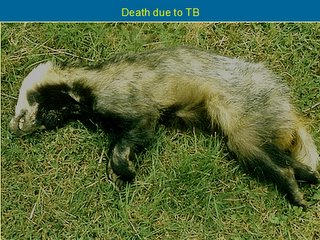
And if everyone else is as fed up as we are with the constant stream of library pictures of shiny, bushy tailed badgers to illustrate this polemic - here's one which died yesterday. Of tuberculosis.

Thursday, February 23, 2012

His master's voice

At the NFU conference this week, Defra minister, Jim Paice slammed another couple of nails into our cattle's hooves - courtesy of his puppet-masters in the European Union.

Both Farmers Guardian and
Farmers Weekly report that farmers with overdue tests which reveal reactors, will be penalised through reduced tabular value compensation.
"Farmers who have overdue TB tests will receive reduced compensation if they have cattle slaughtered as a result of the disease".

That sounds pretty fair - until you realise that dear old SAM, that all singing, all dancing new computer is having hiccoughs with his paperwork. And some farmers are not receiving their timed window for testing at all. And that most definitely is very unfair.

The second change is to cattle attending shows or moving within a 28 day window, and is described by FG thus:
"Cattle which have had TB tests in the past 30 days, and those which have shared accommodation with other cattle at shows, will no longer be exempt from pre-movement tests."

And then speaking about linked holdings and other things giving the European Union FVO indigestion - and there are many - this sanguine comment from Defra's chief vet, Nigel Gibbens:
"At the moment we have a history of being behind the disease."
You mean you can't test and kill our cattle quickly enough? Farms enduring six 60 day Short Interval tests in one year is insufficient? Shame on you. And slaughtering even more cattle, preventing restocking and cutting the knees from Approved beef finishing units, while letting the source of up to 90 per cent of TB breakdowns in hotspot areas run free, helps how?

The more things change, the more they remain the same.

We covered this crazy one sided policy, as it had been operated by Paice and Gibben's predecessors, in this posting.
But if he is to be forgiven for not knowing his Ministry's history on TB control, perhaps Jim should read his parliamentary predecessor's Parliamentary Questions. And then revisit his own NFU speech with an adjusted time scale - and budget. Owen Paterson MP asked for the result of the just 6-8 months badger clearance at Thornbury. The answer:
"No confirmed cases of tuberculosis in cattle in the area were disclosed by the tuberculin test the the ten year period following the cessation of gassing" [150573]
So not 20 years of buggering about trying to cull out infected groups in ones and twos, very occasionally? And why should there have been this astonishingly quick result, we asked? Anything else done? Biosecurity? Extra cattle measures? Pre movement testing? No cattle movements at all? Nope. The answer:
" The fundamental difference between the Thornbury area and other areas [] where bovine tuberculosis was a problem, was the systematic removal of badgers from the Thornbury area. No other species was similarly removed. No other contemporaneous change was identified that could have accounted for the reduction in TB incidence within the area" [157949]


But his masters have spoken, as they also speak on wildlife control - but are you listening Mr. Paice or are your ears tight shut? Tightening up cattle controls will only work if wildlife reservoirs are addressed simultaneously, as our masters in the EU observed in this DG SANCO paper.

In 2009, the UK received 10 million euros for TB 'control' by which Defra meant testing and slaughtering more cattle. This week, Paice dropped this little gem into his NFU speech. He said :
... the European Commission was ‘minded’ to reject the Government’s annual TB Eradication plan, which would result in it withholding €30 million (£25.4m) of EU funding for TB controls. “That would have been pretty disastrous,” he said.
One could say it was pretty disastrous to operate a one sided policy which hoovered up such increasing sums of cash which offer no benefit to taxpayers, farmers or sick badgers, at a time of global austerity. But let that pass. 'We're all in this together' we're told. But that is not quite true. Paice also hinted of a 'share my pain' package for livestock farmers. Nice one.

We have said it before, and will continue to say that current cattle controls are more than adequate (annual testing and double fenced boundaries), provided the maintenance hosts of tuberculosis are removed.

And if these reservoirs are not tackled simultaneously, then no amount of cattle testing, isolation measures or culling will work to reduce the environmental contamination which is fuelling the scourge known as 'bovine'TB.

Sunday, February 12, 2012

That EU elephant again

Slowly but surely the UK system of TB testing and cattle controls (if not wildlife control) is coming from that elephant in the room - the EU. We reported a year ago how many herds would need two tests before herd movement restrictions could be lifted. And that situation has now caught up with the Treasury bean-counters. Coupled with an insidious rise in incidence, purely anecdotal and unable to be officially tracked after August due to the inability of Defra's new toy to add up, it seems that the costs of testing for bTB is causing not a little indigestion.

We referred to the February 1st. EFRA committee report in the previous posting on the SAM computer problems, but after discussing closing some AHVLA regional investigation centres, much of its content centred around TB testing and how much veterinary practices were paid for this. It was revealed that although an agreement 'memorandum' signed by both the Ministry and the veterinary profession was in place, Defra now find that they need to alter the basis for this. Although they seemed more than a little reluctant to say why.

The gist of the committee's dialogue centred around a 4/5 year 'discussion' with the main veterinary organisations and their contractual obligations for the work of testing our cattle. Chief executive of Defra, Catherine Brown explained that she had been meeting the BVA very regularly.
"In fact, for a period of time I was meeting with them every month for discussions about how we could move on from a very unsatisfactory situation with a memorandum of agreement that was signed with them and MAFF 15 years previously, which did not have any quality standards in it. They were unhappy because they thought that they should have been being paid more. I was unhappy because I thought that we could not demonstrate we were getting value for money. "
... and then there was that elephant - the word 'illegal' in much the same sentence as 'competition'. Ms. Brown explained that she had talked to the BVA 'intensely over a long period of time':
We were unable to come up with a mutually agreeable solution, and it turns out that it is probably just as well. It would have been illegal, because we are spending so much money and you have to offer the opportunity for competition for more than £113,000 of Government expenditure. We are spending about £20 million a year across the country on TB testing.

(And with the 2011 EU regs requiring double the amount of testing now kicking in, plus increased incidence, that figure can only increase no matter how much Government tweaks it in the short term - ed.)

Thus a rigmarole of jargon spattered dialogue follows as Ms. Brown explains that tendering for the testing of our cattle must comply with 'quality standards', have 'delivery partners', comply with 'legal advice', be 'anti-competitive', not 'against European rules' (she did say the word - once) and following Minister Jim Paice's point that 'legal advice was the trigger'. Ms. Brown replied ;
"The legal advice was important. It was two things: it was the legal advice, and also we were not making a great deal of progress. For example, they [the vets] felt that they were underpaid; we had been paying them inflation raises for many years. They felt that they would like to get paid more. I felt that I would like them to make some efficiency savings and pay them less,... "

Devon MP Neil Parrish pointed out that he would like to explore this 'tendering process' and asked how small veterinary practises could compete on a 'tendering' basis:
"What they are worried about is the fact that we are going to get a meat hygiene-type system, where we are going to have one or two companies bidding for the whole country, and vets from all over the world coming in, and there is no personal relationship whatsoever between the farmers and those vets coming in to do the testing.
Jim Paice then blustered waded in with the prophetic observation that;
... having lived through the development of the Meat Hygiene Service, to which you referred, that I have no intention of replicating that experience, I assure you.
That would be replicating this particular 'experience' then would it? And thus we can ignore all the European tweaks previously referred to? No we cannot.

As Ms. Brown pointed in answer to a question from George Eustice:
It is not mainly about saving money; it is mainly about being able to demonstrate some kind of basis for the price that we are paying. [] But it is not actually primarily about saving money.
. Useless Eustice pressed his point again, all the while tiptoeing around that elephant.
" I am intrigued by this idea that you have to negotiate with the BVA. It is almost as if they are a trade union; it is like having a discussion with tube drivers or something. Why are you in that position? If you are paying too much, why can you not just top-slice the fee and, if you have poor performers, stop using them as suppliers? Surely individual practices would not be being paid more than the £113,000 threshold in total, or are they ?"
Although Useless Eustice forgot to mention it, £113,000 p.a is the current European Union threshold for procurement tendering and Ms. Brown confirmed that some practises did indeed receive in excess of that figure. So why not side step them, suggested Useless Eustice?
"I am just curious as to why you subjected yourself to this ludicrous EU procurement process when maybe you could have just side-stepped the BVA and dealt with the issue directly?"

Because she can't?
Procurement is an EU competence which cannot be side stepped. Just like Mr. Paice's MHS 'experience' which he is minded not to repeat. But that option has been signed away, Mr. Useless. Had you missed it in various Treaties?

Ms. Brown replied:
" I made every possible attempt to check that we definitely had to go through the procurement process, and we definitely do. [] The legal advice could not be clearer: we do not have a choice on tendering."
So it would appear that courtesy of the EU, the LVI vets are for the high jump as well as TB restricted farms.


By restricting TB restocking options considerably and effectively cutting the legs from potential buyers into approved units, the EU have left hundreds of England's TB restricted farms with little income and no outlet for their surplus stock at all. And with their TB testing potentially to be carried out by foreign vets. Excellent.

But back to that elephant. It does occasionally have something to say which makes sense. We covered one such trumpet in this posting quoting DG SANCO on the thorny problem of wildlife reservoirs of bTB.
The elimination or reduction of the risk posed by an infected wildlife reservoir enables the other measures contained in the programme to yield the expected results, whereas the persistence of TB in these wildlife populations impedes the effective elimination of the disease.
And as the posting below, which covers the 'immediate effect' ban of movements of some TB restricted stock shows, the elusive European beast can move swiftly when it suits. On the procurement directive and the cats cradle the BVA have made for themselves on testing charges we await developments with interest, but on the DG SANCO recommendations - don't hold your breath.

That particular elephant's trunk is in a definite knot.

Friday, February 10, 2012

EU clamp down

Following an audit last autumn our lords and masters in the European Union are less than happy with AHVLA's licensing of cattle movements onto restricted farms.

This is the news release which announced the changes.
Following a recent audit by the European Commission’s Food and Veterinary Office (FVO), who are responsible for ensuring that Community legislation on food safety and animal health and welfare is properly implemented and enforced, the decision has been taken to end this arrangement with immediate effect as it fails to comply with the requirements of EU legislation for TB eradication.
Briefly, as we understand it, following a new confirmed breakdown, no movements on can take place until the removal of the reactor(s) and completion of a 60 day test. Should that test still reveal problems, then licensing may be applied for, but cattle coming onto the holding must be isolated.

There is more on the AQUs (approved quarantine units for young stock) and on beef finishing units, which we will add as we get solid info. At present it appears that the former may go altogether and the latter be restricted from buying further stock should a reactor be revealed either at testing or through abattoir surveillance. And that seriously limits outlets for stock from TB restricted farms.

Farmers Guardian has more points on this story, on this link.

Wednesday, February 08, 2012

SAM chaos - it " should never have happened"

Speaking in oral evidence to the EFRA committee on 1st February, SAM, Defra's new, all singing but not dancing, computer system gets a mention in the last few minutes of the video.

More of that session in a separate posting. But to save you ploughing through over an hour of yawning and banter important information which affects every livestock keeper, Farmers Guardian reports the highlights.

Asked by Environment, Food and Rural Affairs (EFRA) Committee chairman Anne McIntosh if she anticipated the problems would be resolved and when, Catherine Brown (Defra Chief Executive) said:
“They are not resolved yet. We are in the process of resolving them. We should have resolved them already. It is extremely urgent to resolve the problems.”
Errr yes. But to do that, first one must accept that there is a problem. And reading the jargon spattered blumph dropping through farmer's letterboxes about these computer problems, (problems of which farmers are on the receiving end) over the last months, one could be forgiven for thinking that such problems were 'minor' - if they existed at all.

Ms. Brown went on to say that AHVLA had put measures in place to mitigate the impacts of the problems on the ground and had ‘put in fixes’ to the system over the past two weeks. There is another batch of fixes going in on 2 February; there is another going in on the 9th.
"We are continuing to fix it as fast as we possibly can." she said.
.
(We understand there have been several hundred fixes to date - they are ongoing - ed)
Devon Conservative MP Neil Parish described huge problems faced by his constituents, including getting licences to move cattle to slaughter etc. He asked:
“Bluntly, why is it that, in the 21st century, the Government put in a system that they pay good money for and it does not damn well work?”
Ms Brown acknowledged that it ‘should not happen’.
“We have a lot of administrative staff doing things that we should not need to be doing if all those minor things were not wrong with the system. It is not a minor problem overall; it is a significant problem, and it is achieving our absolutely top attention, but it is not like one cataclysmic or hugely insoluble problem with the system that might mean it is never going to work. It is a succession of small things,” she said.
And that most revealing description of this AHVLA chaos is a far cry from the sanguine and anodyne load of tosh delivered to every livestock keeper last week which we reported in this posting and which was described here.

Apart from the glitches, fixes and other problems, we understand that SAM has a major flaw which could not by any stretch of the imagination be described as 'small'. And that relates to its data input. Once on screen, data cannot be changed without losing all the input. This is causing much extra input time if TB test data is to be recorded correctly. But worse than that, we have been told that once SAM's 'Submit' button is pressed, data cannot be retrieved for amendment. SAM has swallowed it and will not regurgitate for any corrections.

Which could explain why cattle culled in the 2001 FMD carnage are still appearing on some farmer's testing instructions - like SAM, they refuse to die.

Friday, February 03, 2012

Crisis? Wot crisis?

Last week, all livestock keepers in SW England received a letter, explaining new changes and "why they are necessary". Now 'change' - if not undertaken for the sake of it - usually implies improvement, but with Government in general and its computer technology in particular, that is rarely the case.

We given you several glimpses of the new SAM computer's chaos in previous postings. The present version of SAM it seems, can neither add up, nor cope with anything other than 100 percent accurate data. One mistake and there is no 'delete' button. The whole lot must be scratched and operatives start again from the beginning. Add to this toxic mix, AHVLA experienced admin staff received their marching orders just as SAM was launched, and were replaced by agency part timers with no knowledge of 14 digit eartag numbers or the 1mm difference in testing results which can mean life or death.

This recipe has given England's 'livestock keepers' severe indigestion, with some farmers receiving bundles of SAM generated paperwork, most inaccurate and many repeated - while others have received nothing at all.

But back to this anodyne and understated letter which explains that SAM will be the all singing, all dancing system which "improves the way we manage TB testing and other disease controls."
"SAM will enable us to do this by automating more of our processes, allowing us to to reduce the number of administrative staff we employ, saving the tax payer over £2 million per annum."
the letter continues:
"SAM, which will replace increasingly out-of-date and expensive to maintain computer systems, can also be used by private veterinary practices, who do the majority of on-farm testing, enabling better and quicker communication between us."
Sounds good? The reality is that vets are still unable to use SAM, that AHVLA's original Help Line number connected with a London solicitor's office and that at present, SAM is losing data, losing reactors, losing herds under restriction, losing historic test data and can't add up.

Our letter ended by dumbing down these many and serious glitches and an apology if 'you have experienced issues with the level of our customer service, for example by incorrect or duplicated correspondence'. Somewhat of an understatement, we feel.

But this week, Farmers Guardian reports that it has received sight of an internal letter about dear old SAM, and the terminology in this document is substantially different from our dumbed down sheet. On that 'time saving veterinary input', the paper reports:

AHVLA staff have therefore been forced to input test result data sent in by private vets, a time consuming process exacerbated by a glitch in the system preventing user errors from being corrected. This is often causing the ‘whole action’ to be cancelled, requiring the information to be manually inputted.

This has caused serious delays in processing test charts, forcing AHVLA to bring in temporary staff to reduce the backlog.

The knock-on effects have included, in AHVLA’s words, ‘confusing and incorrect’ paperwork for farmers, creating uncertainty over the timing and results of tests and nature of disease restrictions. There have also been delays in the collection of reactors from farms and the issuing of calf export health certificates, while uncertainty over the accuracy of data has forced Defra to postpone the publication of national TB statistics.
and of future data? AHVLA say they do not know when the problems with SAM will be ironed out, or whether more will surface.
... the agency’s chief operating officer Nina Purcell gives a fuller account of the situation, describing the roll out of the system as a ‘crisis’ and admitting that a number of ‘outstanding defects’ remain.

She reveals that ‘key fixes’ to Release 6 are due to be implemented in February by AHVLA and its IT contractor IBM. But she acknowledges the agency does ‘not yet know’ how long it will take to resolve the key issue of the link up between the SAM system and private vets.
So a review of the roll out has been commissioned. This will look at:
' how it [SAM] is operating and whether we are on track to meet the objectives of the original business case’
This is due to report at the end of February.

'Business case'?? 'Managing and controlling TB in your herds'?? ' Objectives' ?? And this describes a system which AHVLA describe internally as in 'Crisis', and which they have no idea when or if it can be fixed??

That sort of civil service-speke is guaranteed to enrage the most mild of 'livestock keepers', on the receiving end of such anodyne platitudes and downright lies from his so-called 'Service provider'. And referring to farmers tied down with TB restriction as 'customers' will enrage even further. The word 'customer' implies a choice of provider - and we have none. We also no longer have contact with a local name in a local office for advice on TB .... and now we have SAM.